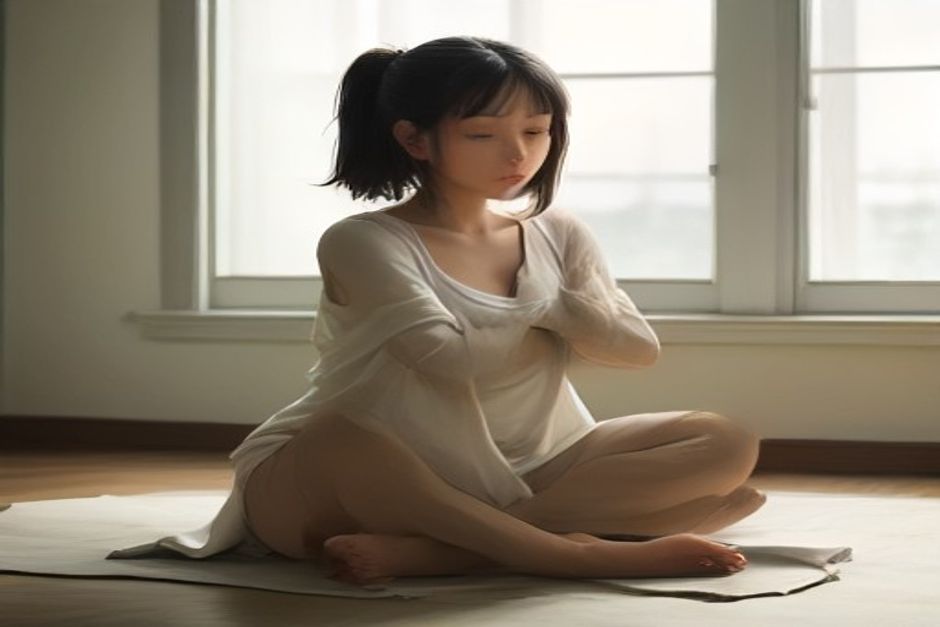
Butterfly Pose — Baddha Konasana, Bound Angle Pose — is the one where you sit with the soles of your feet together and your knees dropped out to the sides, looking a bit like a book propped open. Cobblers in India used to sit this way to work, which is where the old name Cobbler's Pose comes from. It is one of the most commonly taught hip openers in yoga, and one of the most commonly forced. The pose is simple; the patience it asks for is not.
What is actually stretching
The targets are the inner thighs and groin — the adductor group — plus the deep external rotators of the hip. What often limits the pose, though, is not muscle length but the shape of the hip joint itself: the angle of your femur in its socket partly decides how far your knees will ever drop. Two people can sit side by side with identical dedication and very different knee heights. This is anatomy, not failure — our anatomy page goes deeper on why skeletons differ. Your job in Butterfly is not to make your knees touch the floor; it is to find a sustainable stretch and breathe there.
Butterfly Pose — Baddha Konasana
How: Sit on the floor and bring the soles of your feet together, letting the knees fall out to the sides. Hold your feet or ankles with both hands. Now the important part: sit on a folded blanket or two so your hips are higher than your knees — most people need this and skip it. Sit tall, lengthen the spine on each inhale, and let gravity slowly do the work on each exhale. Play with foot distance: feet closer to the pelvis intensifies the groin stretch; feet further away shifts it toward the inner thighs and is usually kinder on the knees. Stay one to three minutes.
Why: Prop height is the whole game. When the hips sit low, the pelvis tips backward, the low back rounds, and the knees hang in the air bearing torque they were never meant to carry. Raise the seat and the pelvis can tip forward, the spine stacks, and the knees descend on their own schedule.
Folded Butterfly
How: From the seated version, inhale to lengthen, then hinge forward from the hips — not the waist — keeping the spine long. Stop the moment the back wants to round. Hands can rest on the feet, the floor, or a block in front of you.
Why: The fold deepens the hip stretch and adds a quiet, introspective quality that makes this a natural pre-meditation seat. But a rounded, strained fold trades hip opening for low-back grumbling — long spine first, depth second.
Reclined Butterfly — Supta Baddha Konasana
How: Lie back with the soles of the feet together and knees out, a bolster or rolled blanket along the spine if you have one, and support under each outer thigh — blocks, pillows, folded towels.
Why: This is the restorative queen version: nothing to hold, nothing to balance, just a long, supported opening for the chest and groin. It pairs beautifully with slow breathing before sleep (see our sleep page) or as the centerpiece of a rest day.
The one rule that protects your knees
Never press the knees down with your hands. It looks helpful and it is the classic way people strain this pose. The knee is a hinge; pushing it sideways borrows range from a joint that does not have any to lend. If the knees are high and unhappy, support them from underneath — blocks or cushions under the outer thighs — so the muscles can actually let go. A muscle that feels safe releases; a muscle that feels forced guards harder. You are negotiating with your hips, not defeating them.
Where Butterfly fits
Use it at the end of a practice, when the body is warm and the day is slowing down. It sits naturally after standing work like Goddess or Wide-Legged Fold, and it makes a fine lead-in to Happy Baby and then Savasana. If you sit at a desk, two minutes of reclined Butterfly in the evening quietly undoes some of the day's chair-shaped hours. For more on building a regular habit, see how often to practice.
Butterfly teaches an unfashionable skill: letting time do the work. Prop yourself well, stop pushing, and stay. The knees drop when they drop — and even if they never reach the floor, the hips will open exactly as much as they need to.