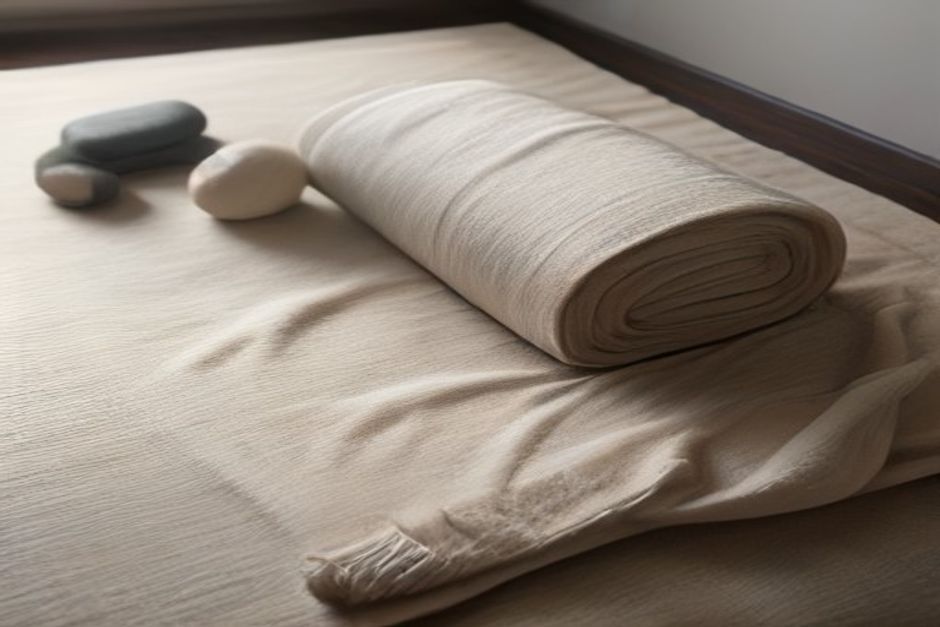
Stand at the back of a studio and peek into a restorative class and a yin class, and you'll see the same inventory: bolsters, blankets, blocks, people lying still for minutes at a time, an atmosphere of legalized nap. The two styles are so visually similar that studios regularly mislabel them, and students regularly walk into one expecting the other — then wonder why the "relaxing" class involved five minutes of intense hip sensation. The difference isn't the props. It's what the props are for.
Restorative: props as support
Restorative yoga, developed largely from B.K.S. Iyengar's prop-based therapeutic work and popularized by Judith Hanson Lasater, has one rule: no sensation worth mentioning. Every joint is supported, every muscle allowed to switch off. In reclined butterfly, the bolster holds the spine, blocks hold the knees, blankets hold the head — the body is so thoroughly propped that gravity finds nothing to pull on. You stay five, ten, sometimes twenty minutes per pose, and a full class may only contain four of them.
The target is the nervous system, not the tissue. Complete support removes the low-grade muscular bracing most of us maintain even at rest, and the sustained comfort is a direct signal to downshift — heart rate, breath, and mental chatter all taper. This is the yoga for burnout, illness recovery, grief, and the kind of exhaustion where even "gentle stretching" sounds like a demand. Our nervous system explainer covers why stillness plus support is such a strong downregulation signal.
Yin: props as leverage
Yin yoga looks the same and feels completely different. Poses are floor-based and held three to five minutes, but the instruction is the opposite of restorative's: find a mild-to-moderate stretch — the "edge" — and stay inside it, muscles relaxed, while gravity does slow work on the hips, hamstrings, or spine. Props appear constantly, but their job is adjustment: a block under the chest to set the depth of a fold, a blanket to tilt the pelvis into more sensation, not less. Props as leverage, not as rescue.
The stated target is the deeper connective tissue — fascia and ligaments — which responds to long, gentle, sustained load rather than short effort. How much structural change actually occurs is an open scientific question (our fascia page gives the honest state of the evidence), but the functional results are well attested: range of motion improves, and something important happens to a mind that stays with low-level discomfort without fidgeting. Yin is meditation with a stretch attached.
Head to head
- Sensation. Restorative: none, by design. Yin: a tolerable 4-to-6 out of 10, sustained. If you feel nothing in yin, the setup is wrong; if you feel something in restorative, the setup is wrong.
- Effort. Restorative asks only that you arrive. Yin asks that you stay — through the first minute's urge to move, the third minute's bargaining, the fourth minute's strange calm.
- Props. Restorative uses them to eliminate load. Yin uses them to calibrate it.
- Emotional weather. Restorative tends toward blank, grateful rest. Yin surfaces things — restlessness, boredom, occasionally tears in a long hip opener. Neither is a malfunction.
- Best moment. Restorative for depletion, illness, high stress. Yin for restlessness, stiffness, and minds that need a job to do while learning stillness.
How to choose
The diagnostic question is: do you need rest or do you need depth? A body that's wrung out — bad sleep, hard week, recovering from something — needs restorative, and giving it yin instead is just another demand dressed in blankets. A body that's wired, antsy, and stiff usually does better with yin's structured sensation, which occupies the mind long enough for stillness to arrive on its own.
Both practices reward good props, and if you're building a home kit, the props guide will save you from buying the wrong bolster twice. One bolster, two blocks, two blankets covers nearly every pose in both styles.
The mix-up that causes trouble
The most common injury story in slow yoga goes like this: someone with yin-level intensity walks into a restorative class expecting pure rest, or — worse — someone with a fragile back walks into a yin class expecting restorative's zero-load promise, and spends five minutes in a deep unsupported fold. Read the schedule carefully, and when in doubt, ask the teacher one question before class: "Will there be stretch sensation in these poses?" The answer sorts the room instantly. If you're practicing at home from videos, the same question applies: restorative videos should never ask you to "breathe into the stretch," and yin videos should never promise you won't feel anything.
Also worth knowing: the two styles combine beautifully within a single session. Open with one yin pose per target area — a held butterfly, a supported fold — then finish with a fully propped restorative pose like legs up the wall to let the nervous system settle after the sensation work. Depth first, then rest, in that order.
Restorative says: you don't have to do anything. Yin says: you only have to stay. Both are harder than they sound.