Ask someone to point at their core and they will almost always point at the front of their belly — the rectus abdominis, the six-pack muscle. It is a reasonable answer and a mostly wrong one. The rectus is the most visible member of a team, and in yoga it is often the least important one. The core that actually stabilizes you in plank, keeps you upright in tree pose, and protects your spine in a twist is a cylinder of muscle wrapped around your midsection, and learning to feel it changes how every pose works.
The cylinder: four walls, one system
Anatomists often describe the deep core as a canister or cylinder. It has a front wall, a back wall, a lid, and a floor, and all four work together by managing the pressure inside your abdomen. Meet the team:
The front wall: transversus abdominis
Beneath the six-pack and the obliques lies the transversus abdominis (TVA), the deepest abdominal muscle. Its fibers run horizontally, wrapping around your waist like a corset. It does not crunch you forward or twist you — when it contracts, it cinches. That cinching raises pressure inside the abdominal cavity, and that pressure stiffens the trunk so the spine has something solid to work from. When a teacher says 'draw the navel gently toward the spine,' the TVA is the muscle they are hoping you will find.
The lid: the diaphragm
The top of the cylinder is your breathing muscle. Every inhale, the diaphragm descends and presses down into the abdomen; every exhale, it rises. This means the core system is never separate from breathing — it is breathing, mechanically speaking. Holding your breath to brace your core works for a few seconds of heavy lifting, but in yoga, where you hold poses for five to ten breaths, the skill is keeping gentle tension in the walls while the lid keeps moving. More on this in our guide to breathing mechanics.
The floor: the pelvic floor
The bottom of the cylinder is a sling of muscles between your sit bones, tailbone, and pubic bone — the pelvic floor. It supports the abdominal contents from below and coordinates with the diaphragm above: ideally, the two move together like a piston. This is the anatomy behind the yoga concept of mula bandha, the 'root lock' — see the bandhas explained for the traditional framing. You do not need esoteric language to use it: a subtle lifting sensation low in the pelvis, about twenty percent effort, is the whole instruction.
The back wall: multifidus and friends
Along the spine, small deep muscles — especially the multifidus, which links vertebra to vertebra — provide segment-by-segment stability from behind. They are not movers; they are guy-wires. This is why a pose like locust, which trains the back of the cylinder, belongs in a balanced practice just as much as any ab exercise.
Why pressure matters more than crunching
Here is the key idea: the deep core stabilizes through intra-abdominal pressure, not through movement. When the TVA cinches, the diaphragm holds steady, and the pelvic floor lifts, the abdomen becomes a pressurized, semi-rigid column. Your spine now has a stable base, and your arms and legs can push, pull, and balance without wobbling the middle. A six-pack crunch, by contrast, just pulls your ribs toward your pelvis — useful for sitting up, nearly useless for holding a steady plank.
This is also why 'engage your core' does not mean 'suck everything in as hard as you can.' Full tension is full rigidity, and you cannot breathe inside it. The working level is modest — think twenty to thirty percent of maximum — enough to feel the midsection firm up while the breath still flows. If you cannot breathe slowly in a pose, you are bracing too hard.
Where this shows up in practice
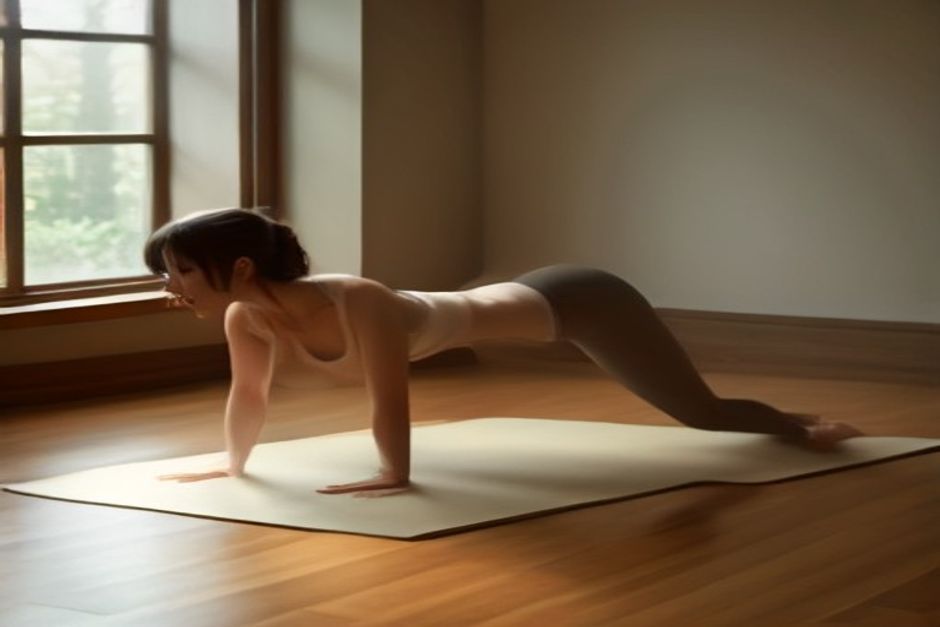
Plank and chaturanga. The sagging low back in plank is usually not weak abs — it is an unpressurized cylinder. Cinch the waist gently, breathe, and the middle holds itself. The same principle makes chaturanga shoulder-safe.
Boat pose. Navasana is the classic core pose, but notice what actually fails first: usually the breath. When the cylinder is pressurized, the pose gets quieter, not harder.
Standing balances. In tree or warrior III, the wobble is rarely about the standing leg alone. A gently braced trunk gives the hip something to stabilize against. Balance improves when the middle stops moving.
Twists and forward folds. Pressure in the cylinder supports the spine while it rotates or flexes — which is why teachers cue a long spine before any twist. Our spine anatomy page explains what the vertebrae are doing underneath.
Training it honestly
The deep core responds to boring, consistent work: planks held with good breathing, dead-bug style movements on your back, slow transitions in your regular practice. No equipment, no burning sensation required. A useful self-test: lie on your back, knees bent, and place your fingers just inside your hip bones. Cough once. The muscle that jumps under your fingers is your transversus. Now try to recreate thirty percent of that contraction and hold it while breathing slowly for ten breaths. That is the whole exercise, and it is harder than it sounds.
The core's job is not to look like something. Its job is to hold pressure, share load, and let you breathe while it works.