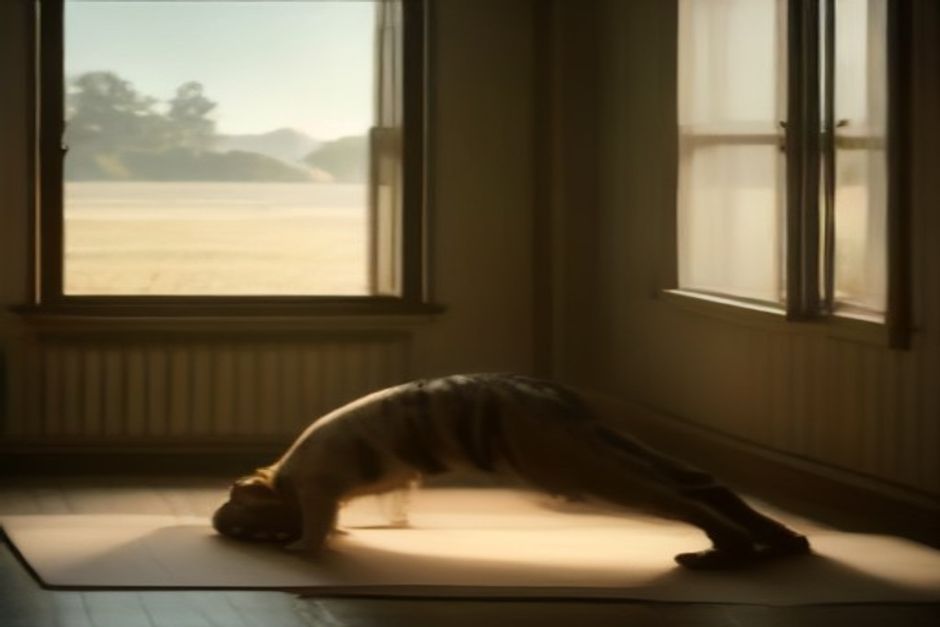
You roll out of bed, reach for your toes out of curiosity, and your body answers like a rusty gate. Yet yesterday at 6 p.m. the same fold was fine. Nothing changed overnight except... everything, a little. Morning stiffness is one of the most universal human experiences and one of the least explained. Let's explain it, and then adjust your practice to match the body you actually have at 7 a.m.
Three honest reasons you feel like plywood
1. Your discs took on water
The discs between your vertebrae behave like sponges. Lying down all night, unloaded, they absorb fluid and plump up; by morning you're measurably taller — and your spine is stiffer and more vulnerable at its end ranges, particularly deep forward bends. This is normal physiology, not damage. It also means the first hour after waking is the wrong time to test your maximum spinal flexion. The bend will come back. It's just still asleep.
2. Your tissues are cold
Muscles and connective tissue are temperature-sensitive, and your core temperature hits its daily low in the early morning. Cool tissue is less elastic — same material, different season. This is why a fold that feels impossible at 7 a.m. feels ordinary at 5 p.m.: you're literally warmer. No amount of willpower overrides physics, but movement and warm air change the number on the thermostat within minutes.
3. Your nervous system is still on guard
Much of what feels like "tightness" is actually protection — your nervous system limiting range it doesn't currently trust. Overnight, without the usual stream of movement data, that trust gets conservative. Morning stiffness partly resolves not because tissue changed, but because your brain got fresh evidence that movement is safe. This is why gentle motion fixes it faster than aggressive stretching: you're updating the software, not forcing the hardware.
So adjust the practice, not the ambition
Morning yoga is wonderful — quiet house, clean slate — as long as you practice for the body that's present. That body wants a warm-up curve, not a cold open.
Start with rhythm, not depth — Marjaryasana-Bitilasana
How: Two or three minutes of cat-cow, slow and breath-led, before anything resembling a stretch. Add gentle circles of the shoulders, hips, wrists.
Why: Rhythmic movement pumps warmth into tissue and feeds your nervous system the movement data it needs to relax its limits. Depth without warmth is negotiation by shouting.
Let the spine wait
How: In the first ten minutes, keep forward bends bent-kneed and shallow, and backbends gentle — think sphinx, not wheel. Save your deepest folds for later in the practice or later in the day.
Why: Those hydrated morning discs are at their most vulnerable in full flexion first thing. The pose isn't going anywhere; give it an hour.
Weight-bearing as a wake-up
How: Once you've moved a little, add poses that load the joints moderately — a low lunge, half plank, a few slow rounds of sun-salutation-style movement with easy ranges.
Why: Gentle compression and muscular effort raise tissue temperature fast and signal "day mode" to your whole system. It's the difference between warming up a car and redlining it cold.
The five-minute morning reality check
If you want a minimal honest routine: one minute of cat-cow, one minute of child's pose with side-stretches, one minute of a supported low lunge each side, one minute of standing side bends and a soft fold, one minute of sitting quietly. That's it. Five minutes, no heroics, and the rusty gate opens. Our morning yoga page has fuller sequences when you have more time, and if you're deciding when to practice at all, the honest comparison of morning versus evening practice is worth a read — evening bodies are genuinely more flexible, and that's fine too.
"Morning stiffness isn't your body failing you. It's your body doing exactly what a rested body does — it just hasn't read your schedule."
When stiffness is telling you something else
Normal morning stiffness eases within thirty to sixty minutes of moving around. Patterns that deserve attention instead of adaptation: stiffness that lasts most of the day, one-sided pain that wasn't there before, joints that are swollen or hot, or stiffness that's steadily worsening over weeks. Those are check-with-a-doctor signs, not stretch-harder signs. Inflammatory conditions announce themselves precisely through long-lasting morning stiffness, and catching that early matters far more than any pose.
The morning body isn't the enemy of practice; it's just the honest one. Meet it with warmth and rhythm, and it'll meet you back — a little taller, a little creaky, and entirely ready by minute five.