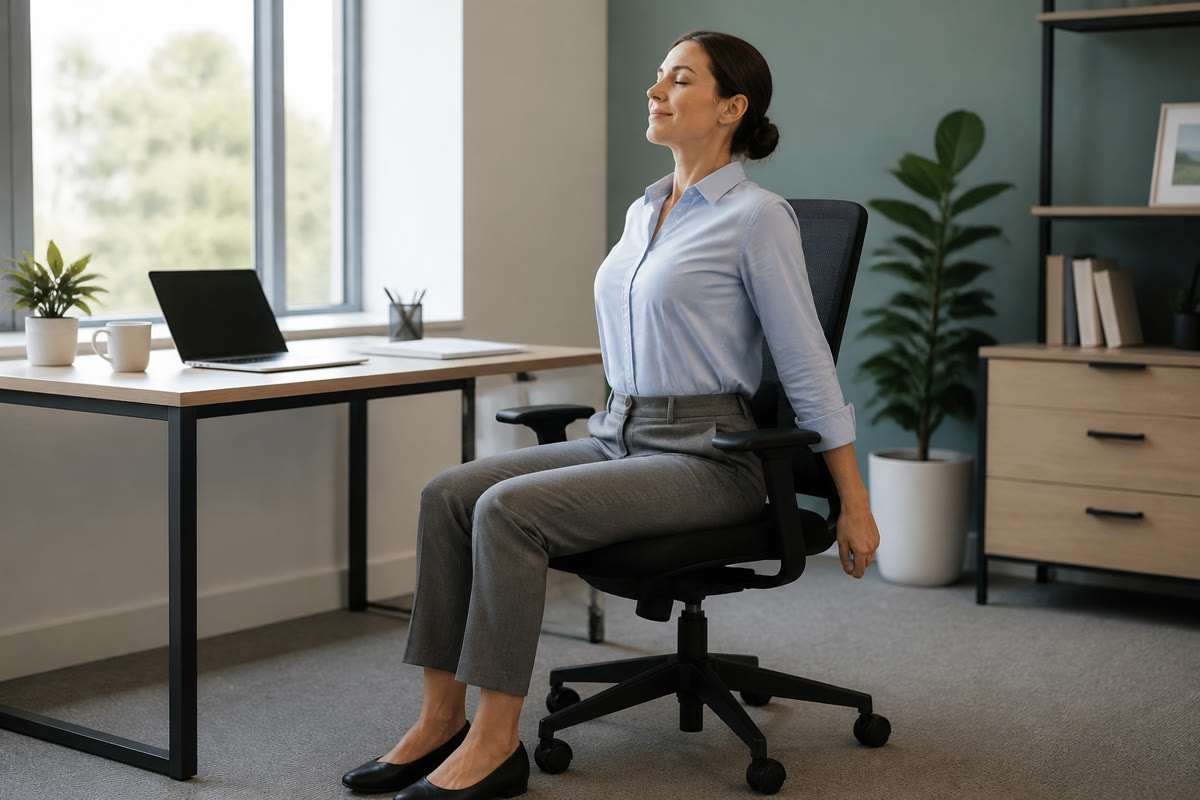
You do not need a mat, a studio, or a change of clothes to practice yoga. You need a chair, ninety seconds, and a willingness to look slightly odd near a printer. Desk yoga is not a watered-down apology for real practice — it is targeted maintenance for a body doing one specific, demanding thing: sitting still for eight hours. And sitting, as our tight hips and sitting page explains, is genuinely demanding. The hips shorten, the upper back rounds, the wrists hold one angle, and the neck cranys forward a centimeter for every year of your career.
Here is what actually helps, in the order your body usually asks for it.
The four hotspots
Seated neck and shoulder release
How: Sit tall, feet flat. Drop your right ear toward your right shoulder — no pulling with the hand, gravity is enough. Stay 20 to 30 seconds, breathing. Switch sides. Then roll both shoulders back five times, slowly, and finish by squeezing the shoulder blades together for three breaths.
Why: The muscles that hold your head up all day (upper trapezius, levator scapulae) are endurance muscles running a marathon daily. Thirty seconds of stretch interrupts the holding pattern, and the blade squeeze wakes up the mid-back muscles that slouching switched off.
Wrist and forearm undo
How: Extend one arm forward, palm up. With the other hand, gently draw the fingers down and back until you feel a stretch along the inner forearm. Hold 15 to 20 seconds, then flip the palm down and stretch the back of the wrist the same way. Switch arms. Finish by making fists and opening the hands wide five times.
Why: Keyboards and mice hold the wrist in slight extension for hours while the forearm flexors stay short. This is the exact counter-stretch, and the fist-to-spread movement pumps fluid through tissues that have been statically loaded all morning.
Seated cat-cow
How: Hands on knees, feet flat. Inhale: arch gently, chest forward, look slightly up. Exhale: round the spine, chin toward chest, press the knees away. Move with the breath, eight to ten rounds, slower than feels necessary.
Why: A chair locks the spine in one shape; seated cat-cow moves it through flexion and extension without anyone in the meeting noticing anything beyond good posture. It is the single highest-value desk movement there is.
Seated figure four
How: Cross your right ankle over your left thigh, just above the knee, and flex the foot. Sit tall, then hinge forward from the hips — flat back, not a rounded slump — until you feel the right outer hip open. Hold 30 seconds, switch sides.
Why: Sitting shortens the hip flexors and puts the outer hips to sleep. This undoes both at once and is discreet enough for most offices. It is the chair-bound cousin of pigeon pose, minus the floor.
The two-minute reset between meetings
For the days when there is no gap, only a smaller gap:
- Stand up (0:00–0:20). Just standing is already a counterpose to sitting. Let your arms hang, shake the hands out.
- Five slow breaths (0:20–0:50). In through the nose, long exhale. This is not filler — a long exhale is the fastest legal way to downshift a nervous system still buzzing from the last call.
- Standing backbend (0:50–1:20). Hands on your low back, hips forward, chest lifting — the exact opposite of your sitting shape. Three breaths.
- Neck release, both sides (1:20–2:00). Then sit back down and let the next meeting meet a slightly different nervous system.
The desk posture breaks page covers how often to do this (more often than you think, shorter than you fear), and our desk yoga journal goes deeper on building it into the workday without it becoming another abandoned system.
What desk yoga is not
A few honest boundaries. Desk yoga is maintenance, not training — it will not build the strength or flexibility a mat practice builds, and it is not a substitute for occasionally standing up and walking somewhere. It is also not a fix for a workstation that is genuinely wrong: if your monitor is too low and your chair has opinions of its own, move the monitor first. Ergonomics is the pose adjustment of office life.
The bigger idea
It is easy to dismiss this as not-real-yoga, and worth resisting. Yoga is attention applied to the body, and your body at 3 p.m. on a Wednesday is as worthy of attention as it is on a mat at sunrise. Two minutes, five times a day, adds up to a practice — one that requires nothing you do not already have. If you are newer to yoga and want the foundations behind these movements, start with yoga basics, then bring the same principles to the chair you are probably sitting in right now.