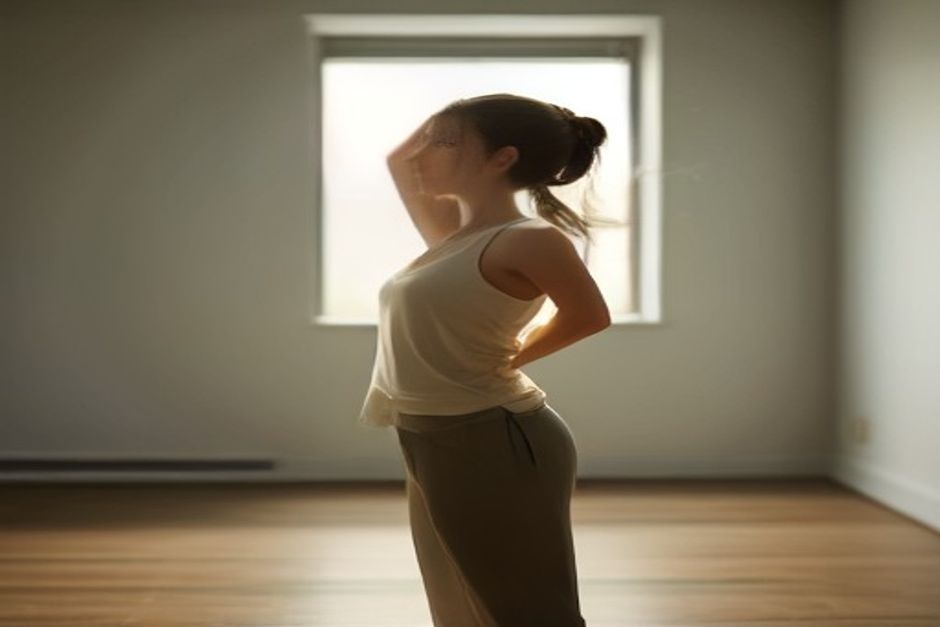
Of all the backbends in yoga, the standing version gets the least respect and does the most daily work. Anuvittasana — roughly "found-again pose," often simply called standing backbend — requires no warm-up sequence, no wheel-pose ambitions, and no particular flexibility. You stand, you tip the chest toward the ceiling, you breathe. Yet for bodies that spend their days folded toward a screen, it is the single most repeated counterpose in an honest practice. Think of it as the undo button for the keyboard hunch.
Why this backbend first
Deeper backbends — cobra, camel, wheel — concentrate their curve in the low back if you approach them carelessly. The standing backbend is harder to get wrong: the legs are doing real work, the hands on the hips limit the range, and gravity is mostly on your side. It teaches the fundamental skill of all backbending — length first, then curve — in a position you can exit instantly. It also fits into life. Thirty seconds at the kitchen counter counts. The asana library is full of impressive shapes; this is the one you will actually do five times a day.
Standing Backbend — Anuvittasana
How: Stand in mountain pose, feet hip-width apart, weight evenly across both feet. Place your hands on your hips or the back of your pelvis, fingers pointing down — this props the pelvis so it stays level. Inhale and lengthen up through the crown of the head. On the exhale, press the hips slightly forward, lift the sternum, and tip the chest back a few degrees. Keep the chin neutral at first; only let the head follow if the neck feels free. Breathe into the front ribs — you should feel them widen like a fan. Hold three to five breaths, then return upright on an inhale, leading with the chest rather than the head.
Why: Hands on the pelvis prevent the classic error of dumping the entire bend into the low back. The movement should distribute along the whole spine, with the thoracic spine — the stiff middle section that slouching locks down — doing its rare share of the work.
Arms Overhead Version — Hasta Uttanasana
How: From standing, sweep the arms overhead on an inhale, palms facing each other. Lift the chest and arc gently back, keeping the arms by the ears and the front ribs contained — don't let them flare. The hips press slightly forward to counterbalance. Two or three breaths, then sweep the arms down as you rise.
Why: This is the version embedded in the classical sun salutation, and it doubles as a shoulder opener. Reaching up before bending back creates the length that keeps the low back out of the argument.
Counter Backbend — supported, at a wall or desk
How: Stand arm's length from a wall or the back of a sturdy chair. Place the hands on it at shoulder height, walk the feet back until the torso is parallel to the floor, then let the chest soften between the arms. This is a supported fold rather than a backbend, but it lives in the same family: the front body opens, the shoulders decompress, and the spine gets traction it never finds in a chair.
Why: For tight shoulders or low energy days, this delivers most of the benefit with almost none of the demand. It is the version to teach your most skeptical colleague.
How deep is deep enough
Shallower than you think. The goal of a standing backbend is not a dramatic arc; it is waking up the front of the body. A bend of ten to fifteen degrees, repeated with full breaths, changes your posture and your energy more than one heroic lean. Depth comes from the thoracic spine and the hip flexors lengthening over weeks, not from pushing harder today. If you want to feel where breath fits into this, three-part breathing practiced upright pairs naturally with the pose — the expanding front ribs are the pose and the breath at once.
The mistakes worth avoiding
- Jutting the chin. Leading with the head compresses the neck. Lift the breastbone; the head comes along politely.
- Collapsing the low back. If you feel a pinch above the pelvis, come up, re-lengthen, and bend less. Pinching is information, not progress.
- Locking the knees. Soft knees keep the pelvis honest and the blood pressure steady.
- Holding the breath. A backbend without breath is just leaning. The inhale is the pose.