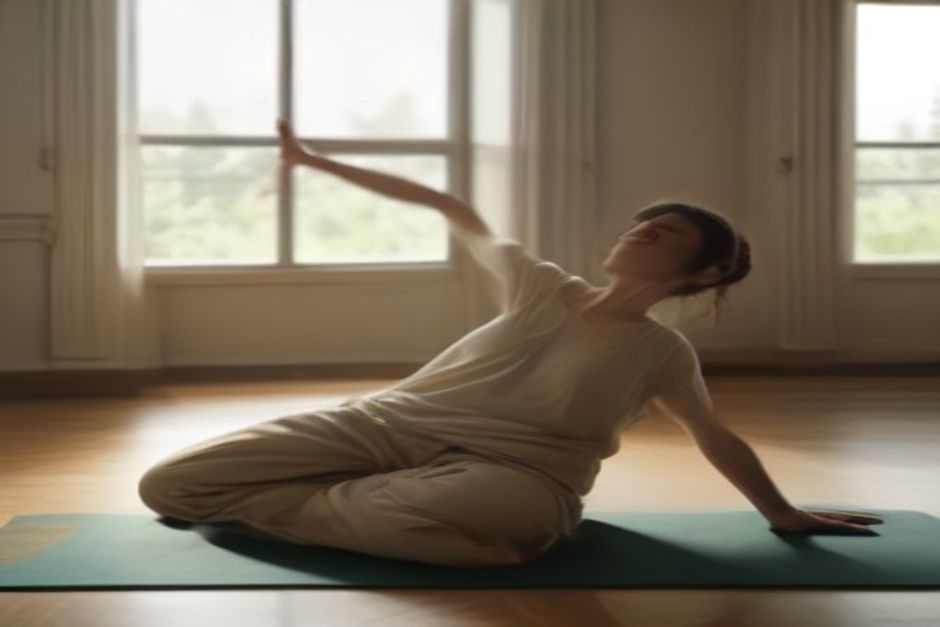
Nobody starts yoga correctly. Everyone starts by holding their breath, cranking into poses their hamstrings voted against, and sneaking looks at the bendy person in the front row. This is normal — it's the tuition you pay. But some mistakes cost more than others, and most of them have a one-sentence fix. Here are the ten we see most, roughly in the order they show up.
1. Holding your breath
The single most common beginner habit. The moment a pose gets hard, the breath stops — you can watch it happen in any class. The trouble is that breath is the whole mechanism: it's what tells your nervous system the pose is safe enough to soften into. The fix: if you can't breathe slowly in a pose, the pose is too deep. Back off until you can. A few rounds of ujjayi breathing before practice makes breath-holding much easier to catch.
2. Treating flexibility as the goal
Yoga's biggest PR problem is that it looks like a stretching contest. It isn't. Reaching the floor in a forward fold is not more enlightened than reaching your shins — it's just longer hamstrings, which are partly genetic. Chasing depth is how beginners turn a shoulder or a low back into a six-week problem. The fix: practice at the depth where you feel broad, easy sensation — a 5 out of 10 — and let the range arrive on its own schedule. The full argument is in the truth about flexibility.
3. Comparing yourself to the room
The person next to you may have danced for fifteen years, hypermobile joints, or simply more practice hours than you have living hours. Their pose tells you nothing about yours. Comparison also does something sneaky: it pulls your attention out of your own body, which is the one place yoga happens. The fix: eyes on your own mat. It's not politeness — it's technique. This is also the entire point of drishti, the focused gaze, which the glossary explains.
4. Skipping Savasana
Beginners leave before the final rest because it looks like lying down doing nothing, and they came to do something. But Savasana is where the practice consolidates — the nervous system downshifts, the body integrates the work, and you learn the underrated skill of being still on purpose. Leaving early is like taking bread out of the oven five minutes early because it already smells done. The fix: stay. If lying flat is uncomfortable, there are several supported versions. Savasana is the hardest pose precisely because there is nothing to do.
5. Locking the joints
Hyperextended elbows in plank, knees slammed straight in standing poses — beginners often stack their weight into the joint instead of the muscle, because it feels stable. It is stable, the way a folding chair is stable: until it isn't. The fix: keep a micro-bend everywhere. Knees and elbows should feel like springs, not sticks. If your joints naturally hyperextend, this one is worth extra attention.
6. Going too hard, too often, too soon
Enthusiasm is the injury nobody suspects. A new student discovers yoga, practices ninety minutes daily, and wonders why their wrists and hamstring attachments are angry by week three. Tissues adapt slower than motivation. The fix: start with twenty to thirty minutes, three to four times a week, and add volume only after a month of no complaints. Consistency beats intensity by such a wide margin it's not a contest. Building a home practice that sticks is mostly about choosing a dose you can repeat.
7. Ignoring pain because "it should feel like something"
Sensation is the point of yoga; pain is not. The useful rule: broad, dull, symmetrical stretch — fine. Sharp, stabbing, one-sided, or joint-located — stop. Beginners often can't tell the difference yet, so they err toward endurance. Err the other way. The fix: when in doubt, come out. Child's pose is always available, in any class, with zero explanation required. A pose you leave is not a failure; it's data.
8. Death-gripping the face, jaw, and hands
Watch a beginner in a hard balance: clenched jaw, furrowed brow, fingers splayed like they're defusing something. All that tension is borrowed effort — it does nothing for the pose and everything for fatigue. The fix: in any hard pose, run a quick audit: jaw soft, tongue down, fingers alive but not clawing, face neutral. It's surprising how much easier the pose gets when you stop doing the extra twelve poses on top of it.
9. Practicing only what you're already good at
Bendy people do backbends; strong people do planks; everyone avoids the thing that exposes the gap. It's human, and it quietly hardens your imbalances. The fix: you don't need to love the hard category, just visit it weekly. Tight hips? One gentle hip opener per session. Weak core? Thirty seconds of boat pose, hated but present. The asana library is organized enough to find your avoidances.
10. Waiting to feel like "a yoga person"
The most expensive mistake is the identity one: deciding you'll start for real once you're more flexible, thinner, calmer, or in possession of better pants. Yoga has no prerequisites — that's not a slogan, it's the structure of the thing. The practice meets the body that shows up. The fix: the beginner version of every pose counts, fully. You're not auditioning.
The pose you can breathe in is your pose. Everything past that is just ambition wearing leggings.