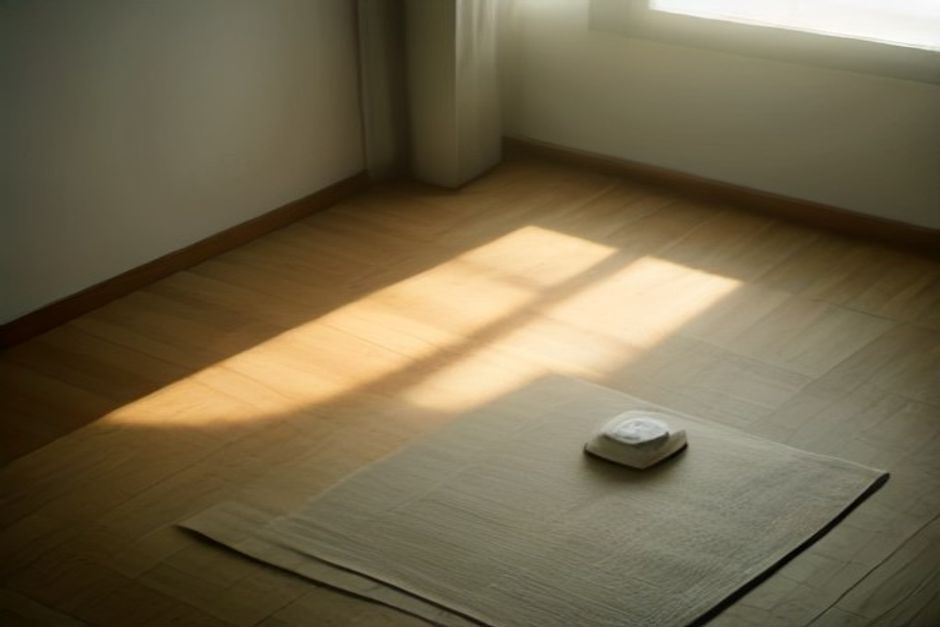
There is a number that quietly ruins most home yoga practices, and that number is sixty. Somewhere along the way we absorbed the idea that a practice counts when it lasts an hour — because studio classes last an hour, because the videos are an hour, because "serious" practice is an hour. Then real life assigns you twelve minutes between the morning alarm and the rest of the day, does the arithmetic, and answers: zero minutes, again. The hour-long practice is not the standard. It is the exception that most people, most days, cannot keep. Ten minutes, kept daily, is not a compromise version of yoga. For most humans with jobs and families, it is the entire game.
Why ten minutes works (and an hour doesn't)
Start with the honest physics of habit. A practice survives on repetition, and repetition survives on a low cost of starting. Ten minutes has almost no negotiation overhead: you do not need to reschedule anything, eat differently, or wait for the house to empty. It fits in the gaps that already exist — before the shower, after the kettle, while the pasta water boils. An hour requires a calendar event; ten minutes requires only a mat on the floor, and our home practice guide has already established that a visible mat does most of the remembering for you.
Then there is the learning side. Bodies adapt to frequency more than to heroic single doses. Connective tissue, balance, breath capacity — all of it responds to regular small signals. One ninety-minute class a week is one signal. Ten minutes a day is seven signals, and seven signals a week is how a body actually changes its defaults. This is also why the question of how often to practice has such an unsatisfying answer: "often enough that it stays normal." Daily ten-minute practice is always normal. Weekly marathons are always an event.
Finally, the psychological dividend: a practice you finish every day makes you someone who practices every day. Identity follows evidence. The person who does ten minutes daily after a year has done sixty hours of yoga and, more importantly, has stopped having the argument with themselves about whether they are "really a yogi." They just practice. That argument consumes more energy than any pose.
The minimum viable sequence
Ten minutes is not a shrunken hour — you cannot do a quarter of everything. You need a sequence built for the container. Here is one that covers the whole body honestly, no equipment beyond a mat:
- Minute 0–1: arrive. Stand or sit and take ten slow breaths. Not a warm-up formality — the transition ritual. The nervous system needs to be told that the next ten minutes are different from the last ten emails.
- Minutes 1–3: spine. Cat-Cow, slowly, eight to ten rounds. The spine moves in flexion and extension, the breath pairs with movement, and the day's desk posture starts unwinding. If you only ever did one thing, this would be a defensible choice.
- Minutes 3–5: hips and hamstrings. A low lunge each side, thirty to forty seconds, then a standing or seated forward fold for the back line. These two hit the exact tissues that sitting destroys.
- Minutes 5–7: strength. One plank hold (twenty to forty seconds, knees down is fine), one standing balance per side — tree or just standing on one leg. Strength and balance are the two capacities that matter most for aging well, and the two most likely to be skipped. Do not skip them.
- Minutes 7–9: twist and release. A reclined twist each side, long exhales. Then one restorative shape — Child's Pose or legs up the wall if you are near one.
- Minute 9–10: stillness. One minute of lying down doing nothing, or sitting and counting breaths — the gateway to everything on the meditation side. Yes, one minute counts. Consistency counts; duration accumulates.
Rules that keep it alive
- Same time, same anchor. Attach the ten minutes to something that already happens daily. Anchored habits survive bad weeks; floating ones die on the first busy Tuesday.
- Never make up a missed day. Missed Monday? Tuesday is still ten minutes, not twenty. The moment practice becomes debt, it becomes avoidable.
- Boredom is data, not failure. Around week three, ten minutes of the same sequence gets boring. Good — that is when you swap one element, not the whole practice. Rotate the strength minute, try a different twist. Keep the skeleton.
- Long sessions are a bonus, not the standard. Some weekends you will have an hour and want it. Wonderful. Enjoy it — and then return to ten minutes the next day without recalibrating what "counts."
The objection, answered
"But can ten minutes really do anything?" Yes — and the question smuggles in the wrong comparison. The alternative to ten daily minutes is not a daily hour; for most people it is nothing. Ten minutes versus nothing is not a close contest. And the ceiling is higher than it looks: breathwork fits in ten minutes, a brisk sun-salutation flow fits, a genuinely settling breath-counting sit fits. The container is small. What fits in it, done daily for a year, is not.
The best practice is not the longest one. It is the one that is still there in March.
Set the mat out tonight. Tomorrow, ten minutes — the spine, the hips, a little strength, a minute of stillness. Do it badly if needed; bad repetitions count the same as good ones, which is the most forgiving rule in all of yoga. Then do it again the day after. That is the whole method, and it has been quietly outperforming January resolutions for years.