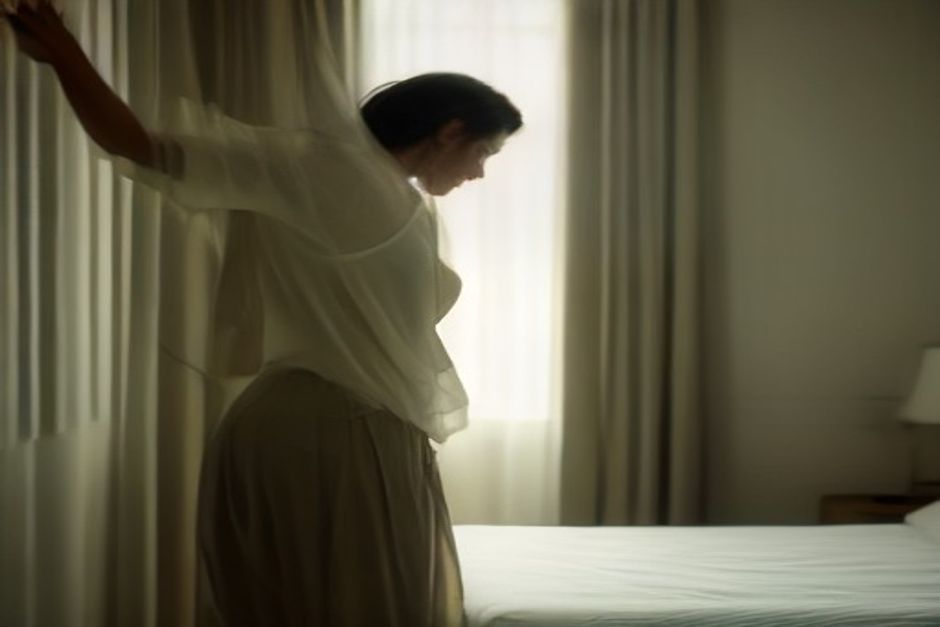
Travel is where home yoga routines go to die. The mat stays home, the schedule shatters, the room is twelve square meters of carpet that may or may not have stories to tell, and after six hours in seat 34C your body feels like it was folded by someone who dislikes you. The good news: this is exactly the situation yoga is for. You don't need a studio on the road — you need fifteen minutes, a floor, and a sequence designed for what flying actually does to a body.
What flying does, roughly: hips locked at ninety degrees for hours, low back rounded against a seat designed by an optimist, shoulders hunched over a phone, ankles swelling from cabin pressure and stillness, and a nervous system scrambled by time zones and recycled air. The sequence below targets exactly that list, in order of priority.
Before you start: the ground rules
- Carpet is fine. A towel on the floor gives you grip if the carpet is suspicious. No mat required for anything here.
- Keep it quiet. No jumping, no slapping down into poses. Hotel walls are thin and the goal is restoration, not cardio.
- Match the dose to the day. Landed at midnight after a red-eye? Do the marked minimum version. A stiff body plus a tired brain is not the moment for ambition.
The 15-minute sequence
1. Standing hang — 1 minute
How: Stand with feet hip-width, knees soft, and fold forward, letting the head and arms hang. Hold opposite elbows if that's comfortable. Sway gently side to side. Breathe into the back of the ribs.
Why: The simplest decompression for a spine that's been seat-shaped for hours. Bent knees keep the low back out of it; gravity does the work. The full version of this pose is covered in standing forward bend.
2. Cat-cow on the bed — 2 minutes
How: On hands and knees on the mattress (a forgiving surface, use it), inhale the chest forward and up, exhale round the spine. Ten slow rounds, breath leading movement.
Why: Segment-by-segment spinal movement is the fastest way to wake up a back that's been frozen in one shape. Details in the cat-cow guide — the hotel version is identical, just softer under the knees.
3. Low lunge against the nightstand — 2 minutes each side
How: Step one foot forward into a lunge, back knee on the floor (fold the towel under it). Hands can rest on the front thigh or the nightstand for balance. Tuck the pelvis slightly and breathe into the front of the back hip.
Why: Airplane hip flexors are the single biggest casualty of flying — shortened for hours, then asked to hold you upright at baggage claim. Two minutes per side is the apology. Full setup notes are in low lunge.
4. Seated twist on the desk chair — 1 minute each side
How: Sit tall in the room's desk chair, feet flat. Right hand to the outside of the left thigh, left hand on the chair back. Lengthen on the inhale, rotate gently on the exhale. Five breaths, switch sides.
Why: Rotation is the spinal movement travel eliminates entirely — seats, seatbelts and suitcases all demand you face forward. Gentle twists feel like unwringing a towel because, mechanically, that's close to what's happening.
5. Figure-four stretch — 90 seconds each side
How: Lie on your back on the floor or bed. Cross the right ankle over the left thigh, thread your hands behind the left thigh, and draw the leg gently toward the chest. Keep the tailbone heavy.
Why: Opens the deep glutes and outer hip — the muscles compressed under your bodyweight all flight. This is the travel-safe stand-in for pigeon pose, with zero knee risk.
6. Legs up the headboard wall — 5 minutes
How: Sit sideways against the wall at the head of the bed, swing the legs up, and lie back. Arms anywhere comfortable, eyes closed. Five minutes minimum; nobody has ever complained about seven.
Why: The closer. Fluid that pooled in the lower legs drains, the nervous system downshifts, and — this is the jet lag part — it's the single most reliable bridge into sleep in a strange room. Setup and timing details in legs up the wall.
The jet lag amendment
Movement resets more than muscles. Light exposure and gentle activity are two of the honest tools for shifting your body clock — far more reliable than supplements. So: after landing, do this sequence, then take a ten-minute walk outside in whatever daylight is left. If you've arrived in the morning local time and need to stay awake, add a few rounds of normal-paced sun salutations before step one to lift energy. If it's evening and you need to sleep, skip the salutations and pair the sequence with 4-7-8 breathing in bed — the long exhale is the point.
What to skip on the road
Hotel-room yoga fails when it tries to be studio yoga. Skip:
- Anything that needs grip. Arm balances and jump-throughs on unfamiliar carpet are how wrists meet regret.
- Long, ambitious flows. Fifteen minutes daily beats ninety minutes once, especially across time zones. Consistency on the road is about lowering the bar until stepping over it is unavoidable — the same principle as minimum effective practice at home.
- Deep stretching when sleep-deprived. Exhausted bodies have sloppy proprioception. Gentle range of motion only.
The hotel-room sequence isn't a compromise version of your practice. Done daily on a trip, it is the practice — just dressed down.