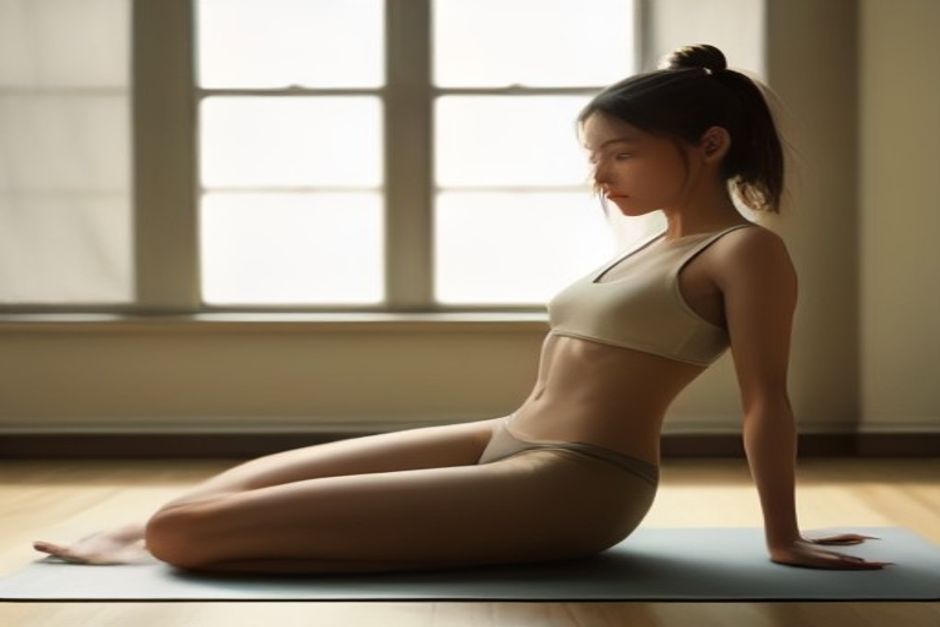
Posture advice usually arrives as a command: sit up straight. You comply for ninety seconds, then the next email arrives and your spine quietly resumes the shape of the chair. This isn't a character flaw. Posture is not a decision you make once — it's the sum of what your muscles and joints can comfortably do. If your chest is tight, your mid-back is stiff, and your hip flexors have shortened to chair-length, "straight" is a position you can hold briefly with effort, not a place you can live. Yoga's contribution is unglamorous but real: open what sitting closes, strengthen what sitting switches off, and standing tall stops requiring willpower.
The anatomy of the desk hunch, in plain terms
Three things happen to a body that sits for a living:
- The thoracic spine stiffens. The mid-back is built to extend and rotate; a screen-forward posture holds it in one mild flexion for hours. Stiff segments eventually feel normal — you stop noticing the slump because the slump is home.
- The front body shortens. Chest muscles adapt to arms-forward keyboarding; hip flexors adapt to ninety-degree hips. Tight fronts pull posture forward no matter how often you remind yourself.
- The back side goes quiet. The muscles between the shoulder blades and the glutes — the ones that would hold you up — do almost nothing all day and get weak and sleepy accordingly.
So the fix has three matching parts: mobilize the mid-back, open the front, wake up the back. Ten to fifteen minutes, most days. Here's the short list.
Mobilize the thoracic spine
Cat-cow, slowly
How: On all fours, move through cat-cow at half speed, eight to ten rounds, letting each segment of the spine participate rather than hinging at one spot.
Why: It reintroduces movement to vertebrae that haven't moved all day. This is the cheapest, highest-value spinal maintenance there is — two minutes, no equipment, works in pajamas.
Thread the needle
How: From all fours, reach the right arm under the body, rest the right shoulder and temple on the floor, breathe into the back ribs for six breaths. Switch sides.
Why: Rotation is the thoracic movement desk life deletes entirely. Gentle, supported twisting restores it without asking anything heroic of the low back.
Open the front body
Sphinx pose
How: Lie on your belly, forearms on the floor, elbows under shoulders, chest lifting gently forward and up. Stay for eight to ten slow breaths. Full details in our sphinx guide.
Why: A mild, sustainable backbend that directly reverses the desk curve. Because it's forearm-supported, you can stay long enough for it to actually matter — a minute or two, most days.
Cow face arms
How: Sitting or standing, take the arm position from cow face pose — one elbow up, one down, hands reaching for each other behind the back. Use a strap or belt between the hands if they don't meet (they won't, at first). Six breaths each side.
Why: The single best shoulder-and-chest opener for keyboard posture: it targets exactly the internal rotation that typing trains in.
Supported fish
How: Place a rolled blanket or firm cushion across your upper back (roughly at the bottom tips of the shoulder blades), lie back over it, arms relaxed wide, and breathe for two to five minutes. It's the lazy, wonderful version of fish pose.
Why: Gravity does the work. The chest and the front of the shoulders open passively while you do nothing — the most compliance-friendly posture fix ever devised.
Wake up the back side
Locust, small and honest
How: From your belly, lift the chest, arms, and legs just slightly off the floor — a low, easy locust. Hold five breaths, rest, repeat three times.
Why: This directly strengthens the muscles along the spine and between the shoulder blades — the ones that hold posture without you thinking about it. Small and repeatable beats big and abandoned.
Bridge
How: Five slow lifts into bridge pose, pausing three breaths at the top of the last one, glutes doing the work rather than the low back.
Why: The glutes are posture's foundation — when they switch on, the pelvis stops dumping you into a slouch. Bridge strengthens them and opens the hip flexors in the same move.
Low lunge with a tuck
How: In a low lunge, tuck the tailbone slightly and breathe into the front of the back hip, six to eight breaths each side.
Why: Tight hip flexors tilt the pelvis and recruit the low back into every standing moment. Release them and standing tall gets measurably easier.
The honest limits
Two truths to keep this realistic. First, yoga opens and strengthens — it doesn't install an alarm. Posture still drifts during the workday; that's what the desk yoga routine is for, plus the unfashionable basics: a screen at eye level and getting up regularly. Second, timelines: expect weeks of daily-ish practice before standing tall feels like the default rather than an effort. The change is real but it arrives quietly — one day you catch yourself upright at 4 p.m. and realize nobody reminded you.
Good posture isn't held. It's allowed — by a body that can actually get there.