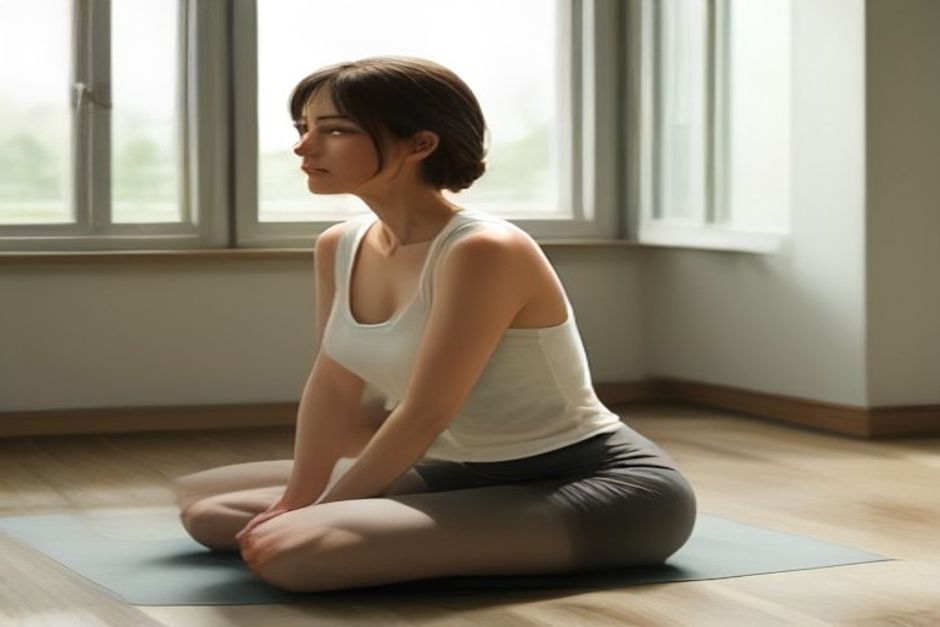
Search for yoga and menopause together and you will find a lot of promises: poses that "balance hormones," sequences that "reverse" the transition, breathing that cools you from the inside forever. Let us start where this site always starts — with what is true. Menopause is a real physiological transition, not a mindset problem, and no pose changes your estrogen levels. What yoga can honestly offer is substantial anyway: tools for the hot flashes, the 3 a.m. wake-ups, the joints that suddenly object, and the mood that comes with all three. That is a shorter list than the marketing, and it is worth more.
Hot flashes: work the thermostat you actually control
You cannot stop a hot flash with a pose, but you can change how you meet one. The cooling breaths are the most useful tradition here: sheetali, the curled-tongue inhale — or sheetkari, teeth together, if your tongue does not curl, which is true for a third of people and is genetics, not failure — genuinely lowers the temperature of incoming air and gives the flash's crest something slow to ride on. Long, unhurried exhales help more than any technique with a Sanskrit name: a flash arrives with a spike of alarm, and a slow out-breath is the fastest legal way to tell the alarm it is not needed. Practical matters count too: practice in a cool room, near a window, in layers you can shed mid-pose. Restorative holds beat hot flows on days when the internal weather is unreliable, and this is not the era to stay loyal to a heated studio if the room has started feeling like an adversary.
Sleep: the 3 a.m. problem
The classic menopausal night is falling asleep fine and waking at three with the mind fully employed. Here yoga has two honest offerings. Before bed: a slow wind-down — a few supine twists, legs up the wall, long exhales — lowers the arousal level you carry into sleep; our yoga for sleep page has the full sequence. After the 3 a.m. waking: do not lie there negotiating with your thoughts. Ten minutes of yoga nidra audio or a slow body scan gives the mind a job simple enough to do badly, which is the point. Many people find the waking shortens — not because the practice knocks them out, but because it removes the second problem, the fury about being awake, which turns out to be most of the problem.
Joints, strength, and the long game
Falling estrogen affects bone density and connective tissue, and the joints often announce this before any scan does. Movement — regular, varied, unheroic — is the boring answer that keeps showing up in the evidence: gentle daily range-of-motion keeps stiff joints feeling better than either total rest or sporadic heroics. Weight-bearing standing poses and slow strength work are worth keeping in the rotation; the muscles around a joint are its best long-term protection. Our page on yoga and aging lays out the general approach: consistency over intensity, warm up longer than you used to, and treat pain as information rather than weakness.
And now, the hype
Claims to file under marketing: any pose described as "massaging the ovaries" or squeezing hormone glands back into production; any sequence promising to delay or reverse menopause; any teacher who suggests yoga makes medical treatment unnecessary. Glands are not sponges and poses are not pumps. The honest mechanism is less glamorous: movement, breathing, and rest reliably change how the nervous system handles symptoms, and that changes daily life. It just does not change the underlying transition, which proceeds on its own schedule regardless of how good your triangle pose is.
None of this is a reason to lower your opinion of the practice — if anything, it is a reason to trust it. A tool that does a few real things well beats a miracle that does nothing, every single night at 3 a.m.
The medical line: hot flashes that wreck sleep for months, bleeding patterns that change, bone-density questions, and the whole topic of hormone therapy belong with a doctor, not a yoga website. Yoga is a companion here, not a treatment. If your symptoms are heavy, take them to someone with a prescription pad — and keep the slow exhales for the waiting room.