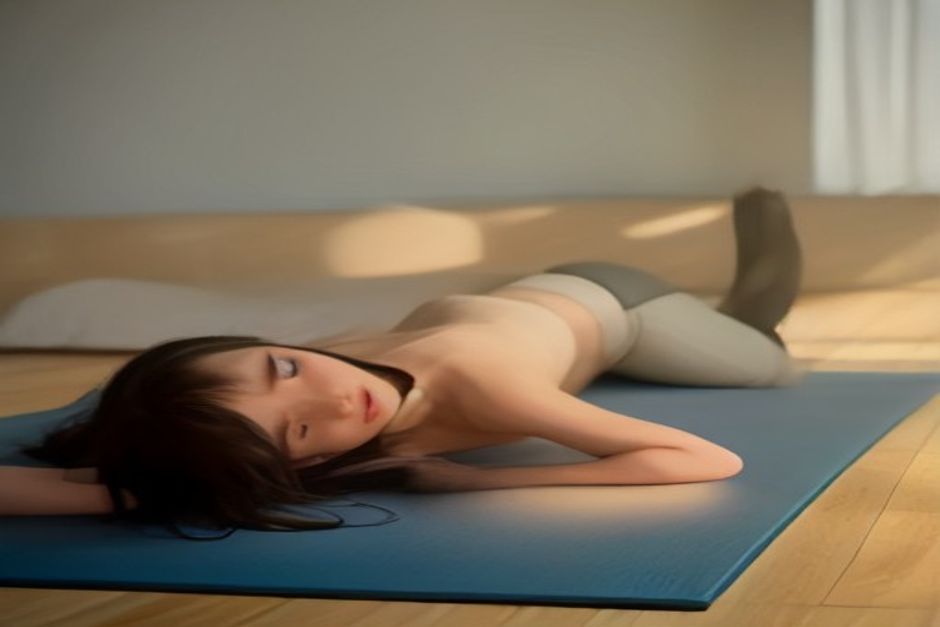
Some poses require instructions, alignment cues, and a certain amount of courage. Bananasana requires you to lie down and bend sideways a little. It is the yin yoga answer to the standing side stretches you already know — same target area, completely different delivery system. Instead of muscle effort, you get gravity, time, and the slow give of connective tissue. For the side waist, the ribs, the lats, and the much-maligned IT band, it is one of the most efficient stretches in the entire catalog, precisely because you are doing almost nothing.
In the yin yoga naming tradition (most yin poses carry their own names, borrowed from Paul Grilley's system), the banana name is literal: from above, your body curves like one. Feet walk to one corner of the mat, shoulders walk to the same corner, hips stay put. That's the whole engineering.
Banana Pose — Bananasana
How: Lie on your back with legs extended and arms resting by your sides. Keeping your hips anchored where they are, walk both feet toward the right edge of your mat, then let your feet stack or rest side by side at the corner. Now walk your shoulders and head toward the same side until your whole body forms a shallow crescent — feet right, hips center, head right. Reach your arms overhead if comfortable, optionally clasping hands or holding opposite elbows. Settle in. Stay three to five minutes, then repeat on the other side.
Why: The entire side line of the body — outer hip, obliques, the fascia between the ribs, lats, even the armpit — gets a slow, sustained stretch it almost never receives in daily life. The fascia along this line responds to duration more than intensity, which is exactly what a long yin hold provides.
Banana with a bolster
How: Slide a bolster or firm pillow under your side ribs on the stretched side before you curve. The support lets the muscles along the spine release instead of guarding, and it turns a stretch into something closer to a nap with benefits.
Why: If you feel pinching in the low back on the long side, or your body refuses to stop bracing, support changes the signal from "hold on" to "let go." Useful for anyone who finds the floor version more effortful than it should be.
Banana with crossed ankles
How: From the basic shape, cross the outer ankle over the inner one (right ankle over left when curving right). This adds a pull along the outer leg and IT band region.
Why: The ankle cross intensifies the stretch down the outside of the thigh — territory that runners and cyclists know as permanently grumpy. Add it only after the plain version feels genuinely easy.
How to use the time
Three to five minutes per side is the standard yin prescription, and the first minute is mostly just arriving. Expect the shape to deepen on its own around minute two as the tissue warms and yields — you may notice your head and feet have crept further sideways without any decision on your part. Breathe into the stretched side ribs; each inhale gently widens the curve from the inside. If you want structure for the hold, breath counting turns the wait into a meditation practice instead of a test of patience.
Coming out deserves care. Walk the feet and shoulders back to center slowly, then lie flat and neutral for thirty seconds to a minute — knees bent, feet on the floor, arms by your sides. Yin teachers call this the rebound: the brief window where the tissue reorganizes. It often feels like warmth or a pleasant fizz along the side body. Don't skip it by rushing to the second side.
Where it fits in a practice
Bananasana pairs naturally with other floor-based yin shapes: follow it with butterfly or a gentle reclined twist, or use it before legs up the wall as part of an evening wind-down. It also works standalone — two sides, ten minutes total, and the stiff side waist from a day of sitting is noticeably quieter. If you're weighing this style of practice against more propped, comfort-first approaches, our restorative vs yin comparison explains the difference.
Who should go gently: anyone with a recent rib injury, acute low-back pain, or a sensitive SI joint should keep the curve shallow and the holds short, or skip the ankle cross. Sharp pain on the long (stretched) side of the waist is a stop sign, not a breakthrough. As with all yin holds, come out if anything tingles, goes numb, or feels wrong rather than interesting.
The banana pose asks for nothing but time and honesty about your edge. In exchange, it opens a whole side of the body that most stretching routines ignore completely. Not a bad trade for lying on the floor.