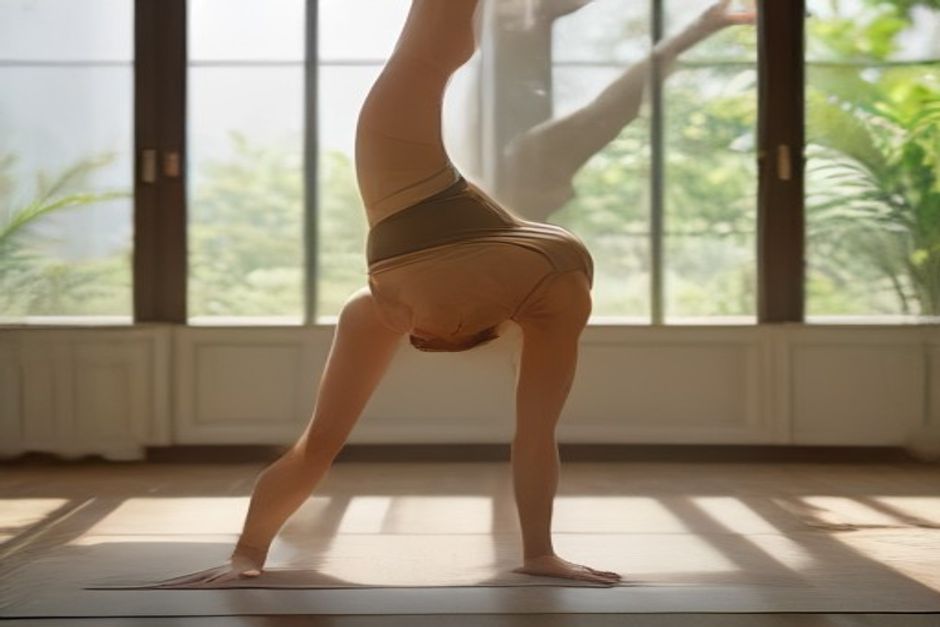
Revolved Crescent Lunge — Parivrtta Anjaneyasana, the twisted cousin of the crescent lunge — is where several difficult things happen at once. The legs are doing lunge work, the spine is rotating, and your balance is being quietly audited the entire time. It shows up mid-sequence in flow classes, usually arrives before you feel ready for it, and then becomes, with a little method, one of the most satisfying poses in the standing series. The trick is to stop treating it as one pose and treat it as three: a lunge, a twist, and a balance, assembled in that order.
Build the lunge first
Every wobble in this pose starts in the legs. If your base is vague, no amount of upper-body effort will save the twist. Set up a strong, ordinary High Lunge before you even think about rotating: front knee stacked over the ankle, back heel pressing toward the wall behind you, hips dropped to a height you can actually hold. If your high lunge is still shaky, spend a few weeks with it and with Low Lunge first — the twisted version will still be there, and it goes far better on stable legs.
The setup — high lunge, squared hips
How: From Downward Dog or standing, step the right foot between the hands. Stack the front knee over the ankle. Ball of the back foot down, heel lifted high, back leg straight and strong. Reach the arms up for two breaths and press the back heel back — imagine someone is gently pulling it. Hips face the front of the mat as squarely as your body honestly allows.
Why: The back heel is the pose's anchor. Pressing it back wakes up the whole back leg, which is the platform the twist will stand on. Squaring the hips first means the twist comes from the spine, not from dumping the pelvis sideways.
Prayer twist — the workhorse version
How: From the lunge, bring your palms together at your chest. Inhale and lengthen the spine forward on a diagonal. Exhale and rotate the torso toward the front leg, hooking the left upper arm against the outside of the right thigh. Keep pressing the palms into each other — that pressure is what turns the chest. Gaze down at first, sideways later, up only when everything below is calm. Three to five breaths, then unwind and switch sides.
Why: The arm against the thigh is a lever, not a crutch. A gentle press of arm into leg and leg back into arm creates rotation through the mid-back — the part of the spine actually built to twist — instead of cranking the neck or the low back.
Open arms or block — Parivrtta Anjaneyasana, wider
How: For more space, open the arms: bottom hand to the floor inside the front foot (or on a block), top arm reaching up, chest revolving open. If the floor is far away, it stays far away — a block under the hand is standard equipment here, not a concession.
Why: The open version trades the prayer twist's leverage for length and breath room. Many people breathe more freely here, and free breathing is the whole point of twisting. The block simply brings the floor up to meet you.
The balance problem
This pose balances on a line, not a base — the feet are on two different tracks, like standing on a tightrope laid across a curb. Three things stabilize it. First, press the back heel back, constantly; a lazy back leg is the top cause of collapse. Second, narrow your gaze: pick one fixed point and keep it, the same trick that holds Revolved Triangle together. Third, slow the breath down. Fast, shallow breathing makes the ribcage pump, the torso bobs, and the whole structure sways. Five slow breaths will teach you more than five grim seconds.
Common mistakes
- The front knee drifts inward. In the effort to twist, the front knee often caves toward the midline. Keep it tracking over the second toe — a twisting lunge with a collapsing knee is how knees, which are hinges, not swivel joints, get annoyed.
- Twisting from the neck. If your head leads and your ribs follow late, you're rotating the most mobile part of the spine and skipping the target. Turn the chest first; let the head come last, or not at all.
- Letting the hips open with the twist. The pelvis should stay committed to the lunge while the spine rotates above it. If the back hip swings open, you've built a different, wobblier pose.
- Grabbing the floor. Reaching the bottom hand to the ground at any cost rounds the spine and closes the twist. The block exists for exactly this moment.
Give this pose a month of unglamorous repetitions — heel back, knee tracking, breath slow — and it repays you twice: once as a genuinely deep twist, and once as balance training that transfers to everything standing. Few poses are this demanding and this honest about what you haven't built yet.