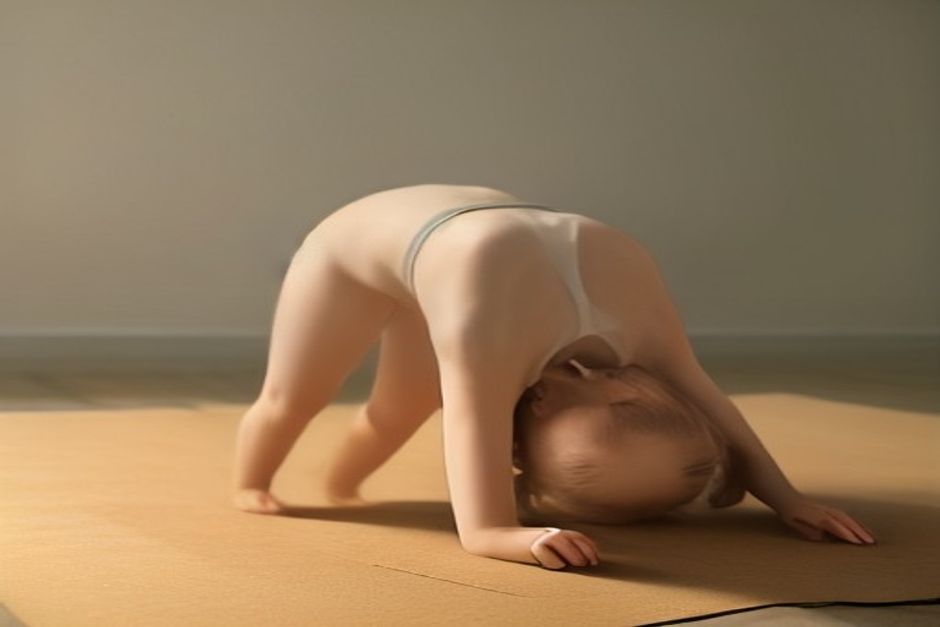
Some poses earn their reputation by being impressive. Extended puppy earns its by being useful. Uttana Shishosana — uttana (stretched out) plus shishu (puppy) — is named for exactly what it looks like: a puppy doing its morning stretch, chest dropped, hips high, tail in the air. It sits halfway between child's pose and downward dog, and it borrows the best of both: the heart-melting chest opening of one, the shoulder-and-spine lengthening of the other, and the wrist-and-hamstring demands of neither.
Teachers reach for it constantly as a transition, which undersells it. Held for a minute or two on its own, puppy pose is one of the most efficient antidotes there is to the desk posture — that forward-rounded, shoulders-creeping-to-ears shape that office work, driving, and phones all sculpt. It takes the thoracic spine and the shoulders in precisely the opposite direction, while the lower body does almost nothing at all.
How to do it
Extended puppy — Uttana Shishosana
How: Start on all fours in a tabletop: knees under hips, wrists under shoulders. Walk your hands forward one hand-length at a time, keeping the hips stacked directly above the knees — this is the part everyone rushes. As the hands travel, let the chest sink toward the floor and rest either the forehead or the chin on the mat, whichever your neck prefers. Press gently down through the palms, keep a slight lift in the elbows, and let the tailbone tip up. Breathe into the back of the ribs for five to ten breaths. To come out, walk the hands back under the shoulders and sit back into child's pose — there is no graceful exit, and that is fine.
Why: With the hips anchored over the knees, gravity does the opening for you. The chest and armpits lengthen, the thoracic spine extends, and the front of the shoulders — the exact tissues shortened by keyboards and steering wheels — get a slow, passive stretch. Because the arms are reaching forward rather than bearing the body's weight, wrists and shoulders carry a fraction of the load they take in downward dog.
Making it fit your body
Supported puppy
How: Slide a bolster, a firm cushion, or a folded blanket under the chest so the torso rests on it completely. Forehead still comes to the mat or to stacked hands. Stay for two to three minutes.
Why: Removing the effort of holding the chest up turns the pose fully restorative. This is the version for the end of the day, for anyone whose shoulders ache rather than stretch, and for people who find the active version too intense to breathe in. If you cannot breathe slowly in a stretch, the stretch is winning — prop it.
Puppy with a twist
How: From the full pose, walk both hands over to the right until you feel the stretch move into the left side of the ribs and the left armpit. Hold five breaths, then switch sides.
Why: The sideways reach turns a front-body opener into a side-body one, targeting the lats and the intercostals between the ribs — tissues that rarely get stretched by anything else in ordinary life. It is a close cousin of thread the needle and pairs well with it.
Puppy at the wall (half-forward fold version)
How: Stand facing a wall, an arm's length away. Place your palms on the wall at shoulder height and walk the feet back as you fold from the hips, until the torso is parallel to the floor — an L-shape. Let the chest release toward the ground between the arms.
Why: Same chest-and-shoulder opening, zero floor required. This is the office version, the hotel-room version, and the version for anyone who finds kneeling uncomfortable. It also shows clearly whether your hamstrings or your shoulders are the limiting factor — useful information for the rest of your asana practice.
The details that change everything
- Hips over knees, not behind them. If the hips drift back toward the heels, the pose becomes a lazy child's pose and the shoulders lose their stretch. Keep checking the stack.
- Hands actively press. A gentle press through the palms, with elbows hovering, keeps the shoulder blades sliding apart across the back instead of collapsing together. The pose should feel wide across the upper back, not pinched.
- The neck gets a vote. Forehead on the mat keeps the neck neutral; chin on the mat adds a throat stretch some people love and others hate. Neither is more advanced. Choose the one that lets your jaw unclench.
- Breathe into the back. The front of the ribcage is pinned by the floor, so each inhale has to go somewhere — let it expand the back and sides of the ribs. This is part of the stretch, not a side effect.
Where it belongs in a sequence
Puppy pose works almost anywhere: as a warm-up before deeper backbends like sphinx, as a shoulder reset between planks, as a stand-in for downward dog on tired-wrist days, or as a two-minute standalone break at the end of a work session. If you keep one pose in your pocket for "my shoulders feel like concrete," this is a strong candidate.