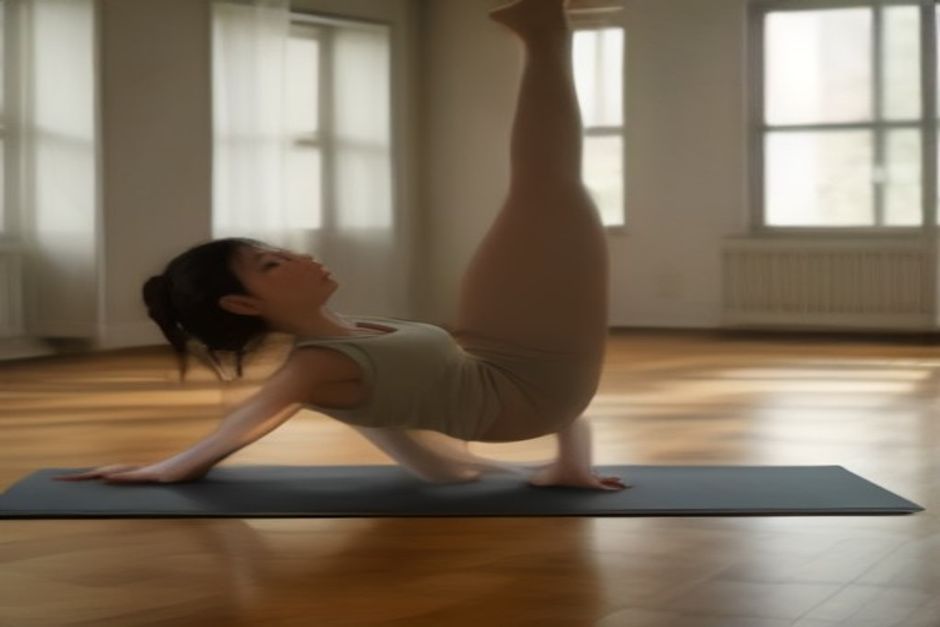
The side-plank family is a productive one. There's plain Side Plank, the dependable parent. There's Fallen Angel, the theatrical cousin who lies down mid-pose. And there's Fallen Star — Patita Tarasana, roughly "fallen star pose" — the one that looks like the practitioner tipped sideways, kept their balance anyway, and decided to make a shape about it. From Side Plank, the top leg lifts toward the ceiling and the top arm reaches, and suddenly the pose is a five-pointed star held up by one hand.
Like its relatives, the Sanskrit name is a modern attachment to a modern pose — no medieval text prescribes balancing on one hand while starfishing. That is fine. Plenty of good poses are younger than their teachers. What Fallen Star offers is a compact training effect: single-arm support, oblique endurance, hip abductor strength, and the particular confidence that comes from being briefly, deliberately precarious — the same skill Crow Pose teaches, minus the face-plant risk.
What the pose actually demands
Four things, in order of importance. First, a shoulder and wrist that can carry your weight on one straight arm. Second, obliques that keep the hips lifted while everything above them moves. Third, enough hip strength to lift the top leg without momentum — the gluteus medius does this, and it will let you know if it's been neglected. Fourth, balance, which matters least, because the pose is far more stable than it looks: your base (hand and foot) hasn't changed from Side Plank at all.
The progressions
Prerequisite: honest Side Plank — Vasisthasana
How: Before the star, the plank. Hold a full Side Plank for thirty seconds per side with the hips genuinely level — not sagging, not piked — and the supporting shoulder stacked over the wrist. If thirty seconds is a negotiation, that is today's practice, and Fallen Star is a future project.
Why: Every difficulty in Fallen Star is a Side Plank difficulty with a leg lifted. Owning the parent pose is not gatekeeping; it is the entire preparation.
Fallen Star, bottom knee down — the honest version
How: From a kneeling Side Plank (bottom knee and shin on the floor, top leg extended), place the supporting hand under the shoulder. Lift the hips, then lift the top leg to hip height — not higher. Reach the top arm up or overhead. Stay for three to five breaths. The bottom knee quietly carries much of the balance work, which is exactly the point.
Why: This version teaches the actual shape — the lifted leg, the open chest, the star silhouette — while removing the wobble tax. Most practitioners should live here for weeks. The pose is not better with the leg straight; it is just more photogenic.
Full Fallen Star — Patita Tarasana
How: Set up Side Plank with feet stacked or staggered. Root the supporting hand, press the floor away, and lift the top leg until it floats at hip height or above, toes active. Reach the top arm alongside the ear for the full star, or keep it on your hip for stability. The head turns to look up only if the neck is happy; looking at the floor is a legitimate star. Hold two to five breaths, lower the leg with control, and return to Side Plank before coming down.
Why: Lifting with control rather than kicking up keeps the load in the hip muscles where it belongs. The slow lower is half the training — gravity teaches the lift, you teach the landing.
Forearm Fallen Star — the wrist-friendly version
How: Same pose built on the forearm instead of the hand: forearm Side Plank, bottom knee down or legs stacked, top leg lifts. The forearm base is more stable but loads the shoulder differently — more lateral deltoid, less wrist.
Why: If wrists are the limiting factor, this version keeps the whole training effect while the wrist heals or strengthens. A pose that adapts to your body is working; a pose that requires your body to adapt to it is furniture assembly.
Shoulder stacking, in plain terms
"Stack your shoulders" is the cue everyone hears and nobody translates. Here is the translation: the supporting wrist, elbow, and shoulder should form one vertical line, and you should then press the floor away hard enough that the space between your shoulder blades stays broad rather than pinched. The chest rotates open toward the ceiling from the ribs, not from cranking the top shoulder back. If the supporting shoulder creeps toward your ear, you've lost the stack — lower everything, reset, and shorten the hold. Ten good seconds beat thirty collapsing ones, in this pose and most others.
Where it fits in practice
Fallen Star is a middle-of-practice pose: the body warm, the mind awake. It pairs naturally after Side Plank in a flow, and its natural neighbors are Wild Thing — the same family, opened into a backbend — and the rest of the side-body work in your sequence. Two or three holds per side is plenty. This is dessert, not dinner.
Fallen Star will never be a foundational pose, and it doesn't need to be. It's the small, joyful proof that your side plank has become so ordinary that you can lift half of yourself off it and smile. Root the hand, press the floor away, lift the leg like you mean it — and enjoy being briefly, deliberately, a star.