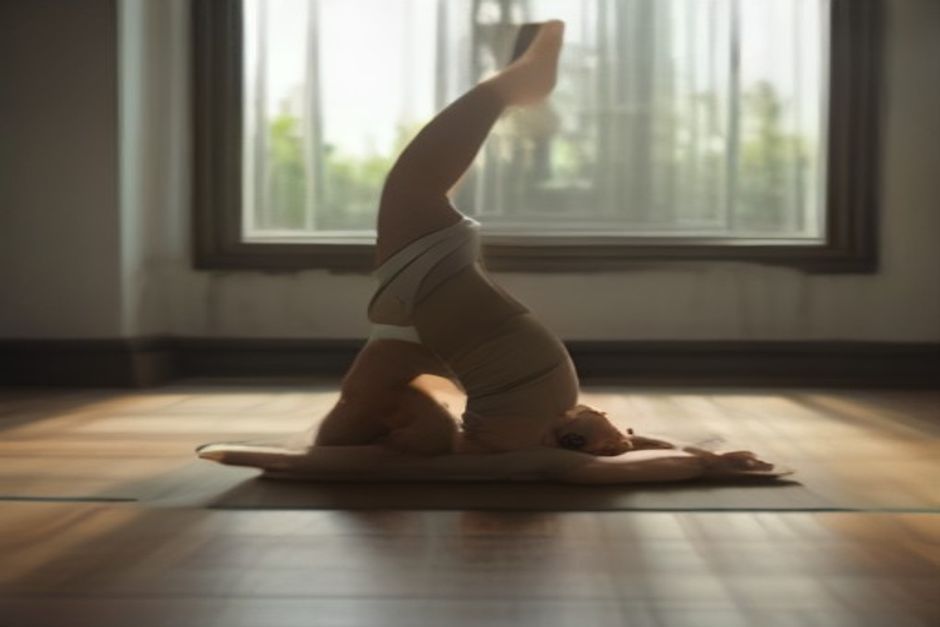
Every yoga family has a show-off cousin, and in the side-plank family that cousin is Fallen Angel. From the outside it looks impossible: the practitioner appears to have tipped over from Side Plank, caught their cheek on the mat, and then casually lifted a leg, as if the whole thing were an intentional nap. That is, in fact, almost exactly what it is. The Sanskrit name sometimes attached to it — Devaduuta Panna Asana, roughly "fallen angel pose" — is modern, like the pose itself. No ancient text prescribes balancing on your temple. It is a recent invention from the playful end of vinyasa practice, and there is nothing wrong with that. Plenty of good poses are younger than the average yoga teacher.
What makes Fallen Angel worth learning is not the photograph. It is the way the pose packages several trainable skills — one-arm support, side-body strength, hip control, and the oddly specific skill of trusting your face near the floor — into one compact shape. Each skill can be built separately. Here is how.
What the pose actually demands
Strip the pose down and it asks for four things. First, a wrist and shoulder that can carry real load on one arm, bent at the elbow this time rather than straight. Second, obliques strong enough to keep the hips from sagging while the torso rotates. Third, enough hip mobility to lift the bottom leg toward the ceiling without yanking the low back. Fourth — and this is the part nobody mentions — the willingness to rest the side of your face on the floor while your arms work. That last one is a nervous-system skill as much as a physical one. The body does not love putting its head down in the middle of effort, and learning to stay calm there is genuinely useful training, the same way Crow Pose teaches you to tip toward the floor without panicking.
Grounded Fallen Angel — the honest starting point
How: Start in a low side-lying shape on your left side: left forearm or left palm on the mat, elbow bent, both knees bent and stacked. Lean the left temple or cheekbone toward the mat — not the ear, and not the neck. Now lift the right (top) leg a few inches, knee still bent. Stay for three breaths. That is the whole pose at half stakes: face down, one arm loaded, one leg working.
Why: This version teaches the two unfamiliar demands — temple on the floor, bent-arm load — without asking for balance yet. If the bent-arm position strains the wrist or shoulder here, the full pose is not your pose this month, and now you know that for the price of a pillow-shaped pose instead of a face plant.
Fallen Angel from Side Plank — the classic entry
How: Set up a solid Side Plank on your left hand, feet stacked or staggered. Bend the left elbow and begin lowering your left temple toward the floor, slowly, as if you were melting sideways. As the cheekbone lands lightly on the mat, keep the hips lifted — the obliques now do what the straight arm was doing. Then lift the bottom (left) leg toward the ceiling, toes pointing or flexed, whatever keeps the hips square. Hold for two or three breaths. To exit, lower the lifted leg, press back through the palm, and return to Side Plank or simply roll down and lie there, which is a legitimate exit and part of the pose's charm.
Why: Entering from a plank you already own means the only new variables are the bent elbow and the head position. One new thing at a time is how poses get learned instead of survived.
Fallen Angel with both knees down — the balance-free version
How: Same entry, but keep the bottom knee and shin on the floor the whole time. Temple rests down, top leg lifts or extends along the mat, top arm can reach overhead for the full silhouette or stay on the hip for stability.
Why: Removing the balance demand lets you feel the actual shape — the loaded shoulder, the open side body, the light contact of the face — without the wobble tax. Most people should live here for several weeks. The pose is not better with the leg up; it is just more photogenic.
The wrist and shoulder question
The supporting arm in Fallen Angel is bent, and the elbow sits under or slightly ahead of the shoulder with the forearm pressing the floor. That is a different demand than straight-arm poses like plank or Upward Dog, and it deserves its own warm-up. A few minutes of wrist circles, gentle forearm planks, and slow Side Plank holds on both sides will tell you everything you need to know about today's readiness. If the straight-arm Side Plank is not yet steady for thirty seconds, Fallen Angel is a future project, and that is fine — the pose will still exist next season.
One more honest point: the head contact should be genuinely light. Think "resting your cheek on a pillow," not "parking your skull on a parking block." The neck stays long, the temple touches down because the torso brought it there, and the arms and core carry essentially all of the load. If you feel weight grinding into the side of your face or any pressure in the neck, you have lowered too far or collapsed the supporting arm. Come out, reset higher, and keep the head hovering an inch above the mat if that is where your strength currently ends. Hovering counts.
Fallen Angel will never be a foundational pose, and it does not need to be. It is dessert: a small, theatrical reward for a side-plank practice done patiently. Learn it the slow way, keep the face light, and enjoy the rare experience of a pose that lets you lie down in the middle of it.