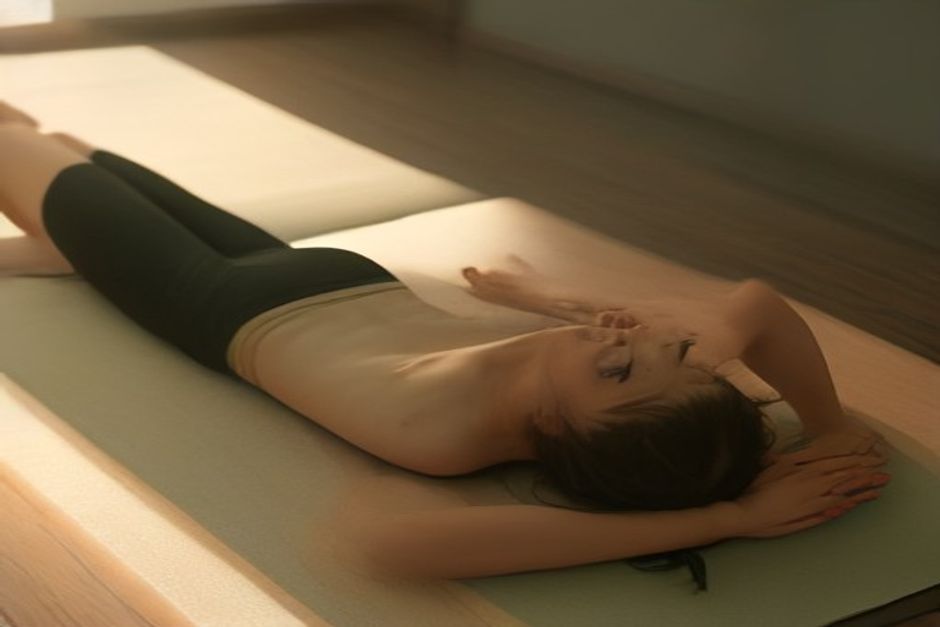
Pigeon pose has a devoted following and a long list of casualties. Done well, it is a superb hip opener; done with tight hips or sensitive knees, it is a slow-motion argument with your meniscus. The supine figure-four stretch delivers most of what pigeon promises — a deep opening of the outer hip and glute — while lying safely on your back, where the knee is bent, supported, and impossible to twist. If your knees have ever objected to pigeon, this is the pose you were looking for.
What it stretches, briefly
The crossed leg is the one being stretched: the target is the outer hip — the gluteus medius and minimus, the deep rotators including the piriformis — the same neighborhood pigeon reaches. Because you control the intensity with your hands (or a strap, or a wall), the dose is adjustable millimeter by millimeter, which is precisely what pigeon is not. For the anatomy underneath, our hip anatomy page has the plain-language tour.
Basic Figure-Four — Sucirandhrasana, more or less
How: Lie on your back, knees bent, feet on the floor. Cross your right ankle over your left thigh, just above the knee — the legs now make a shape like the number four. Keep the right knee gently pressing away from you. Lift the left foot off the floor and thread your hands behind the left thigh (not the shin, and never pulling on the knee itself). Draw the left thigh toward your chest until you feel a clear stretch in the right outer hip. Flex both feet to protect the knees. Keep the back of your head resting on the mat; if your chin is jutting toward the ceiling, put a folded blanket under your head.
Why: Pulling the bottom thigh in rotates the top hip outward under control — the exact mechanism of pigeon, minus the body weight grinding through the knee. Lying down also keeps the pelvis honest: it cannot hike or twist to cheat the stretch the way it does on all fours.
Strap Version — for hands that do not reach
How: Same setup, but loop a yoga strap or belt around the back of the bottom thigh and hold both ends. This fixes the most common form collapse: hunching the shoulders and rounding the spine to reach the leg. With a strap, the shoulders stay on the mat and the neck stays long.
Why: A stretch you have to crunch your neck to reach costs more than it pays. The strap is not a beginner concession; it is how you keep the pose clean for long holds.
Wall Version — the zero-effort option
How: Lie with your sitting bones near a wall, left foot planted on the wall with the knee bent, right ankle crossed over the left thigh. Now slide the left foot slowly down the wall to deepen the stretch, or up to soften it. Hands do nothing at all.
Why: The wall holds the bottom leg so your arms and core can fully switch off. This is the version for rest days, for evening wind-downs, and for anyone whose hip flexors or lower back complain about holding the thigh up. It pairs naturally with legs up the wall in a restorative sequence.
How long to hold
Thirty seconds is a warm-up; sixty to ninety seconds per side is where the tissue actually responds; two to three minutes is the yin-style dose for rest days. Whatever the length, do both sides — hips are rarely symmetrical, and the tighter side is the one doing the talking. On the very tight side, back off ten percent and add time instead of intensity.
Common mistakes
- Pulling on the knee. Hands go behind the thigh. Pressure on the knee joint itself — especially sideways pressure — is how a kind stretch becomes a knee problem. The whole point of this pose is knee safety; do not reintroduce the hazard.
- Soft, sickled foot. A relaxed, flopped foot on the crossed leg twists the knee slightly. Flex both feet; it locks the ankle and knee into a safe line.
- Holding the breath. If you cannot breathe slowly, the stretch is too deep. The exhale is what lets the outer hip release; breathing hard against the stretch just rehearses tension.
- Bouncing. Never, in this or any stretch. Slow in, slow out, still in the middle.
Who should be careful: anyone with a diagnosed hip impingement, labral issue, or recent hip or knee surgery should clear this stretch with a physiotherapist first — it loads the hip in deep flexion plus rotation. Sharp pain in the front of the hip (a pinch, not a stretch) or any pain inside the knee is a stop sign, not a sensation to breathe through. During pregnancy, skip deep versions and take pressure off the belly side; a prenatal teacher can show you the adapted setup.
Supine figure-four will not win any flexibility contests on social media. It will quietly open your outer hips for years without a single knee complaint — which, for a stretch, is about the highest praise available. When you are ready for more load in the same family, thread the needle is the all-fours cousin, and pigeon itself is there waiting, with its full safety briefing, whenever your hips and knees both agree it is time.