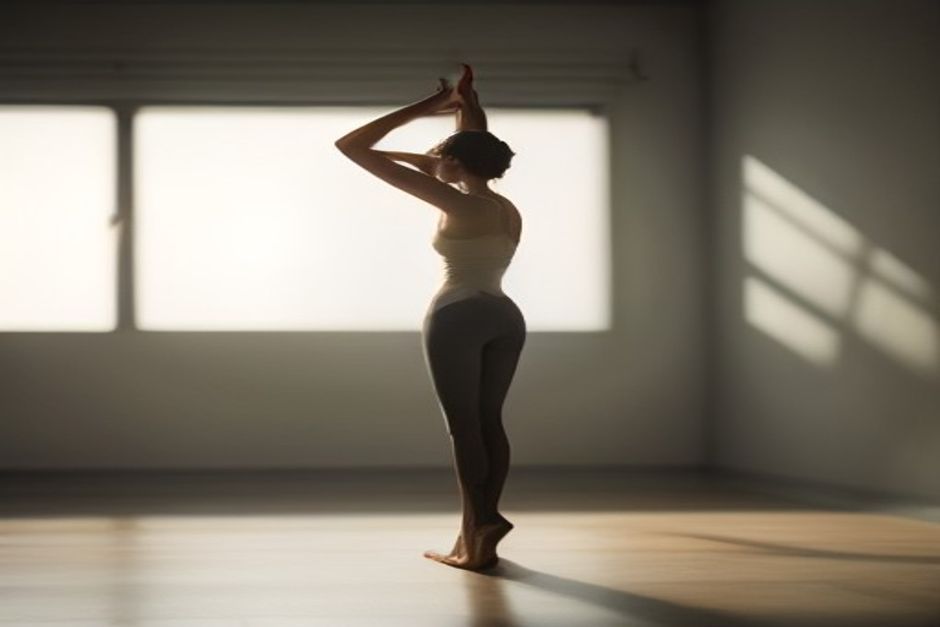
Standing pigeon — sometimes called standing figure-four, sometimes Eka Pada Utkatasana, "one-legged chair pose" — is what happens when pigeon pose gets tired of the floor and stands up. You cross one ankle over the opposite thigh, sit your hips back, and hold. The outer hip and glute of the crossed leg get the same deep stretch pigeon's front leg gets. The standing leg, meanwhile, gets a quiet strength lesson, and your balance system gets honest feedback it cannot argue with.
It is one of the most useful poses for people who live in chairs: no getting up and down off the floor, no props to arrange, doable in a hallway in work clothes. It is also a pose where ambition shows immediately — wobble is data, not failure.
What is actually stretching (and what is balancing)
Two jobs run in parallel. The crossed leg: the outer hip — gluteus medius and the deep rotators — lengthens as the hip flexes and externally rotates. The standing leg: glutes and the small muscles around the ankle work constantly to keep you upright. If you feel nothing in the crossed hip, you are probably too upright. If you feel strain in the crossed knee, the hip is not doing the rotation and the knee is paying the difference — the same rule as floor pigeon, stated once and taken seriously: sensation in the knee means back out. Hip stretch is a dull, broad pull in the buttock. Knee stretch is sharp, local, and wrong.
Standing figure-four, basic — Eka Pada Utkatasana
How: Stand tall with your feet hip-width apart, near a wall if you like. Shift your weight into your left foot and soften that knee slightly — not locked. Lift your right foot and cross the right ankle over the left thigh, just above the knee, flexing the right foot so the toes pull back toward the shin. Sit your hips back as if lowering onto a stool behind you. Hands can stay at the hips, come together at the chest, or hold the wall. Keep your chest lifted rather than rounding forward. Hold for five to ten breaths, then switch sides.
Why: Sitting the hips back is what loads the outer hip of the crossed leg. The flexed foot stabilizes the ankle and protects the knee by keeping the lower leg from twisting.
Wall-supported version
How: Stand with your back a hand's width from a wall. Set up the figure-four as above, then let your hips lean back until they touch the wall. You can also face the wall and rest both palms on it at shoulder height, which takes most of the balance demand away while keeping the full stretch.
Why: Balance is a skill you can train separately. The wall lets you work the hip opening without the wobble tax — useful on tired days, or when you are new and want to learn the shape first.
Forward-folding figure-four
How: From the basic pose, hinge forward from the hips and rest your forearms on the crossed shin, or reach your hands toward the floor if they arrive there without a struggle. Keep the standing knee bent and the spine long rather than rounded.
Why: Folding deepens the stretch in the crossed hip and adds the standing leg's hamstring. It is also harder to balance — earn it with the upright version first.
The balance piece, trained on purpose
Wobbling in this pose is not your body failing; it is your balance system working. Balance runs on three inputs — inner ear, eyes, and the sensors in your foot and ankle — and this pose narrows all three at once. To train it deliberately:
- Fix your gaze. Pick one unmoving spot on the floor a few feet ahead. A drifting gaze is the most common cause of a drifting pose.
- Press through the tripod of the standing foot — the base of the big toe, the base of the little toe, and the heel. Grip less with the toes than you think you need to.
- Breathe normally. Held breath is usually the first sign you are muscling the pose instead of balancing in it.
- Let yourself fall out. Stepping down and re-entering is better practice than a desperate windmill save. The pose tree pose teaches the same lesson with less hip stretch.
Where it fits in a practice
Standing pigeon works well after standing poses like warrior III or half moon, when the legs are warm and the balance system is awake. It also stands alone as a two-minute break from sitting: one side, the other side, done. If balance work interests you as a skill in itself, the pose library has a full standing-balance family to explore.
The deeper point of standing pigeon is the same as the floor version's, delivered faster: hips open with patience and positioning, not force. The wobble is just there to keep you honest.