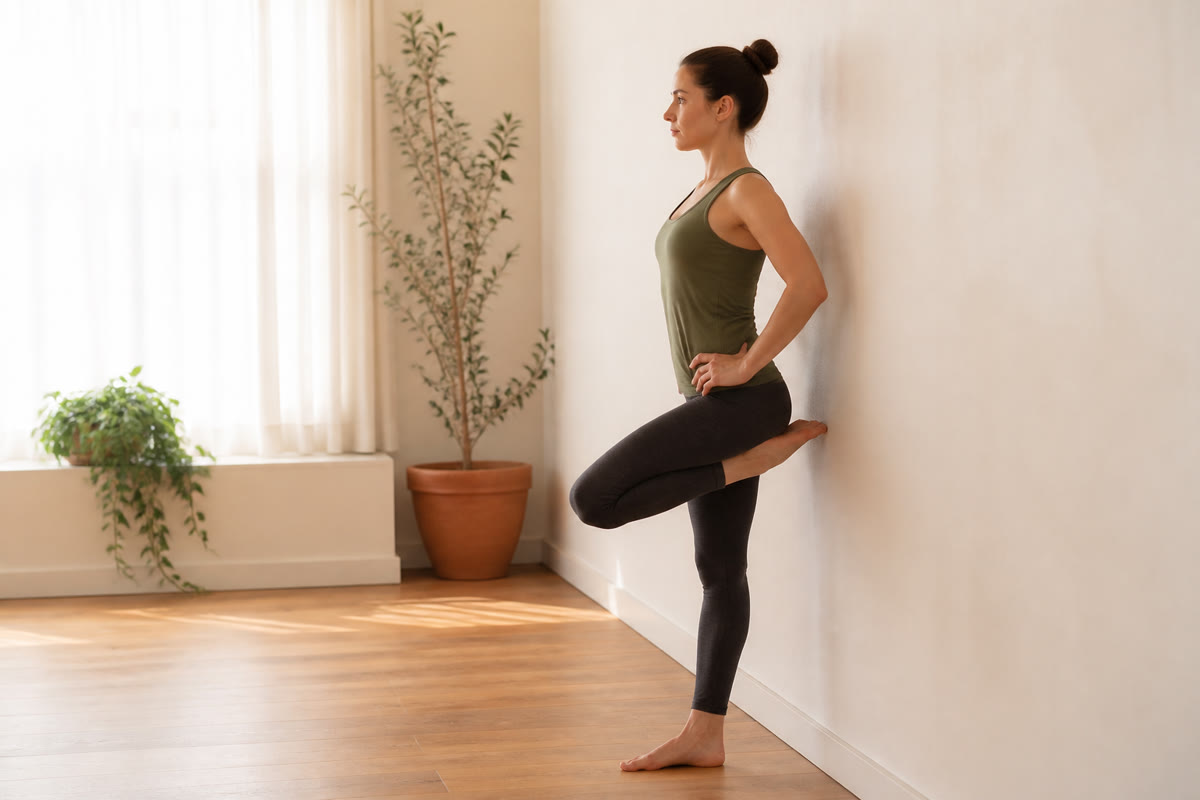
Classic pigeon pose is a wonderful stretch wrapped in a logistical problem. Getting to the floor is its own project, the front knee carries real load, and anyone with cranky knees, a stiff back, or an office chair for a spine has good reasons to hesitate. Half pigeon at the wall keeps the part that matters — the deep opening in the outer hip and glute — and removes almost everything that causes trouble.
The shape is a standing figure four: one shin rests against the wall while you hinge gently forward. Gravity helps instead of fights you, the front knee is bent and supported along its whole length, and you control the intensity with how far you fold rather than how much of your body weight lands on a joint.
The basic setup
Half pigeon at the wall — standing figure four
How: Stand facing a wall, about an arm's length away. Place your hands on the wall at shoulder height. Lift your right foot and cross the right ankle over the left thigh, just above the knee — your shin ends up roughly parallel to the floor, knee pointing out to the side. Flex the right foot firmly; this is not decoration, it protects the knee. Bend the standing leg slightly and start to sit your hips back, as if aiming for a chair that is a little too far away. Stop where you feel a clear stretch in the right outer hip and glute. Stay for 5 to 10 slow breaths, then switch sides.
Why: Crossing ankle over thigh puts the hip in external rotation and flexion — the same position as pigeon's front leg — but standing, your body weight never rests on the knee. The wall carries your balance, so the hip can actually let go instead of bracing.
Three ways to adjust it
Deeper: hinge lower
How: Keep the setup, then bend the standing knee more and let your hips sink lower, walking your hands down the wall if that helps. Keep a long spine rather than rounding to get lower — depth comes from the hip crease, not the low back.
Why: Lowering the hips increases the angle of hip flexion, which moves the stretch deeper into the glutes and piriformis. Doing it with a long spine keeps the low back out of the equation.
Gentler: stay tall
How: Cross the ankle, flex the foot, and bend the standing knee only a few centimeters. Keep the torso nearly upright and breathe into the mild stretch.
Why: Hip opening is dose-dependent, and a small consistent dose beats an occasional heroic one. This version works as a mid-day break even in work clothes, no mat required.
Chair-supported version
How: If standing balance is the limiting factor, do the same shape seated: sit tall near the front of a sturdy chair, cross ankle over thigh, and hinge forward from the hips with a flat back. Hands can rest on the lifted shin.
Why: Seated removes balance entirely, which matters for anyone whose ankles or vestibular system get a vote. Same stretch, lower stakes.
Common mistakes
- Unflexed top foot. A limp ankle lets the knee take rotational load it was never designed for. Flex the foot hard enough that you could balance a coin on it.
- Rounding the spine to "go deeper." Folding from the waist stretches the low back, not the hip, and mostly tells your hamstrings a lie. Hinge from the hip crease instead; our hip anatomy page explains the difference in detail.
- Locking the standing knee. Keep a soft bend. A locked knee steals stability from the hip you are trying to open.
- Holding the breath. If you cannot breathe slowly, the dose is too high. Back off until the exhale is easy.
Who this pose is for
Almost everyone, honestly. It suits people who sit a lot (the tight-hips-from-sitting crowd), runners and cyclists whose outer hips do quiet overtime, and anyone whose knees object to floor pigeon but whose hips still want the stretch. It also works as a warm-up before deeper hip openers or as a standalone two-minute practice on days when a full session is not happening.
Where it fits in a practice
Use it after standing poses when the legs are warm, or on its own against the nearest wall when your hips have spent eight hours in a chair. It pairs naturally with child's pose afterward if you are on a mat, and with nothing at all if you are not. Two minutes per side is a complete practice on a busy day — the wall does not judge.