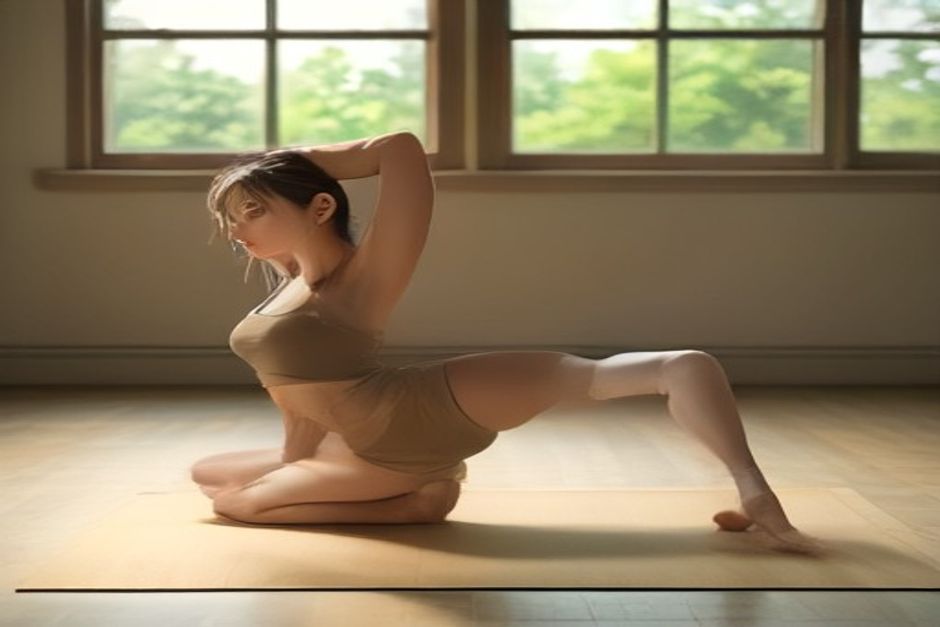
Most hamstring stretches let you cheat. In a standing forward fold, you can round your spine and call it depth. In a seated fold, you can crane your neck toward your shins and feel accomplished. Half splits — ardha hanumanasana, "half monkey-god pose" — takes the cheat away. Your back knee is down, your front leg is straight, and the only way forward is to hinge at the hips. If your spine rounds, you feel it immediately. The pose is a measuring stick, not a performance.
It's named as the halfway point toward full splits (hanumanasana), after Hanuman's legendary leap. Treat the leap as mythology and the hinge as anatomy, and you'll get along fine with this pose.
How to do half splits
From low lunge — the standard entry
How: Start in a low lunge with your right foot forward, hands on the floor or on blocks either side of the front foot. On an exhale, shift your hips back until your front leg straightens and your back knee settles under your hip. Flex the front foot, toes toward your face. Your hips stay stacked over the back knee — not drifting behind it.
Why: Entering from a lunge sets the hips square before the stretch begins. Most people skip this alignment and spend the whole pose twisted.
The hinge — where the pose happens
How: With the front leg straight and the foot flexed, inhale to lengthen your spine forward, as if someone is gently pulling your sternum ahead of you. On the exhale, tip your pelvis forward — a hinge at the hip crease, not a curl of the lower back — and walk your hands down only as far as the spine stays long. Hands on blocks is not a demotion; it's correct positioning for most bodies.
Why: The hamstrings attach at the sit bones. Tipping the pelvis forward moves the attachment point away from the back of the knee — that's the stretch. Rounding the spine just moves your face closer to the floor while the hamstrings barely notice.
Half splits, supported — for tight or tender days
How: Place a folded blanket under the back knee and blocks under both hands at their highest setting. Keep a micro-bend in the front knee. Rather than folding, simply lengthen forward and breathe into the back of the front leg for eight to ten breaths.
Why: Sensation in the back of the thigh is the stretch working; sharpness behind the knee or at the sit bone is not. The supported version lets you stay long enough for the tissue to actually respond.
Common mistakes
- Rounding the back to reach the floor. The floor doesn't matter. The hinge matters. If your spine curls, back off and raise your hands.
- Pushing the hips behind the back knee. It feels like more stretch, but it torques the back knee and unsquares the pelvis. Keep hips stacked over the back knee.
- Locking the front knee hard. If your knees hyperextend, keep a soft micro-bend and press the heel down rather than slamming the knee back.
- Holding the breath. Standard yoga behavior under effort — and the reason nothing releases. Slow, even breathing, like equal breathing, is half the stretch.
Why runners and cyclists swear by it
Running and cycling shorten the hamstrings' resting length without ever asking them to work long. Half splits loads them in a lengthened position while keeping the pelvis honest — which is precisely what yoga for runners is supposed to do. It's also diagnostic: if one side is dramatically tighter, you've found useful information about your stride or your saddle time. For the full picture of what's back there, see hamstring anatomy.
Where it fits in a sequence
Half splits works best warm. Put it after a few rounds of sun salutations or after low lunge and pyramid pose have already visited the hamstrings. Flow between lunge and half splits — forward on the inhale, back on the exhale, six or eight times — and you've built a small, effective hamstring session on its own. Follow with a pigeon or a gentle twist, and both hips will thank you.
"Half splits doesn't care how flexible you look. It only reports how your hinge is doing. That's why it's worth practicing."
The pose will not turn you into someone who does full splits. That's not its job. Its job is to give you an honest thirty seconds with the back of your leg — and over months, honestly practiced, that's the stretch that actually changes. Browse the full pose library for what to pair it with.