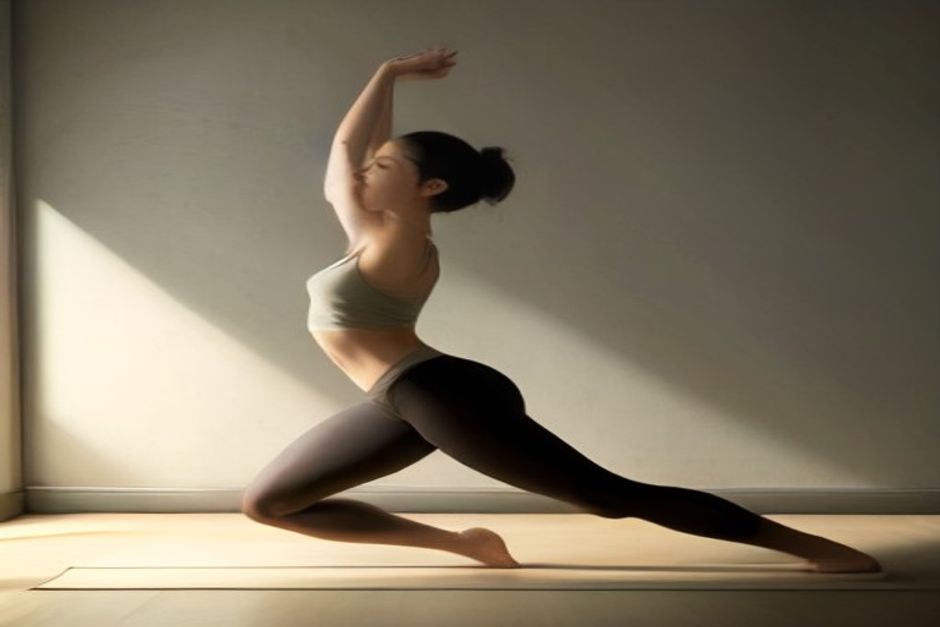
High Lunge has no ancient Sanskrit name of its own — it is sometimes called Ashwa Sanchalanasana (equestrian pose) in modern sequences, sometimes just "lunge." That lack of pedigree is fitting: it is a practical, modern workhorse of a pose. No mysticism, no decoration. Just a long stance, a bent front knee, a lifted back heel, and the immediate discovery of muscles you forgot you owned.
It is the raised-heel sibling of Low Lunge and the launching pad for half the transitions in a flow class. If you are new to standing work, glance at the basics first, then come back.
Step by step
High Lunge
How: From a push-up position or hands and knees, step the right foot forward between the hands. Keep the back knee lifted and press strongly through the ball of the back foot, heel reaching toward the wall behind you. Bend the front knee toward 90 degrees, tracking it over the second and third toes. Level the pelvis — tailbone gently tucked, low belly engaged — then sweep the arms overhead. Shoulders slide away from the ears. Gaze forward. Stay 5–8 breaths, then switch sides.
Why: The front leg builds quadriceps and glute strength under load; the back leg works isometrically from calf to glute; the lifted heel demands ankle stability; the arms overhead add postural work for the upper back. It is a full lower-body strength session disguised as a yoga pose.
The back heel is the engine
The most common way to coast in High Lunge is to let the back heel sag and the back leg go soft. The pose instantly becomes a lean on the front leg. The fix: press the back heel back like you are pushing a wall away, and firm the back thigh until the kneecap lifts. Suddenly the pose is twice as hard and twice as useful. That is the correct trade.
Stance length matters too. Too short and the front knee jams past the ankle; too long and the hips cannot level. The sweet spot: front knee stacked over the ankle with the thigh roughly parallel to the floor, back leg fully extended behind you.
Hips and torso: the quiet battle
Your pelvis will want to tip forward and your ribs to flare as the arms go up — the body borrowing range from the lower back because the hip flexors declined to provide it. The cues are the same as in Warrior I: soften the front ribs down, draw the navel gently in, and let the arms rise without taking the spine with them. If the arms overhead wreck your alignment, keep the hands on the hips. The legs are the point; the arms are optional garnish.
Balance is supposed to be wobbly
High Lunge is a narrow-base balance pose, and wobbling is not a bug — it is the stabilizer muscles of the feet and ankles clocking in for work. Two legitimate aids: widen the stance slightly toward the edges of the mat (railroad tracks, not a tightrope), or fix your gaze on one unmoving point. Both are technique, not cheating.
Transitions: where it earns its keep
High Lunge is the hub of standing sequences. From it you can step back to Plank, pivot into Warrior III, open to Warrior II, or drop the back knee into Low Lunge. Practicing these shifts slowly — inhale to rise, exhale to pivot — builds more usable strength than holding any single shape for a minute. Try this ladder: High Lunge → Warrior III → step back to High Lunge → Warrior II → back to High Lunge. One breath per move, three rounds each side.
Who should be careful: Knee injuries: shorten the stance and reduce the bend, or use Low Lunge with padding. Balance or vertigo issues: practice near a wall or with fingertips on a chair. High blood pressure or dizziness: rise into and out of the pose slowly. Hip or ankle injuries: keep the depth shallow. Pain in a joint — as opposed to effort in a muscle — is a stop sign.
High Lunge will never be anyone's favorite pose. It has no drama, no exotic name, no photogenic twist. It just builds the legs that carry you through everything else — the yoga equivalent of vegetables.