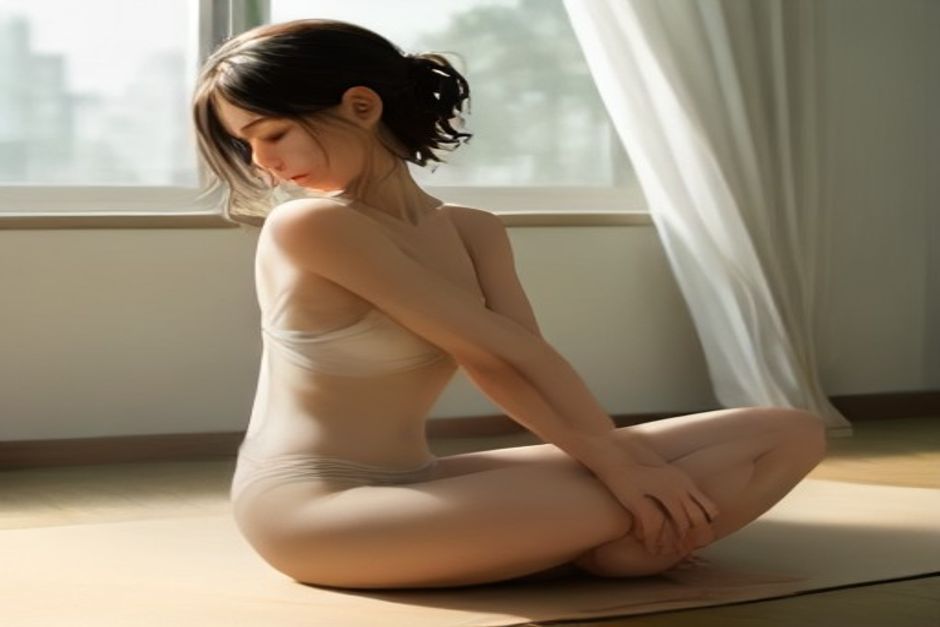
Ardha Matsyendrasana — half lord of the fishes pose, named for a sage the tradition credits with inventing yoga after eavesdropping on Shiva — is the seated twist most people meet first. It's also one of the most commonly muscled-through poses in the repertoire: the elbow hooks the knee, the arm heaves, and the twist happens to the shoulders rather than in the spine. The result looks rotated and changes little. The real pose works differently: the legs create a stable base, the spine grows tall, and the rotation arrives from the rib cage — with the arm as a gentle reminder, not a winch.
Setting up the base
Sit with both legs extended, then bend the right knee and step the right foot to the outside of the left thigh. The left leg either stays long or folds underneath you so the heel comes toward the right hip — the folded version is the classic shape, but it asks a lot of the left knee and hip, and it is optional. Sit tall. If the lower back rounds when you sit on the floor — and for most desk-trained adults it will — sit on a folded blanket or two until the pelvis can tip forward and the spine can stack. This is not cheating; it's what allows the twist to happen in the spine at all.
Half Lord of the Fishes — Ardha Matsyendrasana
How: With the right foot outside the left thigh, inhale and lengthen through the crown of the head. Exhale and begin turning the chest toward the right knee — led by the ribs, not the shoulders. Bring the left upper arm to the outside of the right thigh, or simply hug the knee with both arms. The right hand plants behind you like a second spine: lightly, for balance, not to crank with. With each inhale, find a little more height; with each exhale, let the rotation deepen a degree or two if it arrives on its own. Five to eight breaths, unwind slowly, switch sides.
Why: Twisting a compressed spine just grinds the discs' neighbors; twisting a lengthened spine is the movement the vertebrae are actually built for. The breath-based rhythm — grow tall, then turn — is what keeps the twist in the mobile thoracic spine instead of the lower back, which barely twists by design (see spine anatomy for the numbers).
Chair twist
How: Sit sideways on a sturdy chair, both feet flat. Hold the chair back with both hands and rotate the chest toward it, growing tall on the inhale and turning on the exhale. Same rules: ribs lead, hands assist politely.
Why: The chair removes the hip and knee puzzles entirely, which makes it the honest choice for anyone with knee trouble, hip replacements, or a floor they don't love getting up from. It is also the version you can do fully dressed, at work, in thirty seconds — our desk yoga piece builds a whole break around it.
The arms are not the engine
The classic mistake deserves its own paragraph because nearly everyone makes it: hooking the elbow outside the knee and levering hard. The elbow-knee bind is a fine finishing detail for an open body, but as a mechanism it produces shoulder strain and a false twist — the chest appears rotated while the spine beneath it has barely moved. A better test: can you hold the twist with the front hand resting gently on the knee and the breath still free? If the twist collapses without the arm's leverage, the arm was doing the spine's job. Use the arm for feedback — a soft pressure to lengthen against — and let the obliques do the rotating.
Details that matter
- Both sit bones stay honest. If one hip lifts dramatically to accommodate the crossed foot, straighten the bottom leg or raise your seat. A level pelvis is worth more than a photogenic leg arrangement.
- The back hand is a kickstand. Fingertips light. If it's bearing weight, you're leaning, not twisting.
- Keep the neck last. The head turns at the end of the rotation, only as far as is comfortable. Cranking the neck to "complete" the twist just borrows range from the one place that already has plenty.
- Both sides, even when one is dull. Most bodies have an easy side and a stubborn side. The stubborn one is the point.
Where it fits
Seated twists belong in the middle-to-late part of a practice, once the spine is warm — after standing poses, before deep forward folds or savasana. They pair naturally with seated forward folds as a counter-movement and with reclined twists as a gentler follow-up at the end of a session. On their own, one slow twist per side is the single best antidote to a long afternoon in a chair.
Done honestly, Ardha Matsyendrasana is a modest pose with an immodest effect: stand up afterward and the spine feels rinsed, the shoulders lower, the breath deeper. That feeling — not the elbow bind, not the photo — is what the sage was after.