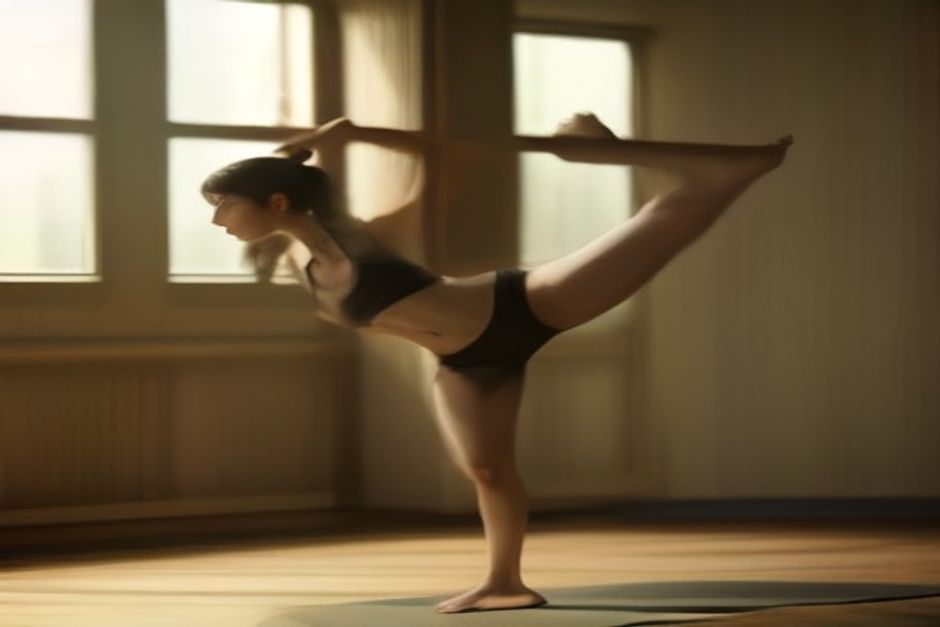
Standing splits — Urdhva Prasarita Eka Padasana, "upward-expanded one-foot pose" — looks like a party trick. One leg points at the ceiling, the head hangs somewhere near the standing shin, and Instagram applauds. Here is the honest version: the lifted leg is mostly along for the ride. The pose is won or lost in the standing leg's hamstring and in your willingness to keep your hands on the floor (or blocks) instead of chasing height. A standing split with the lifted leg at forty-five degrees, hands grounded, and breath steady is the real pose. The vertical version is decoration.
What the pose actually asks for
Strip the drama away and standing splits is a one-legged forward fold. The demands, in order of importance:
- Standing hamstring length. This is the gatekeeper. If your standing forward bend only happens with bent knees, the split version will be a bent-knee pose too — which is completely fine, but worth knowing before you chase the leg skyward.
- Standing-leg balance. All of your weight is on one leg while your head is below your heart. That combination is the actual challenge for most people — not flexibility.
- Hip flexor and quad openness in the lifted leg. A small ask. The lifted leg doesn't need to go high for the pose to count.
- Hamstring comfort in the lifted leg. Yes, that too — but if the hips stay even moderately closed, the lifted hamstring barely stretches. Which is another way of saying: stop worrying about the lifted leg.
If your hamstrings are the limiting factor — and for most adults who sit for a living, they are — spend a few weeks with half splits and a strap, and read up on how hamstrings actually respond to stretching. The short version: slow, frequent, unforced work beats heroic weekend sessions every time.
The build-up
Step 1: Forward fold with a leg lift — the honest starting point
How: From a standing forward fold, place your fingertips on the floor (bend your knees as much as needed to get them there). Shift your weight into your right foot and lift the left leg just until it's parallel to the floor — hip height, no higher. Keep the standing knee soft. Hold for three to five breaths, switch sides.
Why: This is the pose, minus the vanity. You get the one-legged balance, the standing-hamstring stretch, and the head-below-heart effect, without requiring anything your body doesn't already have.
Step 2: Hands on blocks — the game changer
How: Set two blocks at their tallest height under your shoulders. From the hip-height version above, press your hands into the blocks and let the standing leg straighten a little more. The blocks bring the floor up to you, so the stretch deepens without you collapsing into the standing hip or rounding the spine into a question mark.
Why: Blocks let you find length before you have the raw flexibility for the floor. They also give your arms something to push against, which stabilizes the balance enormously. This is not a cheat; it's how the pose is built.
Step 3: The leg floats higher — emphasis on "floats"
How: From the block version, keep the standing leg exactly as it is and simply let the lifted leg rise as high as it goes without your hips twisting open. The lifted hip wants to roll toward the ceiling — resist that. Both hip bones face the floor, or as close as your body allows. Five breaths, then come out slowly: bend the standing knee, lower the lifted foot, fold, and roll up.
Why: Keeping the hips square is what makes this a hamstring pose rather than a hip-opening pose. Squared hips also keep the standing sacroiliac joint quieter. If the lifted leg barely rises past horizontal, that is correct practice, not failure.
Step 4: Full standing splits — for the day it happens by itself
How: One day the hands will reach the floor, the standing leg will straighten, and the lifted leg will float up without effort. Walk your hands back toward the standing foot if that's available, wrap an arm behind the standing calf if that's available. None of it is required. Exit the same way: bend, lower, fold, breathe.
Why: The full pose is a side effect of patience, not a goal to force. If it never arrives, steps one through three are a complete practice on their own.
Where this fits in a practice
Standing splits belongs after the body is warm — following sun salutations or standing poses like warrior III, which rehearses almost the same balance with less fold. It pairs naturally with pyramid pose as a hamstring-focused standing pair. Don't open a cold practice with it; cold hamstrings plus balance demands plus a hard floor is a recipe for the kind of morning you'll remember for a week.