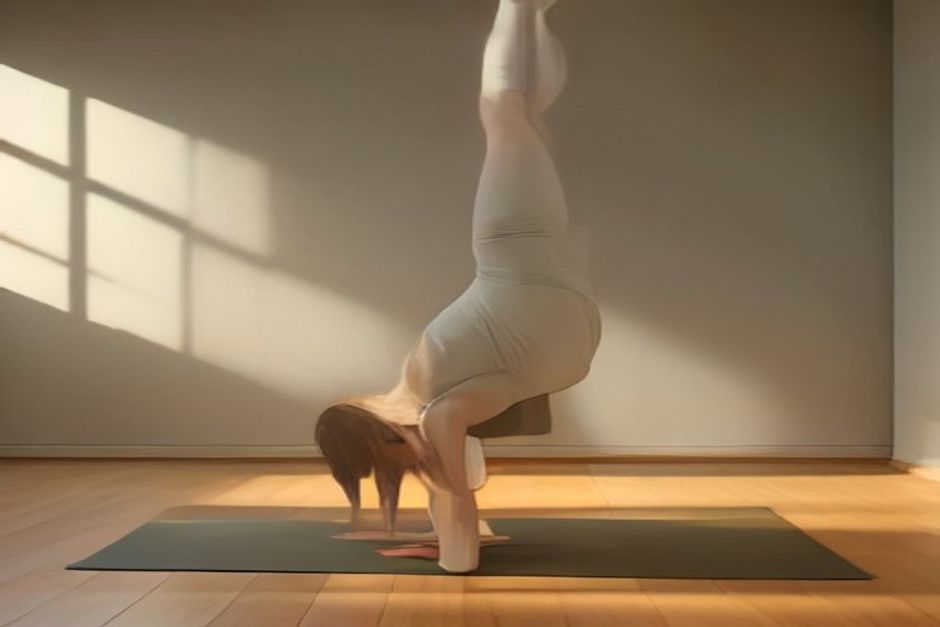
Urdhva Prasarita Eka Padasana — upward stretched one-foot pose, which is Sanskrit's way of saying "standing splits" with appropriate ceremony — looks like a party trick and behaves like an exam. The exam subject is not how high your leg goes. It is whether your standing hamstring, your balance, and your ego can all stay in the room at the same time. Most practitioners discover that two of the three cooperate on any given day, and that is enough to practice with.
Before anything else: this pose is a deep forward fold on one leg. If your Standing Forward Bend is still a negotiation, spend time there first, and consider the gradual build-up on our standing splits prep page. The full pose will wait. It is very patient.
What the pose actually asks
- Standing leg: a strong, slightly soft knee and a hamstring willing to be loaded while stretched — the real work of the pose.
- Lifted leg: mostly along for the ride. Height is a side effect of hip flexion, not the goal.
- Hips: roughly square to the floor. This is where honesty gets graded.
- Balance: ankles, eyes, and breath doing quiet teamwork while everything else demands attention.
Entering from a forward fold — the basic version
How: From Uttanasana, bring your fingertips to the floor or to blocks, shoulder-width apart. Shift your weight into your right foot until the left foot is clearly light. Keep the right knee soft — bent a few degrees, not locked. On an exhale, slide the left leg back and up, toes reaching away, hips staying as level as they will. Breathe five slow breaths. Lower the left foot on an exhale, pause in the fold, then do the other side.
Why: Entering from the fold loads the standing hamstring gradually instead of kicking into it cold. The soft knee is not a flaw; it is how you keep the stretch in the muscle belly and out of the back of the knee joint.
Hands on blocks — the version most people should use
How: Place two blocks at their tallest height under your shoulders before you lift the leg. Arms straight, spine long, and let the lifted leg rise only as high as it goes with the chest still open. If your head is below your hips and your neck is straining, the floor is too far away — that is what blocks are for.
Why: Blocks turn the pose from a dangling balance scramble into a supported fold with a leg that happens to be up. You get the same hamstring work with a fraction of the neck and lower-back static.
Wall balance drill — for the wobbly
How: Stand facing away from a wall, about a leg's length out. Fold, place your hands down, and lift one leg until the sole of that foot presses into the wall behind you. Press gently into the wall and notice how much steadier everything gets. Stay for five breaths each side.
Why: The wall removes the balance variable so you can feel what square hips actually feel like — information you can then hunt for in the middle of the room.
The mistake everyone makes once
To get the leg higher, the hip of the lifted leg rolls open toward the ceiling. It works — the leg rises impressively — and it is also cheating. Opening the hip converts the pose from a deep fold into a sideways arc, which looks dramatic in photos and skips most of the hamstring work. The correction feels like a demotion: square the hip back down, let the leg drop, and discover your real altitude. That lower, squarer version is the pose. The high, open one is a different pose pretending to be this one. Related balance work in Warrior III trains exactly this hip discipline, and Pyramid Pose builds the same squared-hip hamstring loading without the balance demand.
How high is high enough?
Somewhere between horizontal and "a bit above horizontal" covers almost every honest practitioner. The vertical, foot-by-your-ear version belongs to people with unusual hip sockets and years of practice, and even they will tell you it is mostly for looking at. A standing splits where you can breathe slowly, feel the standing leg working, and stay for five breaths without your face turning colors is a full expression of the pose. Everything above that is decoration.
Safety note: Skip or heavily modify standing splits with a recent hamstring strain (that pulling spot near the sit bone needs a professional's opinion, not deeper folding), with uncontrolled blood pressure, glaucoma, or any condition where head-below-heart is discouraged, and in later pregnancy. Sharp pain at the back of the knee or sit bone is a stop sign, not a stretch. If hamstrings are a long-running argument, our page on not being able to touch your toes is a calmer place to start. Browse the full pose library for alternatives.