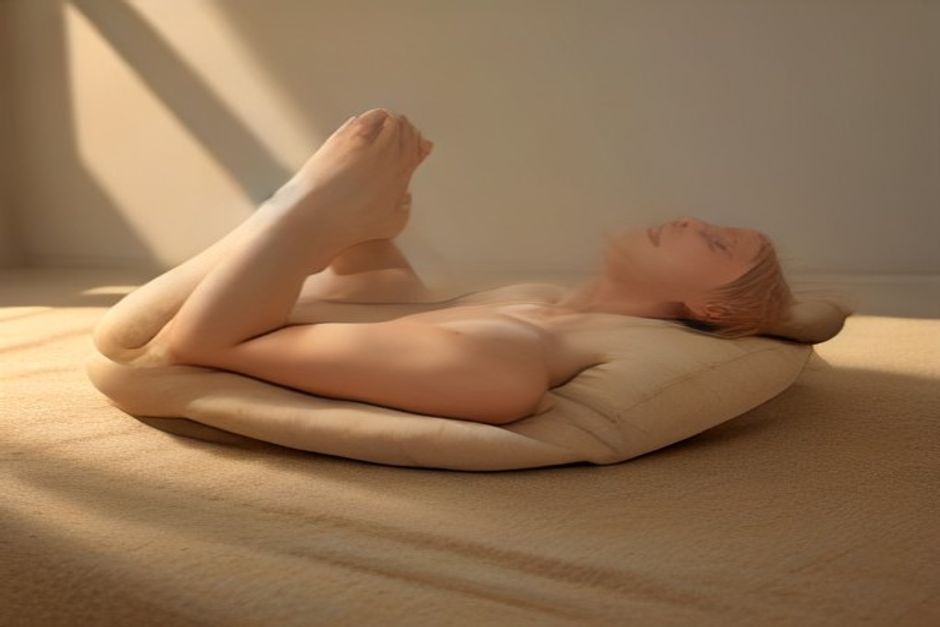
Some poses you do; this one you move into, like a room you like. Supta Baddha Konasana — reclined bound angle — takes the seated bound angle pose, lays it on its back, and removes the last of the effort from it. Soles of the feet together, knees open, spine supported, arms resting wherever they fall. It shows up at the end of restorative classes, in prenatal sequences, and in the ten minutes before bed when the day has been too much. The pose is simple. The setup is where it succeeds or fails.
Reclined Bound Angle — Supta Baddha Konasana
How: Sit with the soles of your feet together and knees out to the sides, heels a comfortable distance from the pelvis — farther away is easier on the groins. Lie back slowly, supporting yourself with your hands. If your low back arches uncomfortably or you want the full restorative version, lie over a bolster or firm cushion running lengthwise under your spine, with a folded blanket under your head. Place a block, cushion, or rolled blanket under each outer thigh so the knees are fully held. Rest your arms out to the sides, palms up. Stay five to fifteen minutes. To come out, use your hands to bring the knees together, roll to one side, and sit up slowly.
Why: With the spine and thighs fully supported, the inner thighs and groins release under their own weight — no muscular effort, no stretching sensation required. The supported backbend across the bolster gently opens the chest and front of the shoulders, a quiet antidote to the curled-forward posture of desks and phones.
Why the props are the pose
In an active stretch, sensation is the point. In this pose, sensation is a problem to be solved. If the knees hang in the air, the inner thighs must work isometrically to hold them there — or worse, the groin ligaments take the load. Either way, the tissue you're trying to release is busy. Blocks or cushions under the outer thighs hand the job of holding the legs to the furniture, which is what the furniture is for. The same logic applies along the spine: unsupported, most backs either flatten hard into the floor (compressing the low back) or arch away from it. A bolster under the spine gives the back ribs somewhere to rest and lets the front body open without any backbend effort from you.
This is the difference between reclined bound angle and its simpler cousin, reclined butterfly, which we usually teach flat on the floor as a quick release. Both are worth knowing; the propped version is the one you can genuinely inhabit for a quarter of an hour.
Setups for different bodies
Full restorative setup — with bolster and blocks
How: Bolster lengthwise under the spine from the tailbone up, blanket under the head so the chin doesn't tip back, blocks under both thighs, optional blanket swaddled around the feet with the ends tucked under the outer shins to hold the legs.
Why: This is the version for exhaustion, high stress, or the last pose of the day. Every joint is held; the nervous system gets the message that nothing is required of it. Pair it with slow breathing from our three-part breath and it becomes a full practice by itself.
Flat version — no equipment
How: Simply lie on your back, feet together, knees open, cushions under the thighs if the groins pull. Hands on the belly or out to the sides.
Why: Hotel rooms, lunch breaks, anywhere without props. Two minutes here after a long sit — see also our notes on what sitting does to hips — changes how the rest of the day feels in the pelvis.
Knees together variation — constructive rest
How: If the open knees don't suit you, keep the feet wide on the floor and let the knees knock together instead.
Why: Not bound angle at all, technically, but the honest alternative for anyone whose groins, hips, or knees object to the open position. The low back releases in the same way, and nobody is keeping score.
Groin and knee care
The inner-thigh adductors and the knee share a rule: the knee is a hinge that dislikes sideways force, and in this pose sideways force is exactly what a too-deep opening applies. The distance of the heels from the pelvis is the volume knob. Heels close to the groin: intense, knee-risky for many. Heels farther away, shins closer to a right angle at the knee: milder, kinder, and for most people the right default. Support under the thighs reduces strain further still. If anything pinches in the hip joint itself or pulls at the inner knee, back the pose off — move the feet away, raise the props, or take the knees-together version. A restorative pose that hurts has missed its own point.
How long to stay? Longer than feels productive. Two minutes is a stretch; ten is a state change. Set a gentle timer so you're not peeking, dim the lights if you can, and let the exhales run long. When the timer goes, resist the urge to spring up — gather the knees, roll to the side, and arrive back in the room at the speed the pose leaves you.
Who should modify: anyone with a groin strain or inner-knee pain should use generous props and the wide-heels setup, or skip the pose in favor of legs up the wall. Late-pregnancy practitioners should avoid lying flat for long periods — a left-side-lying rest is the better option. And if the low back gripes in the flat version, the bolster isn't optional; it's the fix.