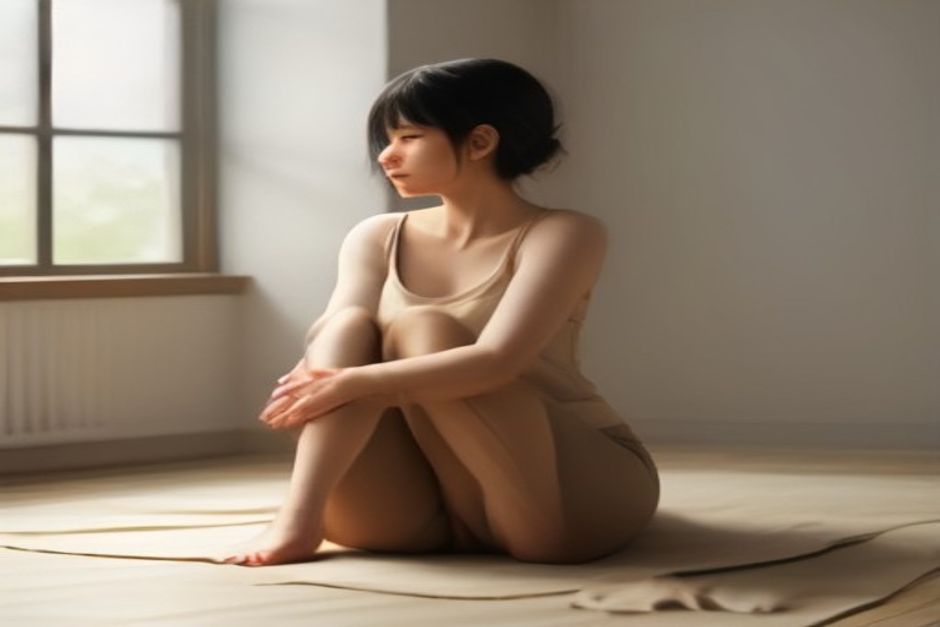
Bound Angle Pose — Baddha Konasana, where baddha means bound and kona means angle — is the classical version of what many classes casually call Butterfly. Same shape, slightly different emphasis: in Bound Angle you hold the feet firmly and work the pose as a deliberate groin opener rather than a passive fold. (For the gentler, gravity-led version, see our Butterfly Pose page.) It looks like the easiest thing in the world — sitting down with your feet together. Anyone with tight hips knows better.
What the pose is asking for
Bound Angle opens the inner thighs and groin — the adductor muscles that run from the pubic bone down the inside of the leg — and asks the hips for external rotation. Two things decide how it goes for you: soft-tissue length, which improves with patient practice, and the architecture of your hip sockets, which does not. Our hip anatomy page explains why some knees will hover forever no matter how dedicated the practitioner. Neither outcome is a moral verdict. The pose has one job: a sustainable stretch you can breathe in.
Bound Angle Pose — Baddha Konasana
How: Sit tall and bring the soles of the feet together, knees dropping out to the sides. Before anything else: place a folded blanket or firm cushion under your seat so the hips sit higher than the knees. Hold the feet with both hands — some traditions open them like a book, thumbs inside. Draw the heels in toward the pelvis only as far as the knees allow without complaint. Lengthen the spine on every inhale; on the exhale, let the knees settle a fraction toward the floor on their own. Stay one to three minutes.
Why: The raised seat lets the pelvis tip forward so the spine can stack upright instead of rounding. Without it, most people slump backward and the stretch migrates from the groin into a strained low back — same shape, wrong pose.
Bound Angle with a forward hinge
How: From the seated pose, inhale long through the spine, then hinge forward from the hip creases — not the waist — keeping the back flat. Hands stay on the feet or walk forward onto the floor or a block. Stop well before the spine rounds.
Why: The hinge deepens the groin stretch and adds a quiet, inward quality that makes Bound Angle a traditional seat for pranayama and meditation. Depth is optional; the long spine is not.
Supported Bound Angle, knees on blocks
How: Set up as usual, then place a block, cushion, or folded towel under each outer thigh so the knees are fully supported wherever they naturally rest. Hands on the feet, spine tall, shoulders soft. This version is made for long holds — three to five minutes.
Why: A muscle that has to hold itself up against gravity stays half-contracted. Support the knees and the adductors get the message that it is safe to lengthen. This is also the version to choose for tired days, sore hips, or as a lead-in to evening relaxation.
The knee rule, stated plainly
Do not push your knees down — not with your hands, not with your elbows, not with a helpful friend. The knee is a hinge with almost no rotational range; pressing it sideways borrows movement the joint does not have, and the meniscus pays the bill. Our knee anatomy page covers the mechanics. If the knees are high, support them from below and wait. Hips open on their own schedule, which is slower than ego's schedule and considerably safer.
Foot distance is a dial, not a rule
Heels close to the pelvis intensifies the groin stretch and the demand on the knees. Feet further away — the legs forming a wider diamond — softens both and shifts the work toward the inner thighs. Tight or cranky day? Feet away. Warm and spacious? Feet closer. There is no prize for maximum heel proximity, and nobody respectable is checking.
Where it fits in a practice
Bound Angle belongs in the second half of a session, once the hips are warm — after standing work like Warrior I or a few rounds of sun salutations. It pairs naturally with Wide-Legged Forward Fold before it and Happy Baby after. If you are building a home routine, our asana overview shows where seated hip openers sit in a balanced sequence.
Bound Angle is a long game measured in seasons, not sessions. Raise the seat, support the knees, hold the feet, and breathe. The binding is in the name — the patience is in the practice.