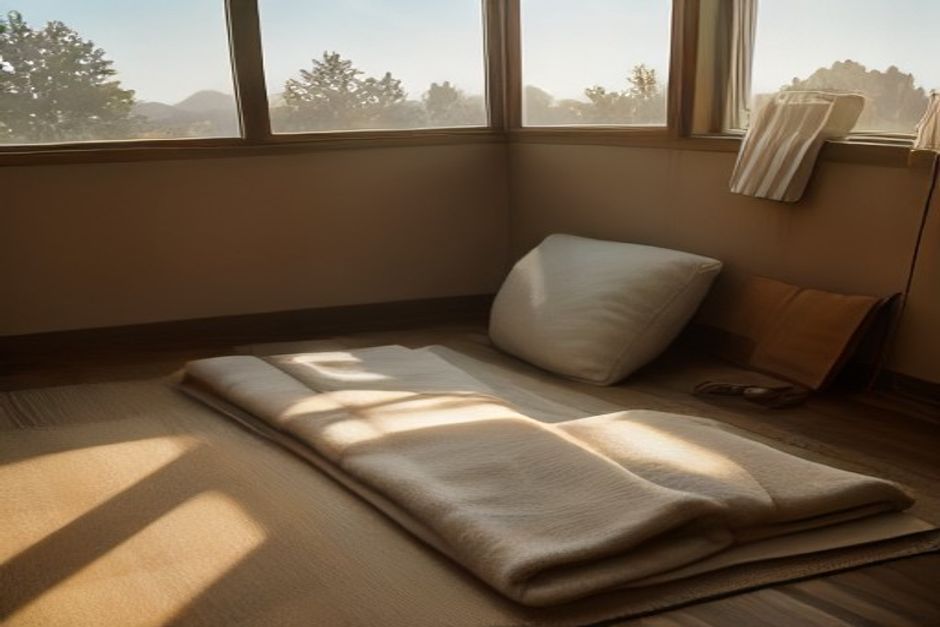
There is a particular tiredness that belongs to late summer. Not the fresh tiredness of a good workout — a lower-grade depletion, built up over months of heat, long light, travel, and the low-level social intensity of the season. The body has been running hot and outward since June, and somewhere in August it starts asking, quietly, to come in. The summer practice was about working with heat; the autumn practice will be about grounding into darker days. The late-summer reset is the hinge between them — two or three weeks of deliberately shifting gears rather than waiting for exhaustion to shift them for you.
What the season actually asks for
Ayurveda, which takes seasons more seriously than most systems, classifies late summer as the time when pitta — the hot, sharp, driven quality — has accumulated and needs discharging before it tips into irritability, inflammation of the temper, and that specific August burnout. You don't need to subscribe to the whole framework to recognize the pattern: by this point in the year, more intensity is rarely the answer. The practices that feel right are the ones that discharge heat and return weight to the body: slower, lower, cooler, earlier.
Concretely, the late-summer reset has four dials to turn: pace, height, breath, and bedtime.
Dial one: slow the pace
If your practice all summer has been flowing and vigorous — and heat makes people oddly ambitious — the reset begins by cutting the tempo in half. The same sequence at half speed is a different practice: transitions get honest, balance gets tested, and the breath has time to actually lead. A sun salutation that takes ninety seconds instead of forty-five will show you every place you've been hiding momentum. This is not "easier." It is slower, which is a different kind of hard, and the right kind for August.
Dial two: get lower
Hot seasons pull energy upward and outward; the counterweight is floor work. Build practice around poses that keep you close to the ground:
- Supine work first. Start practice lying down — knees bent, a few minutes of breathing before anything moves. It feels like cheating. It is the point.
- Forward folds of all kinds. Standing and seated folds are physically cooling and psychologically quieting — the face turns in, the spine lengthens, the gaze drops. Let the head hang; let the exhales lengthen.
- Long-held hip openers. Low lunge, pigeon variations, a slow happy baby — held for two minutes a side rather than flowed through. The hips are where the season's accumulated sitting and driving live.
- Restorative finish. End every practice with legs up the wall for five to ten minutes. If one pose were the official emblem of the late-summer reset, it would be this one: legs drained by gravity, nervous system downshifting, nothing to achieve.
Dial three: cool the breath
Skip the heating breathwork for a few weeks — this is not the season for kapalabhati. What fits instead: long, unforced exhales (let the out-breath run a count or two longer than the in-breath, without straining), and the classic cooling breaths if you know them — sitali through a rolled tongue, or sitkari through the teeth if you can't roll. Even without any technique, the rule of the season is simple: whatever breathing you do in practice should leave you cooler and quieter than it found you, never more revved.
Dial four: move bedtime up
The most effective late-summer reset is not a pose. It is going to bed twenty minutes earlier, starting now, while the light still tricks you into staying up. Summer sleep debt is real — long evenings, heat-disrupted nights, the general holiday looseness of schedule — and no amount of hip opening compensates for it. Treat the earlier night as part of practice, because it is: the sleep page has the details, but the short version is that everything you're trying to repair on the mat repairs faster in bed.
A 20-minute reset sequence
For the days when deciding what to practice is itself too much:
- Lie down, knees bent, hands on the belly — 2 minutes of plain breathing
- Slow cat-cow and thread-the-needle — 3 minutes
- Low lunge with a twist, 2 minutes per side, moving like honey
- Standing forward fold, head heavy — 1 minute
- Seated wide-legged fold — 2 minutes
- Reclined twist, both sides — 3 minutes
- Legs up the wall — 7 minutes
The honest note
A reset is not a detox, and August fatigue is not a moral failure. If you are genuinely exhausted — the kind that doesn't lift after rest, or comes with other symptoms — that is a conversation for a doctor, not a yoga sequence. But if you are simply seasonally cooked, the remedy is unglamorous and reliable: slow down, get low, cool the breath, sleep more. The rest-day principles apply at the scale of a season too. Autumn will ask for energy soon enough. Spend the hinge weeks arriving at it restored rather than running on fumes.