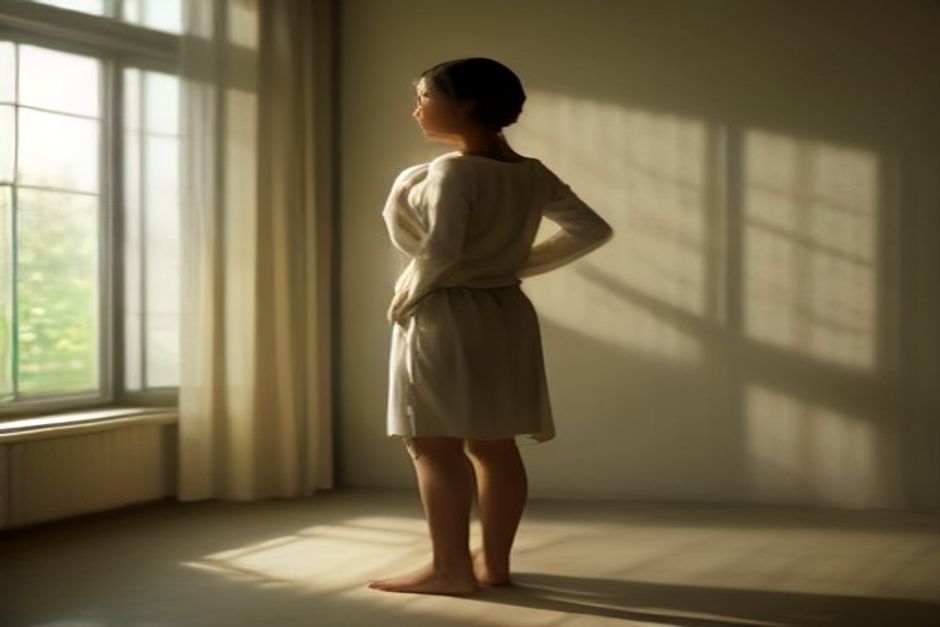
Everyone has had the moment in tree pose: fine on one side, a comedy routine on the other. Or fine yesterday, hopeless today, for no visible reason. The wobble feels personal. It isn't. Balance is a continuous negotiation between three sensory systems and a set of reflexes in your joints, and it fluctuates with sleep, stress, and what your brain happens to trust that morning. Understanding the machinery takes the drama out of the wobble — and tells you how to actually train it.
System one: the inner ear
Deep in each ear sits the vestibular system — three fluid-filled loops (the semicircular canals) plus two tiny gravity sensors (the otolith organs). The loops detect rotation: nod, shake, tilt. The otoliths detect straight-line movement and which way is down. Together they answer the question "where is my head, and how is it moving?" several times per second, without asking your permission.
This system is why spinning makes you dizzy: the fluid keeps sloshing after you stop, and your ears report motion your eyes deny. It is also why turning your head slowly in a balance pose is genuinely harder — you are feeding one of your three instruments noisy data on purpose.
System two: the eyes
Vision is the balance system you consciously notice. Your brain uses the horizon, the edges of the room, and the stillness of whatever you are looking at to compute your own movement. This is why the classic cue in balance poses is drishti — a steady gaze on one unmoving point. It is not mysticism. A fixed visual anchor removes noise from your most trusted sensor.
Close your eyes in a standing balance and the pose roughly doubles in difficulty, because you have just fired a third of your balance team. That is a feature, not a failure — it makes eyes-closed work one of the best balance drills that exists. More on that below.
System three: the body's own map
The third system is proprioception — the sense of where your body parts are without looking. It lives in sensors woven through your muscles, tendons, and joint capsules, and it is densest where balance is negotiated first: the ankles and the soles of the feet. Those small muscles fire in constant micro-corrections, swaying you around your center of mass like a very committed metronome. The foot's tripod — heel, big-toe mound, little-toe mound — is the platform all of this stands on.
Here is the useful sequence to know: for small sways, your body corrects at the ankle. For bigger ones, it bends at the hip. For the biggest, it gives up and takes a step. Watching yourself wobble through that sequence in tree pose is watching your nervous system escalate through its standard playbook.
Why some days you wobble more
- Sleep debt. Balance is brain work, and tired brains integrate the three systems more slowly. One bad night measurably worsens standing balance.
- Stress and breath-holding. Bracing your breath braces everything. The micro-corrections freeze, and small sways become big ones. Slow exhales genuinely help — the mechanism in yoga and the nervous system applies on one leg too.
- Footwear habits. Feet that live in supportive shoes send less detailed data. Barefoot time is balance training whether you call it that or not.
- One-sidedness. Almost everyone balances better on one side. Train the weaker side first, and let it set the dose.
- Age — but mostly disuse. Balance declines with age largely because it is practiced less. The encouraging flip side: it responds to training at every age.
Training balance like a skill
Balance improves the way skills do: frequent, short, slightly-harder-than-comfortable practice beats occasional heroics. A realistic progression:
1. Build the base. Stand on one foot while brushing your teeth, thirty seconds a side. Boring, free, and it works, because the nervous system learns from repetition more than from intensity.
2. Add the poses. Tree, then warrior III with hands on a wall, then eagle. Hold each five to ten breaths. A slight hover of the toes off the floor in tree — rather than pressing the foot into the thigh like a vice — recruits the ankle team instead of parking on it.
3. Challenge the senses. Once a hold is steady, add one difficulty at a time: turn the head slowly, look up, then close the eyes for a breath or two. Never stack new challenges on a new pose. One variable per session.
4. Go dynamic. Static holds are only half the skill. Walking heel-to-toe, slow transitions from warrior III into standing splits and back, and flowing between poses without touching down train balance in motion — the kind you actually use on stairs, trails, and icy sidewalks.
The goal of balance practice is not to never wobble. It is to recover from the wobble so quickly that nobody — including you — is sure it happened.
What the wobble teaches
There is a reason balance work sits inside a practice about attention. You cannot balance while rehearsing an argument in your head — the moment attention leaves the body, the body announces it. In that sense the wobble is honest biofeedback: not a verdict on your worth, just a live report on where your mind is. Treat it as information, breathe, find your point of focus, and start again. That loop — notice, reset, resume — is the entire practice, and it transfers off the mat more reliably than any pose. More maps of the machinery in the anatomy section.