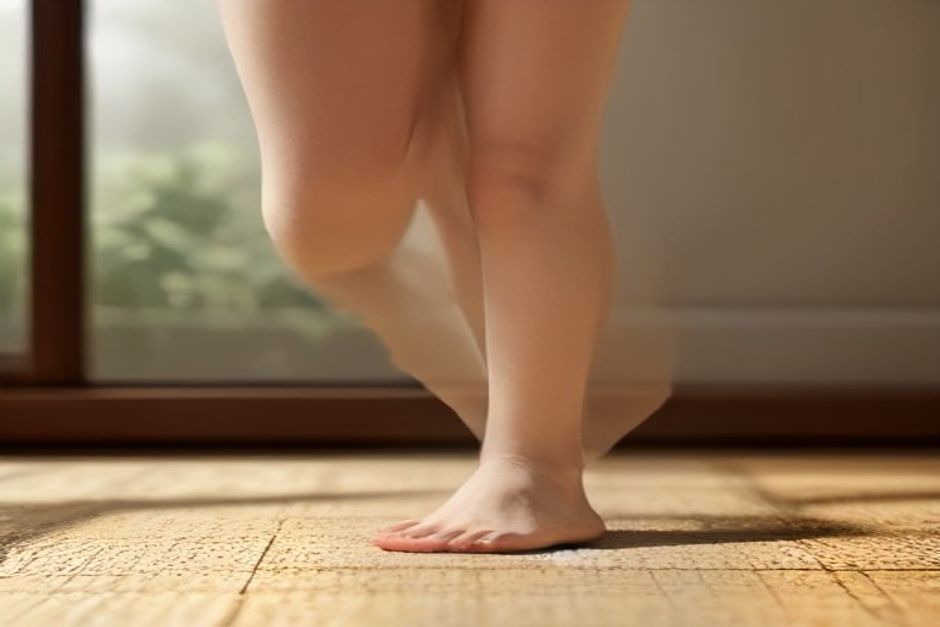
Somewhere along the way, most people with flat feet were handed a quiet verdict: your arches have fallen, your foundation is broken, proceed with caution forever. Then they arrive at a yoga class, where everyone is barefoot and the teacher keeps saying "lift your arches," and the verdict seems confirmed. The reality is less dramatic and more useful. Flat feet — a low or absent medial arch — are present in roughly a fifth to a quarter of adults, most of whom walk, run, hike, and practice yoga without incident. What matters is not the shape of your arch on the floor but how the foot behaves under load. That distinction changes everything.
Two kinds of flat feet, one easy test
The first thing to know is that "flat feet" covers two different situations. A flexible flat foot has an arch when you sit or stand on tiptoe, and loses it when you stand normally — the structure is there, the support muscles are just underemployed. A rigid flat foot stays flat in every position, which points to bony structure rather than muscle. The self-test takes ten seconds: stand, rise onto the balls of your feet, and look in a mirror. If an arch appears, yours is flexible, and flexible arches respond to training. If nothing appears, your foot is built that way — which is still not a disaster, but it changes the strategy from "rebuild" to "organize around." Rigid flat feet that hurt, or one arch that dropped suddenly in adulthood, deserve a professional look before anything else on this page.
For the fuller tour of what lives in the foot — the three arches, the tripod, the plantar fascia — see your feet in yoga. This page is about the flat-footed version specifically.
What flat feet actually change in yoga
When the arch drops, the foot rolls inward — overpronation — and the leg above it tends to follow: the shin rotates inward, the knee drifts toward the midline, the hip internally rotates. In yoga this shows up in predictable places:
- Balance poses. In Tree Pose, the standing arch may visibly collapse and the ankle wobbles more. This is a strength and endurance issue, not a structural ban — the arch musculature fatigues fast at first and improves within weeks.
- Warriors and lunges. In Warrior I, a collapsing front arch lets the knee cave inward, which is the exact thing teachers cue against. The fix starts at the foot, not the knee.
- Long holds and standing sequences. Flat feet tire sooner in long standing work because the small intrinsic muscles are doing overtime. Needing a break in a hold is information, not failure.
- The knee connection. Persistent inward collapse loads the inner knee over time, which is why flat feet and unhappy knees so often travel together — and why the foot work below pays off above the ankle.
The cue that still works: tripod first, arch second
"Lift your arches" is a difficult instruction to follow directly — most people can't find the muscle. The better route is the tripod: press down through the base of the big toe, the base of the little toe, and the center of the heel, evenly. For flat feet, the big-toe mound is the critical point; it tends to float. Press it down firmly — while keeping the toes long, not clawed — and the arch lifts as a side effect. Practice it in Mountain Pose until it's findable on demand, then carry it into every standing pose. This single habit does more for flat-footed practice than any prop or product.
Barefoot practice: the good news
Yoga is one of the few activities where flat feet are trained rather than accommodated. Barefoot on a mat, the foot's intrinsic muscles — the small ones inside the foot itself, which shoes outsource — have to work. Research on foot strengthening consistently shows that intrinsic muscle training improves arch function in flexible flat feet, and a regular barefoot practice is essentially that training, smuggled into something you'd do anyway. Two cautions apply. First, progress gradually: if you've lived in supportive shoes for decades, an hour of barefoot standing poses is a big dose — start with shorter sessions and let the foot adapt over months, not days. Second, the plantar fascia — the tension cable along the sole — is the usual casualty of sudden barefoot enthusiasm. A heel that aches in the morning is asking you to back off, not push through.
Orthotics: keep them, mostly
If you wear orthotics and they keep you comfortable in daily life, keep wearing them in daily life — yoga class is the one hour they can stay in the shoe rack. What the evidence doesn't support is the idea that orthotics are mandatory forever, or that going without them is inherently dangerous. Think of orthotics as a cast you can walk on: useful while tissue calms down or while you're on concrete all day, but not a substitute for the foot doing its own work when the surface allows. A reasonable arrangement for many people: orthotics for long days in shoes, barefoot for home and mat, foot exercises in both worlds. If a podiatrist prescribed them for a specific condition, that plan beats anything written here.
Five minutes that matter more than arch shape
- Short-foot holds. Seated or standing, draw the ball of the foot toward the heel without curling the toes, lifting the arch, five seconds, ten reps. This is the most direct arch-strengthening exercise known, and nearly invisible.
- Big-toe presses. Press only the big toe down while the other four lift, then reverse. Awkward at first; that awkwardness is the untrained muscle introducing itself.
- Single-leg stands. Barefoot, tripod set, thirty seconds per side. The whole chain — arch, ankle, knee, hip — organizes itself around the task.
- Calf raises, slow. Rise and lower over three seconds each way, fifteen reps. The calf and the arch are teammates; strong calves share the load the arch currently carries alone.
When to see someone: a foot that went flat recently and quickly, pain along the inside ankle or arch that persists, morning heel pain that lasts weeks, or numbness and tingling — these belong to a podiatrist or physiotherapist. Yoga is excellent maintenance for flat feet; it is not an assessment.
The arch you have is the arch you train. Most flexible flat feet get stronger, more comfortable, and less dramatic within a few months of barefoot practice plus five minutes of deliberate work. And the rigid ones? They do fine too — the body compensates brilliantly when the chain above the foot is strong and the practice is honest. The verdict was always too harsh. The floor is not your enemy; it's where the training happens.