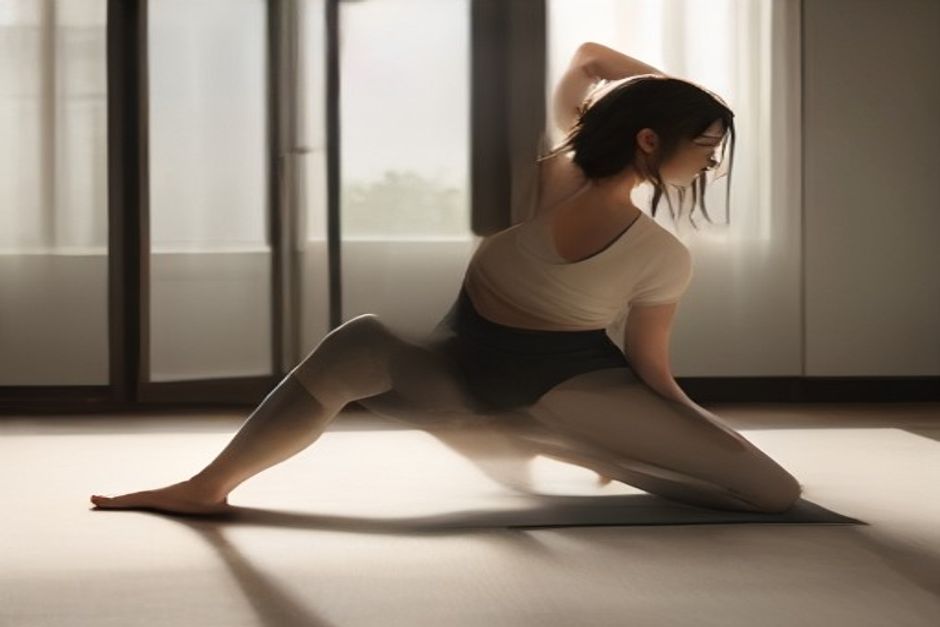
If you sit for a living, you have probably been told your psoas is tight, angry, shortened, traumatized, or all four. The psoas has become yoga's favorite scapegoat — blamed for back pain, hip pain, bad posture, and possibly the weather. Some of that reputation is earned. Most of it is marketing. Here is what the muscle actually is, what sitting actually does to it, and which stretches reach it versus which ones miss politely.
Where the psoas actually lives
The psoas major is a long, deep muscle that starts on the sides of your lower spine — the lumbar vertebrae — travels forward through the bowl of the pelvis, and attaches to the inner top of your thigh bone. It is the only muscle that directly connects your spine to your leg. Its little sibling, the iliacus, lines the inside of the pelvis and joins it near the hip; together they are often called the iliopsoas.
Its main job is hip flexion: lifting your thigh toward your chest. Every step you take, every stair you climb, every time you pull a knee up in a yoga pose, the psoas is working. It also plays a quiet stabilizing role in how you stand — more scaffolding than mover.
Two honest notes before we continue. First, you cannot see or touch most of the psoas — it sits behind your abdominal organs, which is why "psoas release" massages are uncomfortable and why most claims about it deserve a raised eyebrow. Second, the psoas is one muscle in a team. The rectus femoris (a quad), the TFL, and the adductors all flex the hip too. Blaming the psoas alone is like blaming one player for a lost season.
What sitting actually does
Sitting holds your hips at roughly ninety degrees — a flexed position — for hours. Muscles adapt to the length you keep them at, and the hip flexors adapt to short. This is not damage; it is just the body being economical. The result you notice: when you stand up, the front of the hip resists lengthening, the pelvis can get pulled forward, and the low back picks up the slack. That cascade is why "tight hip flexors" and "low back ache" so often arrive as a pair.
There is a second, quieter effect: muscles you don't use get deconditioned. Hours of sitting leave the glutes on standby, and weak glutes make the hip flexors work even harder when you move. For more on the full picture, see what sitting all day actually does and what it does to your hips specifically.
Stretches that reach the psoas (and ones that miss)
Because the psoas crosses the hip and attaches to the lumbar spine, a stretch reaches it when two things happen: the hip extends (thigh behind the body's midline) and the pelvis stays tucked enough that the low back doesn't just arch and absorb the movement. That second part is where most people fail.
Low lunge with a posterior tilt — Anjaneyasana, refined
How: From low lunge, place the back knee on a folded blanket. Before going deeper, gently tuck your tailbone — imagine zipping your belt buckle toward your chin until the low back flattens slightly. Only then shift your weight forward. Keep the stretch mild and breathe.
Why: The tuck is everything. Without it, the pelvis tips forward, the lumbar spine arches, and the psoas rides along unchanged while your back does the "stretching." With the tuck, the lengthening lands where you intended.
Couch stretch (quad + psoas)
How: Kneel facing away from a wall or couch, one shin up against it, other foot forward in a lunge. Tuck the pelvis first, then come upright only as far as you can without arching the low back. Stay 45–60 seconds per side.
Why: This combines hip extension with knee flexion, loading the rectus femoris along with the deeper hip flexors. It is intense — back off the moment the low back complains, because that complaint means the stretch has left the target.
Bridge with a long tailbone — Setu Bandha
How: From bridge pose, press evenly through both feet and think of reaching your tailbone toward your knees rather than pushing your hips to the ceiling. Lower and repeat slowly, five to eight times.
Why: This is less a stretch and more a negotiation: hip extension under light load, glutes doing the work the psoas usually does alone. Strengthening the opposition is half of "releasing" anything.
What misses the mark
- A deep standing quad pull with the pelvis tipped forward — feels like a lot, reaches the quad, mostly spares the psoas.
- Cranking deeper into any lunge by arching the low back — the arch eats the stretch.
- Aggressive "release" work — poking near your organs hoping to trigger catharsis. If you have real pain in this region, see a physiotherapist, not a trending video.
The boring truth
One stretch, held occasionally, will not undo eight daily hours in a chair. What works is frequency over intensity: a short lunge with the pelvis tucked, a few times a day, plus some glute and core work so the psoas isn't doing everyone's job. Our core anatomy guide covers the cylinder that shares this load.
Safety note: Hip flexor stretching should feel like a broad, warm pull in the front of the hip — never a pinch in the groin, and never back pain. A pinch often means the joint itself is being compressed; back off, re-tuck the pelvis, and shorten the range. Persistent groin or low-back pain deserves a professional assessment, not a deeper stretch.
Your psoas isn't traumatized and it isn't evil. It is a hard-working muscle doing exactly what your habits trained it to do. Change the habits, gently and often, and it will change with them — no drama required.