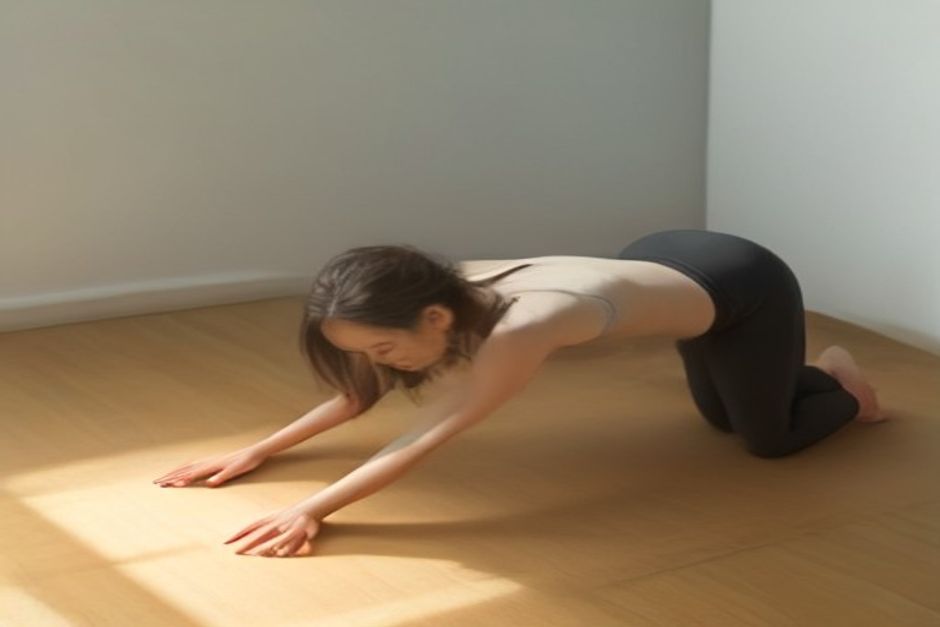
Here is an uncomfortable fact about yoga culture: the people it rewards most visibly — the ones whose legs fold behind their heads, whose backs bend like question marks — are often the people yoga is most likely to injure. If your joints move well beyond the typical range, you may be hypermobile, and hypermobility changes the rules of practice completely. The honest truth about flexibility applies double here: more range is not more health. For the bendy body, the goal of practice flips. You are not there to gain range. You are there to build the strength to control the range you already have.
What hypermobility is
Every joint has a designed range of motion, held in check by ligaments, the joint capsule, and the tension of the muscles around it. In hypermobile people — a trait that often runs in families, rooted in how their collagen is built — those restraints are looser. Elbows and knees can extend past straight. Thumbs bend back to the forearm. The floor is reachable with flat palms on the first try, ever. Clinicians screen for this with a simple nine-point checklist called the Beighton score; roughly one in five adults lands somewhere on the hypermobile spectrum, most mildly, most without knowing it.
Mild hypermobility is not a disease, and it is not automatically a problem — dancers and gymnasts have built careers on it. The problem arrives when a body whose ligaments don't say "stop" meets a practice culture that keeps whispering "deeper."
Why bendy people get hurt in yoga
Stiff practitioners hit a wall in a stretch: the muscle resists, the sensation says enough, and they stop. Hypermobile practitioners sail through that wall into the territory behind it — where the load shifts from muscle to ligament, capsule, and the joint surface itself. Those tissues don't complain loudly at first. They complain months later, as aching shoulders, unstable knees, or an SI joint that never quite settles. The common patterns:
- Hanging on the joints. Locked knees in standing poses, elbows pushed past straight in poses like Plank or Upward Dog — resting on ligaments instead of using muscle. It feels effortless because it is: the effort was outsourced to tissue that can't do the job forever.
- Chasing depth in hip openers. Pigeon variations taken to the floor on day one, folding the joint capsule into ranges it will later struggle to stabilize.
- Collapsing in weight-bearing. In Chaturanga and arm balances, hypermobile shoulders can shrug into positions the rotator cuff can't control — see shoulder anatomy for what lives in that neighborhood.
- Stretching what's already loose. The hamstring attachments and the front of the hip are classic victims: they feel tight because they're overworked stabilizing a loose joint — and stretching them removes the body's only brake.
The reframe: practice for stability, not depth
The good news is that yoga is genuinely excellent for hypermobile bodies — once the aim changes. The practice becomes strength training with better PR:
- Keep a micro-bend, always. Knees and elbows never fully straighten in weight-bearing poses. This single habit does more for hypermobile safety than any other. It feels, at first, like you're doing the pose wrong. You're doing it right.
- Stop at 70 percent. In every stretch, back well off your end range and then engage — gently contract the very muscles being lengthened. Sensation should be mild. If you can scroll your phone in a stretch, you're probably hanging in it.
- Prioritize closed-chain strength. Plank, lunges, standing balances — poses where joints bear load with muscles active — are the hypermobile person's best friends. The core cylinder deserves special attention: it stabilizes the spine and SI joint that loose hips leave exposed.
- Treat balance wobble as training, not failure. Proprioception — knowing where your joints are — is often dulled in hypermobile bodies. Slow, wobbly single-leg work rebuilds it better than any stretch.
- Short holds, active exits. Long passive holds (deep yin-style stretches to end range) are where hypermobile practitioners most often overdo it. Come out of poses using muscle, not momentum.
The psychological work
Honestly, the hardest part isn't physical. Bendy practitioners are used to praise — the pose photos, the teacher's "beautiful backbend." Choosing a smaller, engaged, unphotogenic version of the pose means giving up the one thing practice always applauded them for. It helps to remember what the applause was for: range you were born with, not skill you built. The skill — control — is invisible in photos and obvious in your joints twenty years from now.
For the hypermobile body, yoga's promise is real but inverted: not "become more open," but "become more organized." Bendy got you in the door. Strength is what keeps you in the room.