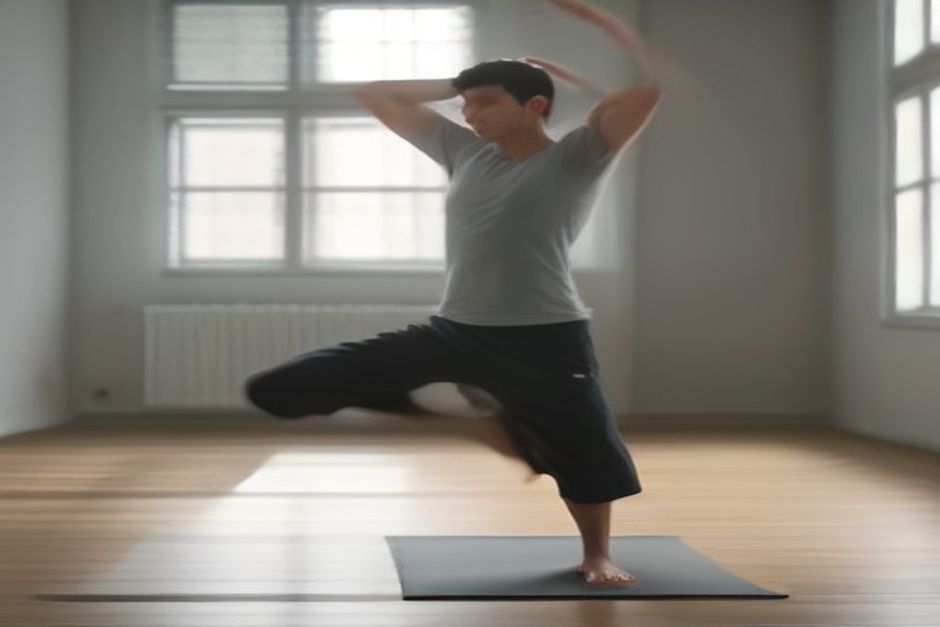
Men are roughly a quarter of the people on yoga mats in Western studios, and judging by how many men say "I should try yoga" versus how many do, the gap is not physical. It is anticipatory embarrassment: the picture of being the stiff guy in the corner who can't touch his toes while everyone else folds in half. So let us deal with that picture directly, because it is wrong in useful ways — and then cover what actually happens, what your particular body brings to the room, and how to start without making it a whole thing.
The flexibility question, settled
Yes, your hamstrings are tight. So are the hamstrings of the woman on the next mat, the teacher when she started, and every runner who ever walked into a studio. Adult men — especially men who lift, run, cycle, or sit for a living — arrive with short hamstrings, guarded hips, and shoulders that stopped rotating freely around age thirty. Teachers know this. It is the single most predictable body in the room, and no one will be surprised by it, because half of teaching yoga is teaching this exact body. If not touching your toes is the barrier, read why touching your toes doesn't matter — the short version: the pose is the reaching, not the touching.
Strength: your asset and your saboteur
If you are strong, the first month of yoga will be a strange negotiation. Strength helps enormously in some places — plank, chaturanga, arm balances come faster to people with a gym background — and actively betrays you in others. The pattern: strong people muscle through ranges they do not own. You can force a pose with effort long enough to strain something, where a less strong person would simply have to stop. The skill yoga teaches strong bodies is not more effort but better information: distinguishing the burn of work from the warning of a joint. Treat "I could push through this" as a reason to check in, not a green light. The hamstring anatomy page explains why yanking on a tight muscle is the slow road.
What actually happens in a first class
You arrive ten minutes early (do this), tell the teacher it is your first class (do this too — it changes what they offer you), and set up a mat. The class starts with sitting or lying down and breathing, which feels awkward for about ninety seconds and then just feels like breathing. Poses follow, named in English, Sanskrit, or both; you will not know them, and you will watch the person in front of you, which everyone does and denies. At some point you will wobble out of a balance pose. Nobody will look. At the end comes savasana — lying still for five minutes — which many men report as the strangest and, a month later, the most valued part of the class. Then you leave, and the next day you discover muscles you did not know you had. The standard beginner questions — what to wear, which class, how often — are covered on the yoga basics page; nothing about the answers is gender-specific.
Which class to book
- "Beginner," "level 1," or "foundations" — the correct first move regardless of fitness. Your gym conditioning will not save you in a mixed-level flow class; it will just help you compensate.
- Hatha or slow flow if you want the mechanics explained — recommended if you have old injuries to work around.
- Power or vinyasa if you need to sweat to feel like it counted. Fine, with one caveat: pick level 1 anyway. Ego is the most commonly injured body part in yoga.
- Home first is legitimate. Two weeks of fifteen-minute sessions from the pose library — cat-cow, downward dog, low lunge, pigeon — removes 80 percent of first-class awkwardness.
The body you bring, used well
The typical male beginner profile — strong upper body, tight hips and hamstrings, competitive streak — is not a problem to apologize for; it is a starting configuration with known trade-offs. The tight hips that frustrate you in pigeon are also the stable hips that protect your lower back. The competitiveness that tempts you to match the person on the next mat can, redirected, make you the rare student who actually practices between classes. Even the stiffness has a use: it gives you honest, immediate feedback, and beginners with lots of sensation tend to learn alignment faster than flexible beginners who feel nothing until something tears.
A realistic first month
Twice a week beats once-a-week-heroically. Expect the first two weeks to feel mostly awkward and the next two to feel surprisingly good — the learning curve is front-loaded. Soreness after early classes is normal (see the guide to post-yoga soreness for the line between normal and too much). By week four, most men notice the same three things: hips move better in the gym, sleep runs deeper, and the five quiet minutes at the end of class stopped feeling like wasted time. Nobody will ask you to chant, buy special clothes, or believe anything. You show up, you do the shapes, you breathe, and the stiffness you walked in with becomes the thing you work on rather than the thing that kept you out.