Sitting is not dangerous, despite what the headlines say. But sitting for three, six, ten hours at a stretch — a flight, a road trip, a day of back-to-back meetings — does something very predictable to a body. The hip flexors spend hours shortened and start to treat that as the default length. The glutes go quiet. The upper back rounds toward whatever screen or window you were facing. The ankles barely move, and the calves, which normally pump fluid back up the legs, take the day off.
You step out of the car or off the plane feeling like a folded map. The fix is not an hour-long power class. It's ten targeted minutes that reverse the specific shape sitting made. Do it in your hotel room, your living room, or — genuinely — the airport lounge if you can handle the looks.
Why this particular sequence
Long sitting creates four specific debts: short hip flexors, a rounded upper back, sleepy glutes, and stagnant lower legs. A general stretch helps vaguely; this sequence pays each debt directly, in an order that makes sense — wake up the spine first, open the front of the hips second, lengthen the back line third, then drain the legs. The anatomy behind it is laid out in what sitting all day actually does, and the deepest culprit, the psoas, gets its own explainer in the psoas, honestly.
The 10-minute undo
Minute 1–2: Cat-Cow — Marjaryasana-Bitilasana
How: On hands and knees, alternate slowly between arching and rounding the spine, letting the breath lead — inhale to arch, exhale to round. Ten to fifteen slow rounds. Our Cat-Cow guide has the details.
Why: The spine has been held in one shape for hours. This is not a stretch so much as a reintroduction — each segment gets reminded that movement exists.
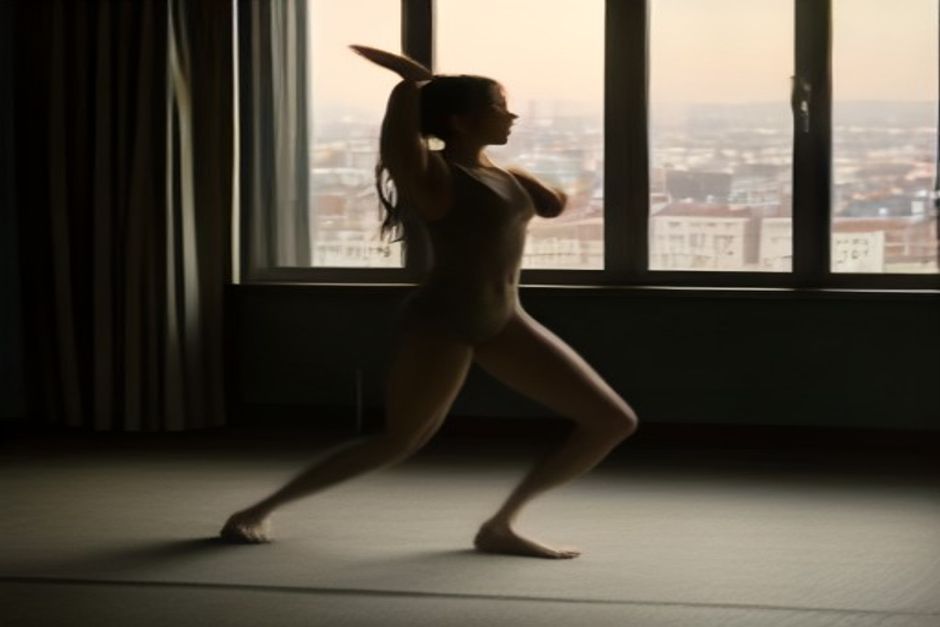
Minute 3–5: Low Lunge, each side — Anjaneyasana
How: Step one foot forward between your hands, back knee on the floor (pad it — folded sweater works). Sink the hips gently forward without arching the low back; keep a slight tuck in the pelvis. Stay for a minute per side, breathing into the front of the back leg's hip. Hands can rest on the front knee. Details in the Low Lunge guide.
Why: This is the direct antidote to the sitting shape — the hip flexor that spent all day shortened finally gets length. If you only do one thing after a long sit, do this.
Minute 6–7: Standing Forward Bend — Uttanasana
How: Roll up slowly from the lunge, stand with feet hip-width, knees softly bent, and fold. Let the head hang. Hold opposite elbows if the shoulders are cranky. One to two quiet minutes.
Why: The whole back line — calves, hamstrings, spinal muscles — lengthens at once, and the head-below-heart position is a mild reset after hours of upright alertness. Bend the knees as much as needed; straight legs are not the goal.
Minute 8–10: Legs Up the Wall — Viparita Karani
How: Sit sideways against a wall, swing your legs up as you lie back, and scoot your hips close. Arms wherever they're comfortable. Two to three minutes of slow breathing. The full guide covers setup tricks.
Why: After a flight or drive, the lower legs are usually holding fluid from hours of stillness. Gravity reverses that while you do absolutely nothing — the most efficient pose in yoga. If no wall is available, calves resting on a chair or hotel bed does the same job.
The office version
No floor, no mat, colleagues nearby? The sequence compresses into four standing minutes: thirty seconds of slow neck half-circles, a standing side bend each way, a calf stretch against the wall, and a standing figure-four (ankle over opposite knee, sit back) per side. It is less thorough but infinitely better than the alternative, which is sitting from 9 to 6 and wondering why your back is filing complaints. On ordinary desk days, our desk yoga routine spreads this idea across the workday in two-minute installments.
When to skip or adjust
If a long flight leaves you with a swollen, tender, or warm calf — especially on one side only — that is not a stretching situation; that is a see-a-doctor situation, and soon, since it can signal a blood clot. Ordinary stiffness and puffiness in both legs is normal and responds well to the routine above. And if you're jet-lagged, keep the practice slow: this is an undo, not a workout. The goal is to arrive feeling like a person again, not to set records.
Ten minutes. No equipment, no warm-up, no heroics. The body folded for hours; you unfold it. That's the whole transaction — and it works every single time.