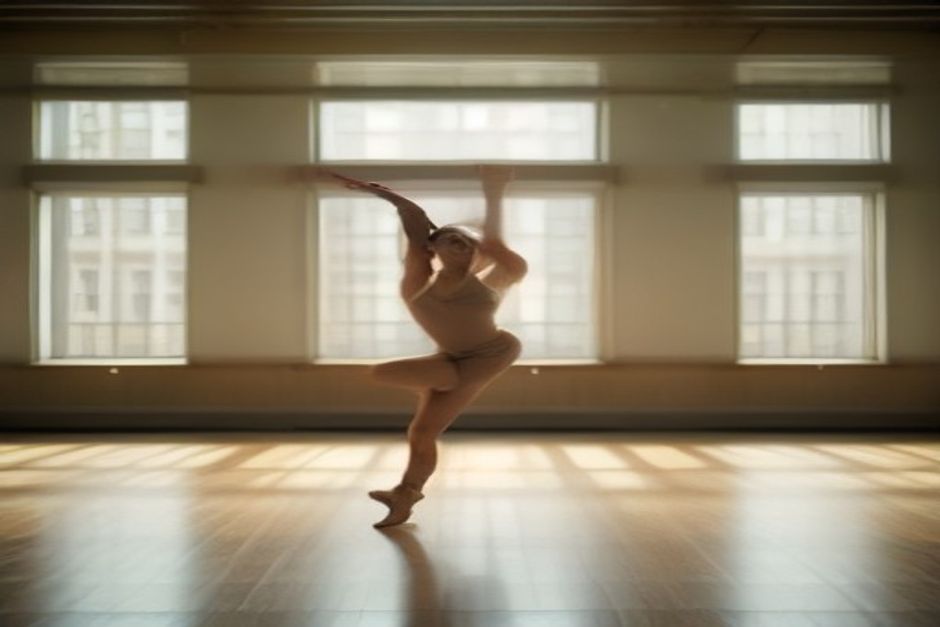
Dancers and yogis borrow from each other constantly, and mostly it works. A dancer's first yoga class is usually a pleasant surprise: the poses feel familiar, the floor work is easy, and the teacher keeps complimenting their lines. Then, around week three, something less expected happens — the dancer notices what yoga asks that dance never did, and what dance trained into them that yoga quietly asks them to unlearn. Both discoveries are worth having.
Where the two practices overlap
The shared ground is large. Both traditions care about alignment, about the spine's relationship to the pelvis, about feet that actually feel the floor. A dancer's years of pliés translate directly into chair pose and the warriors. Port de bras is already half of a sun salutation's arm pathways. And dancers arrive with the single hardest thing to teach: proprioception — knowing where your body is in space without looking. That head start is real, and it should be acknowledged, because what comes next is the honest part.
What yoga genuinely adds
Balance that isn't choreographed
Dance balance is rehearsed: you know the turn is coming, you've spotted it a thousand times, the music tells you when. Yoga balance is improvised — hold tree pose for a minute with your eyes closed and there is no choreography to lean on, just the three systems described in the anatomy of balance negotiating in real time. This trains a more general, transferable steadiness: the kind that saves you when a landing goes wrong, not the kind that only works on eight.
Breath as a tool, not an afterthought
Dance training treats breath as something that supports the phrase. Yoga treats it as the practice itself. Learning ujjayi — a slow, audible, even breath — gives dancers a way to regulate effort mid-variation and a way to actually recover between rehearsals instead of just collapsing. Many dancers discover they have been breath-holding through hard combinations for years without noticing.
Permission to stop
Dance culture rewards pushing through. Yoga, at least the honest kind, keeps asking the opposite question: what happens if you do less? A practice that includes legs up the wall and real savasana teaches recovery as a skill. For dancers whose training load borders on punishing, this is not a luxury — it's the difference between a long career and a short one.
The hypermobility warning
Here is the caution that matters most, and it's specific to dancers. Many dancers are hypermobile — joints that move well beyond the typical range, often thanks to lax ligaments rather than long muscles. It looks like a gift and, on stage, it is. In a yoga class it's a liability, because the entire culture of stretching assumes that more range is the goal. For a hypermobile body, more range is the problem.
If you can sink into full splits with no warm-up, fold flat, or drop into a deep backbend on demand, your yoga practice should not chase depth — you already won that game, and the prize was joint instability. Your work is the opposite: strength at end range. That means:
- Bent knees in folds. Keep a micro-bend in standing forward bend and feel the hamstrings work instead of hanging on the ligaments behind the knee.
- Shorter stances. In poses like pyramid, a shorter stance keeps you in the muscular middle of your range rather than the ligamentous end of it.
- Engagement before depth. In backbends, glutes and legs active first, depth second — the approach described in hamstring anatomy applies to every bendy joint you own.
- No passive stretching of already-loose joints. Long yin-style holds in your deepest range are where hypermobile dancers quietly damage the tissue that holds their joints together.
Hyperextended knees and elbows deserve special mention: "lock out and hang" is the resting position dance drilled into you, and it loads the joint capsule instead of the muscle. Relearning to hold a straight-but-soft leg takes months and pays off for decades. See knee safety in yoga for the mechanics.
What to unlearn
Turnout is the other thing. Years of externally rotated everything mean many dancers can barely stack a knee over a straight-ahead second toe — and that stacking is exactly what warrior poses and lunges demand. Expect warrior I to feel bizarrely foreign. Expect your parallel to feel like pigeon-toed. That's fine; you're building the movement directions dance skipped, which is precisely the point of cross-training.
Also on the unlearn list: performing. Yoga has no audience, no mirror that matters, and no correction coming. The practice works when you stop making shapes for an observer and start investigating them from the inside. Some dancers find this liberating. Some find it harder than any variation they've ever been given.
A realistic cross-training week
For a dancer in heavy training, yoga works best as complement, not competition. Two or three sessions of twenty to thirty minutes: one strength-focused practice (standing poses, plank work), one quiet practice (breathwork, long supported holds away from your extreme ranges), and one that's just a walk and ten minutes of breathing on a day your body is asking for mercy. Our guide on how often to practice applies here with the volume turned down — you're already an athlete; yoga is your recovery and your weak-link training, not another performance.
Dance teaches you what your body can show. Yoga teaches you what your body can feel. Dancers need both, and usually only have the first.