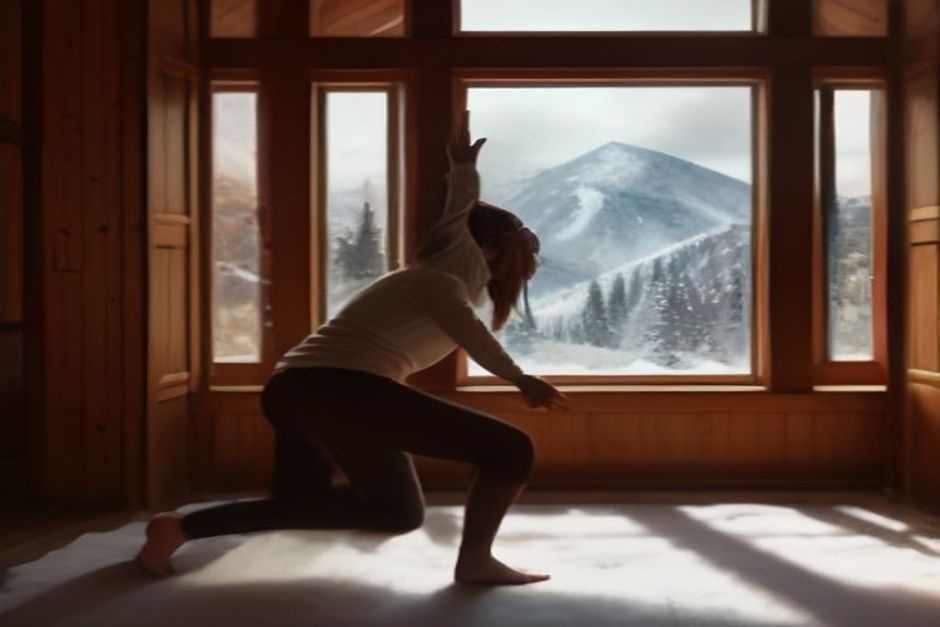
Skiing is a strange sport, physiologically. You spend the day in a half-squat, absorbing bumps with your thighs, rotating from the hips while your feet stay fixed in stiff boots — and then, in the evening, you sit down to dinner and discover muscles you forgot you owned. Yoga will not make you a better skier by magic. What it can do is prepare the specific capacities skiing spends (leg endurance, hip mobility, ankle awareness) and help you recover them afterward, so day three of the trip feels less like a penalty.
What skiing actually demands
Watch any skier from the side: hips hinged, knees bent, weight forward, thighs working continuously to control the descent. That is hours of eccentric quad work — the muscle lengthening under load — which is exactly the kind of effort that produces next-day soreness. Add hips that must rotate while the boots and bindings hold the feet nearly still, and a low back that absorbs whatever the legs cannot. The preparation list writes itself: strong legs, mobile hips, honest ankles.
Pre-season: six weeks of quiet insurance
Starting about six weeks before your first day on snow, two short sessions a week is enough. The priorities:
Chair Pose holds — Utkatasana
How: Three rounds of 30–45 seconds in Chair Pose, weight in the heels, knees tracking over the toes. Rest a minute between rounds. When that gets easy, add slow pulses — an inch down, an inch up — without losing the heel connection.
Why: This is the skiing position, minus the mountain. Building tolerance here is the closest thing to practicing the actual demand.
Goddess Pose — Utkata Konasana
How: A wide squat from the Goddess page: feet wide, knees tracking over the toes, thighs working toward parallel. Hold for five to eight breaths, come up, repeat twice.
Why: Adds the inner-thigh and hip stability that turning demands — the muscles that keep a ski edge honest.
Ankle mobility work — knee-to-wall rocks
How: Facing a wall, one foot a hand-length back, rock the front knee toward the wall without lifting the heel. Ten slow rocks per side.
Why: Ski boots lock the ankle, which means stiff ankles push the work up into the knees. The ankle anatomy page explains the chain — and the drills.
Add a few minutes of balance work if you can: simply standing on one leg while brushing your teeth trains the small stabilizers that decide whether a wobble on the slope becomes a fall. It looks like nothing. It is not nothing.
Après-ski: the fifteen-minute unwind
After a day on the slopes, the goal is not a workout — it is putting length back into what shortened and calming a nervous system that spent hours managing speed. Boots off, sweater on, floor of the hotel room is fine:
- Figure-four stretch on your back, one minute per side — for glutes that steered all day.
- Supported pigeon with the front hip on a folded jacket, two slow minutes per side — for the hip rotation you could not do in boots.
- A low lunge with the back knee padded, gentle and unforced — for quads and hip flexors that spent the day mid-range.
- Legs up the wall or calves on a chair, five minutes — for heavy lower legs and a genuine downshift before dinner.
None of this is glamorous. It just works, the way stretching works when you actually do it. Pair the evening routine with decent sleep — altitude and exertion both tax it — and the morning legs will forgive you faster.
The honest limits
Yoga will not teach you to ski; lessons do that. It will not prevent the soreness of the first big day; nothing entirely does. And if a knee twinges on the slope, the answer is a lift ticket's worth of caution and, if it persists, a professional — not a deeper stretch. But as winter practice goes, skier's yoga is one of the most practical versions there is: a clear job, done a little at a time, paying out exactly when you click into the bindings.