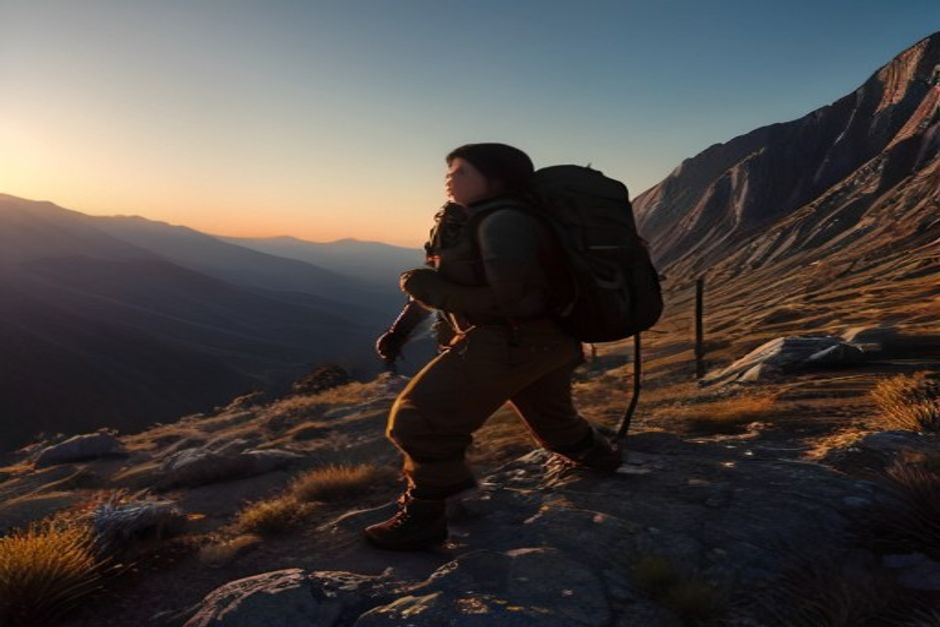
Hiking is sneaky. It feels like the gentlest of sports — you're just walking, after all — right up until mile nine, when your calves have the consistency of wooden dowels, your hip flexors have shortened to match the uphill grade, and your knees are keeping a precise ledger of every downhill step. Yoga and hiking pair unusually well: the trail builds endurance and leg strength, and the mat restores the range of motion that long, repetitive walking quietly removes. This is the practical version — what to do before, after, and on rest days.
What the trail does to your body
A long hike is thousands of repetitions of a narrow movement. Forward, mostly uphill or down, ankles bouncing over terrain, hip flexors lifting a leg with a boot on the end of it. The predictable results:
- Tight calves and ankles. Climbing keeps the ankle in constant flexion; descending loads it eccentrically. Both end in stiffness, and stiff ankles change how your knees track — our knee anatomy page explains why that matters downhill.
- Shortened hip flexors. Hours of stepping up, plus the drive to the trailhead, leave the front of the hips short — the same mechanism behind desk-posture problems, as described in hip anatomy for yogis.
- Grippy hamstrings. Descents are thousands of small eccentric hamstring contractions. They will be louder about it tomorrow than today.
- A rounded upper back. That's the backpack talking, plus hours of watching your footing.
Before the trail: a five-minute warm-up
Do this at the car or the trailhead, no mat required. The goal is not flexibility — it's telling your joints what's coming.
Ankle rocks and circles — 1 minute
How: Holding a tree or trekking pole, rock forward and back over the balls of your feet ten times, then circle each ankle slowly, five times each direction.
Why: Ankles take the first and worst of rough terrain. Warm ankles adapt; cold ankles roll.
Standing figure-four — 1 minute per side
How: Cross one ankle over the opposite knee and sit back as if into a chair, hands on a rock or pole for balance. Breathe into the outer hip for five breaths per side.
Why: Wakes up the glutes and outer hips — the stabilizers that keep your knees tracking straight on uneven ground.
Walking lunges with a twist — 2 minutes
How: Eight easy lunges, adding a gentle rotation toward the front leg on each one. Small range, no heroics.
Why: Rehearses the exact pattern of the uphill step while opening the hip flexor and mid-back — the two spots that stiffen first.
Calf raises and heel walks — 1 minute
How: Fifteen slow calf raises, then walk twenty steps on your heels.
Why: Switches on the calves and the shin muscles that control your foot on descents.
After the trail: the 15-minute recovery sequence
Timing matters here: do this within a few hours of finishing, before the stiffness sets like concrete. A mat is nice; a campsite patch of grass works.
Low lunge, hands on blocks or poles — Anjaneyasana
How: Pad the back knee. Sink into a low lunge, torso tall, hands resting on your front thigh or trekking poles. Ninety seconds per side, breathing into the front of the trailing hip.
Why: The single most important post-hike stretch. Hip flexors shortened by climbing are the main mechanical suspect in post-hike low-back aching.
Standing or supine hamstring stretch — 2 minutes per side
How: Lie on your back, loop a strap, belt, or backpack strap around one foot, and extend the leg up, keeping a soft knee. Ease in slowly. Skip the aggressive pulling.
Why: Eccentrically worked hamstrings are injury-prone when stretched hard; gentle and long beats deep and short. The mechanics are in hamstring anatomy.
Downward-facing dog, pedaling — 1 minute
How: From hands and knees, lift into a soft downward dog and pedal the feet slowly, bending one knee then the other, for a full minute.
Why: Coaxes length back into the calves and the backs of the legs while decompressing the spine after the pack's weight.
Reclined twist — Supta Matsyendrasana
How: On your back, drop both knees to one side, arms wide, eight slow breaths, then switch. Let gravity do it.
Why: Unwinds the low back and the deep hip rotators after hours of one-directional movement.
Legs up the wall (or a boulder) — Viparita Karani
How: Legs up a wall, a tent wall, a car tailgate, or a convenient rock. Five to ten minutes. Let the arms fall open.
Why: Legs up the wall drains heavy legs and downshifts the whole system after a long effort. On backpacking trips it is the single best recovery tool that weighs nothing.
On rest days between hikes
If you're hiking multiple days in a row, the rest-day work is what keeps day four feeling like day one. Ten minutes of easy cat-cow, low lunges, and gentle twists in the morning; legs up the wall in the evening. Skip deep stretching on tired muscles — the goal is circulation and comfort, not range records. And if a joint complains in a way that's sharp or one-sided, that's information, not weakness: shorten the next day, and see our honest notes in yoga for back pain if the back is the complainer.
The trail rewards the stubborn. The mat rewards the honest. Do both, and the knees might forgive you by Monday.