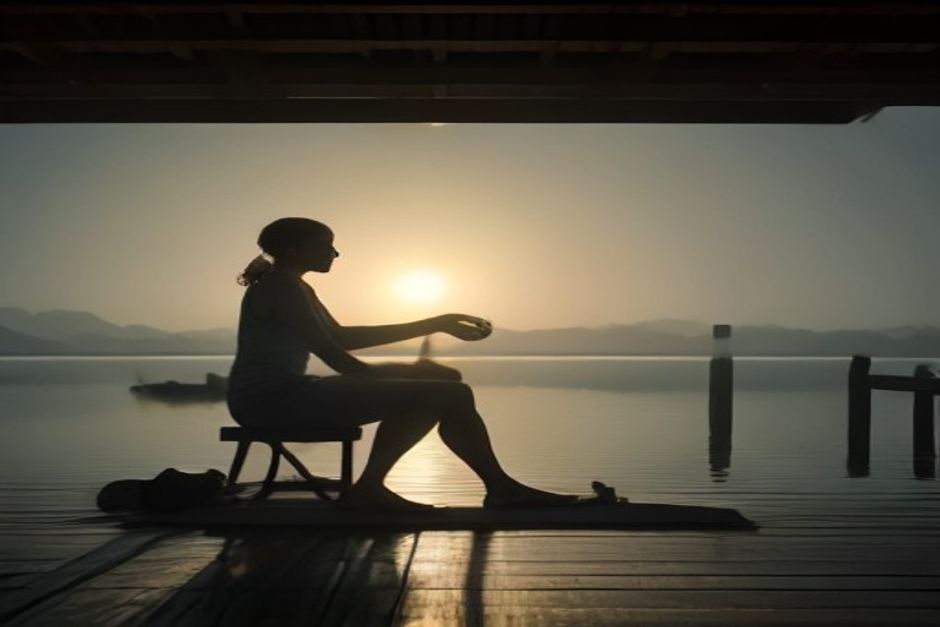
Rowing has a reputation as the perfect full-body exercise, and it nearly earns it — legs, back, arms, lungs, all in one smooth stroke. But "full-body" hides a detail that matters over a season: it is the same full-body movement, repeated. A steady outing is a couple thousand strokes, which means a couple thousand loaded hip hinges, a couple thousand rounds of shoulders reaching and pulling, a couple thousand compressions of the spine into the catch position. Repetition builds fitness and pattern in equal measure. Yoga's job, for a rower, is everything the stroke never does.
What the stroke leaves behind
Three patterns show up in nearly every regular rower:
- The low back lives loaded. The catch asks for a hinged, slightly rounded posture under force, drive after drive. Rowers' low backs are strong; they are also frequently grumpy. Strength without enough extension and decompression is the usual recipe.
- Hip flexors and hamstrings tighten in tandem. The stroke never fully opens the front of the hip, and the slide keeps the hamstrings under load in a shortened-mid range. Hinge volume up, hip extension volume zero.
- Shoulders roll forward and in. Thousands of pulls with the palms down bias internal rotation and a protracted shoulder blade — the same shape as desk work, earned at much higher wattage. The rotator cuff, detailed in rotator cuff anatomy, does the stabilizing and files the complaints.
None of this means rowing is bad for you. It means rowing is specific for you, and specificity needs a counterweight.
The poses that earn their place
Sphinx Pose — 2 minutes
How: On the belly, forearms down, elbows under shoulders, chest lifting without crunching the low back. Breathe into the front of the body. Two minutes, most days.
Why: The gentlest possible answer to a spine that spends its training life in flexion. Extension, with the load dialed low enough to actually enjoy it. The Sphinx guide covers the setup in detail.
Low Lunge — Anjaneyasana, 90 seconds per side
How: Back knee down and padded, hips sinking forward, torso tall. Rowers often have the quad flexibility for this but guard the hip flexor like a state secret — go slowly and let it open over weeks, not sessions.
Why: The missing movement: full hip extension. Every stroke ends just short of it; this pose supplies it. The low lunge guide keeps the low back from muscling in.
Thread the Needle — 90 seconds per side
How: From hands and knees, thread one arm under the body, shoulder and side of the head to the mat, and let the upper back rotate. Breathe wide into the ribs.
Why: Thoracic rotation — the movement between the shoulder blades that rowing deletes entirely. Stiff thoracic spines make the low back and the neck do overtime; this gives the middle its job back.
Puppy Pose — Uttana Shishosana, 90 seconds
How: Hips over knees, walk the hands far forward, melt the chest toward the floor. Forehead or chin down, whichever the neck prefers.
Why: Opens the lats and the front of the shoulders — the exact tissue thousands of pulls shorten. It also gently reverses the forward-shoulder posture that rowing and erg screens encourage.
Locust, gentle version — Salabhasana, 3 rounds of 20 seconds
How: On the belly, lift the chest and legs a modest few inches, arms back, and breathe. Short holds, full rest between rounds. This is endurance work for the back of the body, not a height contest.
Why: Rowers need a back that resists fatigue, and twenty-second holds train exactly that. The Locust guide covers the safer variations.
Seated Twist — 90 seconds per side
How: Tall seat, cross one leg over, rotate from the ribs, hand behind for gentle leverage. Both sides, always — rowers who sweep on one side know exactly why this sentence exists.
Why: Rotation plus a mild decompression for the spine after a session of pure hinge. Sweep rowers should count their strokes' asymmetry in years and treat the twist as maintenance, not luxury.
Hands, wrists, and the grip tax
The oar handle and the erg grip keep the hands closed and the forearms loaded for the whole session — rowers and climbers share this particular problem. Post-row, open the hands wide ten times, stretch each forearm gently both directions for twenty seconds, and circle the wrists. Two minutes of this, most sessions, is cheaper than the tendinitis that develops when you skip it for a season. The full protocol lives in wrist anatomy for yoga.
When to practice around rowing
- After on-water or erg sessions: the sequence above, ten to fifteen minutes, while warm. Sphinx and lunge first — they are the priorities.
- Rest days: a longer, slower session. Twenty to thirty minutes, heavy on the twists and shoulder openers.
- Before rowing: skip the long holds. Movement only — cat-cow, leg swings, arm circles. Long static stretches before power work are the wrong tool.
- Race week or head-race season: nothing new. Familiar poses, short holds, done.
For a second angle on the same sport — including the mental side of repetitive training — the yoga and rowing journal is the companion read. And if the low back is already talking to you between sessions, read lower back anatomy before you stretch anything aggressively.
"Train the stroke on the water. Train everything the stroke ignores on the mat. The second training is what makes the first one last."