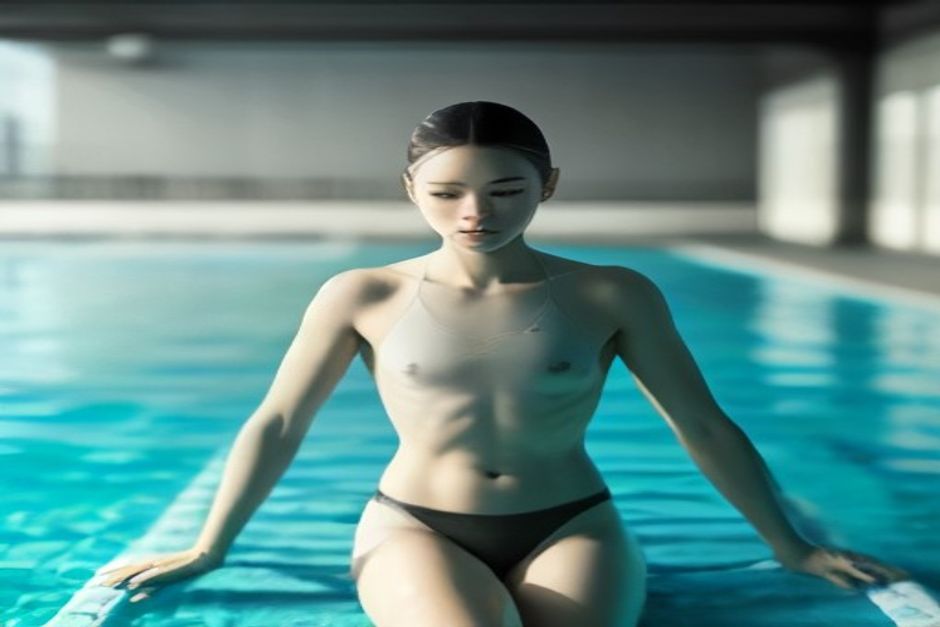
Swimming and yoga have an unusual amount in common: both are rhythmic, both run on breath, and both reward a long, organized spine. But swimming, for all its virtues, develops the body asymmetrically. The stroke repeats the same shoulder arc thousands of times per session, the hips barely rotate, and the breath is rationed rather than free. A short dryland yoga practice fills exactly those gaps — which is why so many competitive swim programs quietly include it.
What the water does to your shoulders
The freestyle stroke demands enormous range from the glenohumeral joint — the ball-and-socket at the top of the arm — while the chest and front of the shoulder shorten from pulling water. The result, over a season, is the classic swimmer's posture: rounded shoulders, tight pecs, a thoracic spine that has forgotten how to extend. Our shoulder anatomy page explains the joint mechanics; the short version is that swimmers need extension and external rotation — the exact movements the stroke never trains.
Two poses do most of that work:
Cow Face Arms — Gomukhasana arms
How: Sitting or standing, reach one arm overhead, bend the elbow so the hand drops between the shoulder blades. The other arm reaches behind the back, hand up. Clasp fingers, or hold a strap or belt between the hands if they do not meet — for most swimmers, they will not, at first. Keep the head from jutting forward. One minute per side.
Why: The top arm trains external rotation and overhead range; the bottom arm trains internal rotation and extension. One stretch, both directions of the stroke. Full details on our Cow Face Pose page.
Sphinx and gentle backbends
How: Lie on your belly, elbows under shoulders, forearms on the mat, chest lifting without strain. Two quiet minutes. Progress, over weeks, to a low Cobra or a supported Bridge.
Why: Backbends are the direct counter-shape to a swimmer's hunch. They open the chest and front shoulder and wake up the mid-back muscles that keep the shoulder blades parked where they belong. Start with Sphinx — it is nearly impossible to overdo.
The breath advantage
Here is where swimmers have an edge and do not know it. You already understand breath control better than most yogis — you have spent years inhaling strategically in the half-second your mouth clears the water. What pranayama adds is range and awareness on dry land:
- Three-part breath (Dirga) trains fuller use of the lower lungs — the capacity that shallow, panicky race breathing ignores.
- Alternate nostril breathing is a pre-race classic: five minutes settles nerves without making you drowsy.
- Extended exhale practice — exhaling twice as long as you inhale — builds comfort with the slow underwater exhale that separates relaxed swimmers from gasping ones. The safety notes in our breathwork safety article apply; keep it easy.
One warning from experience: never practice breath-holding exercises in or near the water. Shallow-water blackout is real and unforgiving. All breathwork belongs on the mat, fully dry, sitting or lying down.
The 15-minute pool-deck sequence
Do this before swimming as a warm-up, or after as a cool-down. It needs no equipment.
- 2 min — Cat-Cow, slow, matching breath to movement. Wakes the spine up along its whole length.
- 3 min — Thread-the-needle: from hands and knees, slide one arm under the body and rest shoulder and temple on the mat. Ninety seconds per side. Thoracic rotation — the thing freestyle claims to give you but mostly does not.
- 2 min — Cow Face arms, strap version, one minute per side.
- 2 min — Low Lunge with the back knee down, arms overhead. Hips barely extend during flutter kick; this fixes that.
- 2 min — Wide-Legged Forward Fold, hands on the floor or a block. Hamstrings and inner thighs, which every kick shortens.
- 2 min — Sphinx, settling the breath.
- 2 min — Seated three-part breath, finishing quiet.
Core, honestly
Streamlining is a core skill: the ability to hold a rigid, aligned line from fingertips to toes while rotating around it. Swimmers chase this with endless crunch variations, which train the front and ignore the rest. The cylinder model of the core explains what is missing, and Boat Pose plus Side Plank train it directly. Two minutes of each, twice a week, will do more for your body line than another hundred sit-ups.
Swimming gives you rhythm, breath, and a body that loves the water. Yoga gives you back the movements the stroke borrows and never returns. Fifteen minutes on the deck, and the pool gets a better swimmer.