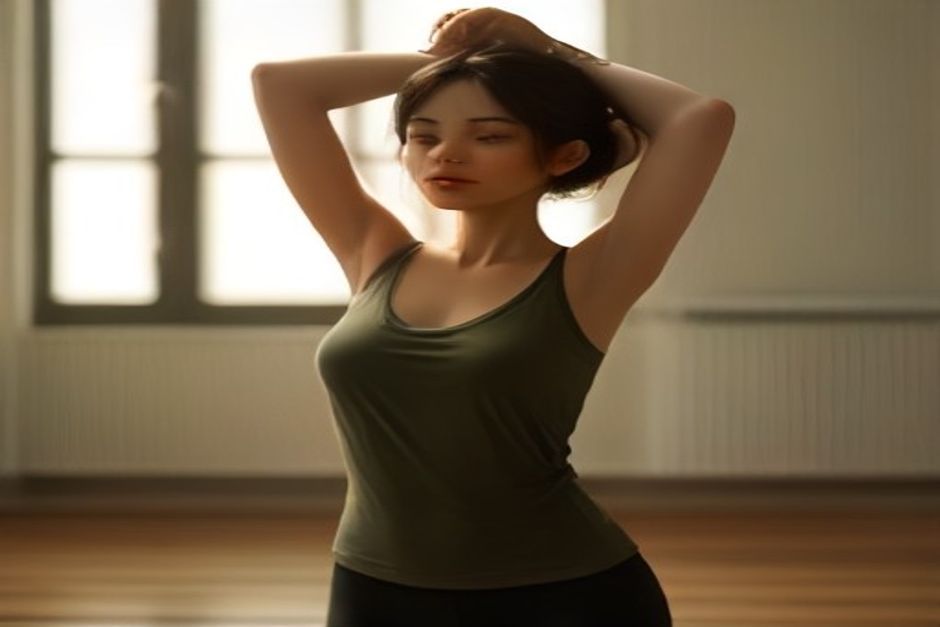
Most of us move through the day in exactly one plane: forward. We walk forward, type forward, drive forward, fold forward. The sides of the torso — the ribs, the waist, the lats, the whole quiet stretch of tissue between armpit and hip — rarely get asked to do anything at all. Crescent Moon Pose is the polite interruption. Stand tall, reach up, arc to one side, and a whole neighborhood of your body wakes up and files a report. The name comes from the shape: arms and torso curving like a crescent moon. Some traditions treat it as a standing variation of Anjaneyasana; most people just call it a standing side bend, which is exactly what it is.
What it actually opens
The honest list: the intercostal muscles between the ribs, the obliques along the waist, the latissimus running from arm to low back, and the fascia of the whole side seam. What it does not do — despite what you may feel — is decompress your spine like a traction table or wring out your organs. It's a stretch, and a good one. It also quietly trains something most forward-focused movement skips: the ability to lengthen one side of the body while the other side works. If you like the logic of Gate Pose, Crescent Moon is its standing cousin.
Crescent Moon, arms overhead — standing Anjaneyasana variation
How: Stand with feet hip-width, weight even. Inhale and sweep both arms overhead, interlacing the fingers with index fingers pointing up — or simply take the palms to face each other if the shoulders object. Ground down through both feet, then exhale and arc the whole torso to the right, arms following like a single sail. Keep both hips pointing forward, as if you're standing between two panes of glass. Take three to five slow breaths into the left ribs, inhale back to center, and repeat to the other side.
Why: Reaching the arms up first creates the length; the side bend then spends that length on the ribs and waist rather than collapsing it into the low back. The breath is the engine — each inhale makes a little more room between the ribs, each exhale lets you settle into it.
Hands-on-hips version
How: Same shape, humbler arms. Place the hands on the hips, lift the chest, and side-bend from the waist while the elbows stay wide. This is the version for days when shoulders are cranky or when you want to feel the pure side-body line without the arm variable.
Why: Removing the overhead arms lowers the demand on the shoulders and neck and often reveals that the side bend was being borrowed from the arms all along. It's a diagnostic as much as a stretch.
The pelvis problem
The most common way this pose goes wrong: the hips swing out to the opposite side like a pendulum, the standing hip pops, and the elegant crescent becomes a lean with extra steps. A swinging pelvis shortens the very waist you're trying to lengthen. The fix is unglamorous — imagine your pelvis is a bowl of water you don't want to spill, and let the bend happen above it. You will bend less far. You will feel it more. This is the trade the pose is offering.
The second common wobble: the ribs flare forward and the chest rotates toward the ceiling. A crescent moon is flat, not spiral-bound. Keep the chest facing forward; if you want rotation, that's a different pose and there are good ones.
Details worth stealing
- Bend less, breathe more. Depth is measured in rib sensation, not in how far your fingertips drift. Three full breaths in a modest arc beat one gasp in a deep one.
- Even feet, always. The moment the outside foot unloads, the pose has become a lean. Press both big-toe mounds down the whole time.
- Soften the bottom ribs. On the bending side, the lower ribs like to jut. Keep them gently knit in, and the stretch moves up into the rib cage where it belongs.
- Return slowly. Coming back to center on an inhale, with control, is half the pose. Flopping upright is how people tweak their backs in a stretch this gentle.
Where it fits in a practice
Crescent Moon earns its keep early — after Cat-Cow and a few easy standing movements, before anything demanding. It also works as a mid-day intervention at the office: thirty seconds a side, beside the desk, no mat required. Pair it with a gentle twist and a forward fold and you have a two-minute reset that covers all three planes of movement your chair pretends don't exist. If you're building a standing sequence, it slots naturally between Mountain variations and the warriors.
There's a reason side bends show up in every tradition from gym class to classical yoga: the side body is the most neglected real estate in the modern torso, and it takes about ninety seconds a day to change that. Crescent Moon is those ninety seconds, standing up.