Fire log — Agnistambhasana, literally "firewood stack pose" — is named for the shape: one shin stacked on the other, two parallel logs. It is a deep outer-hip opener in the same family as pigeon, and it has a reputation. Sit down, stack your shins, and within seconds you will know exactly how much external rotation your hips actually own. For many people the answer is "less than I thought," delivered by a top knee floating somewhere near the ceiling.
That's fine. This pose is measured in props and patience, not in how flat you can get. Here's how to build it without paying for it in your knees.
Setting up the base
The foundation — before any stacking
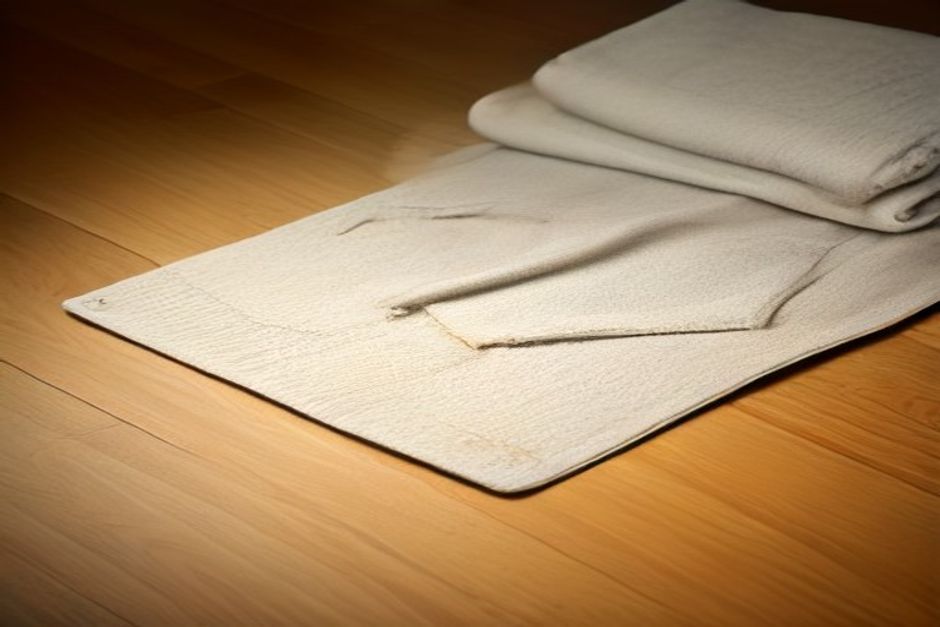
How: Sit on the floor with your legs extended, then sit on a folded blanket so your hips are higher than your knees — this single prop changes everything. Bend both knees and place your right shin in front, roughly parallel to the top of your mat, foot flexed. Now lift your left shin and stack it on top, left ankle resting on (or just beyond) your right knee, left foot flexed hard.
Why: The blanket tilts your pelvis forward so your spine can stay long instead of rounding. Flexing both feet locks the ankles and — more importantly — splints the knee joints. A soft, pointed foot in this pose is an invitation for the knee to twist, and twisting is the one thing knees refuse to forgive. See knee anatomy for the full argument.
The pose itself
Upright fire log — Agnistambhasana
How: With shins stacked and feet flexed, press your sitting bones down into the blanket and lengthen your spine upward. If your top knee floats high, support it — slide a block or folded blanket under it so it isn't hanging in space. Stay upright, breathe slowly, and hold for one to three minutes. Then switch sides; the second side is often a completely different pose.
Why: The upright version is already a substantial stretch through the outer hip and glute of the top leg. The floating knee is not failure — it's information about your hip socket. Forcing it down with your hand is how an honest stretch becomes a knee injury, because the pressure reroutes from the hip to the joint below it.
Fire log with a fold — the full version
How: Only if the upright version is calm and your top knee rests close to your bottom ankle: walk your hands forward and hinge from the hips, keeping the spine long. Stop the moment the stretch becomes sharp or the knee starts to complain. Forearms on a block is plenty; the floor is not a requirement.
Why: Folding adds load to the same tissues, not new stretch elsewhere. The long spine matters — rounding turns this into a back stretch and takes the target off the hip you came for.
When the knees say no
Some hips don't stack, no matter how much you stretch. Bone shape varies — socket depth and angle differ from person to person, and no amount of practice rearranges your skeleton. The hip anatomy page covers why "open hips" is a six-direction project, not one heroic pose. If fire log isn't yours, use these instead:
- Reclined figure four. Lie on your back, cross one ankle over the opposite thigh, and draw the legs toward your chest. Same outer-hip target, zero knee leverage, fully adjustable. Our figure four page has the standing version too.
- Half pigeon with props — pigeon pose with the front hip supported gets you the same stretch from a different angle.
- Seated shoelace-lite. Just sit cross-legged with a tall seat and hinge forward slightly. Boring, effective, uninjured.
Fitting it into practice
Fire log belongs late in a session, after the hips are warm — after lunges, warriors, or a few rounds of cat-cow at minimum. Cold deep-hip stretching is where ambitious people meet their physical therapist. Hold each side one to three minutes with slow breathing; the three-part breath gives the hold a rhythm. It also fits naturally into a yin-style practice, where long holds are the whole method.
Done honestly, fire log is one of the most direct hip openers available — no flow, no momentum, nowhere to hide. Stack the logs, prop the knee, breathe, and let the pose be whatever shape it is today. It keeps its promises. It just doesn't hurry.