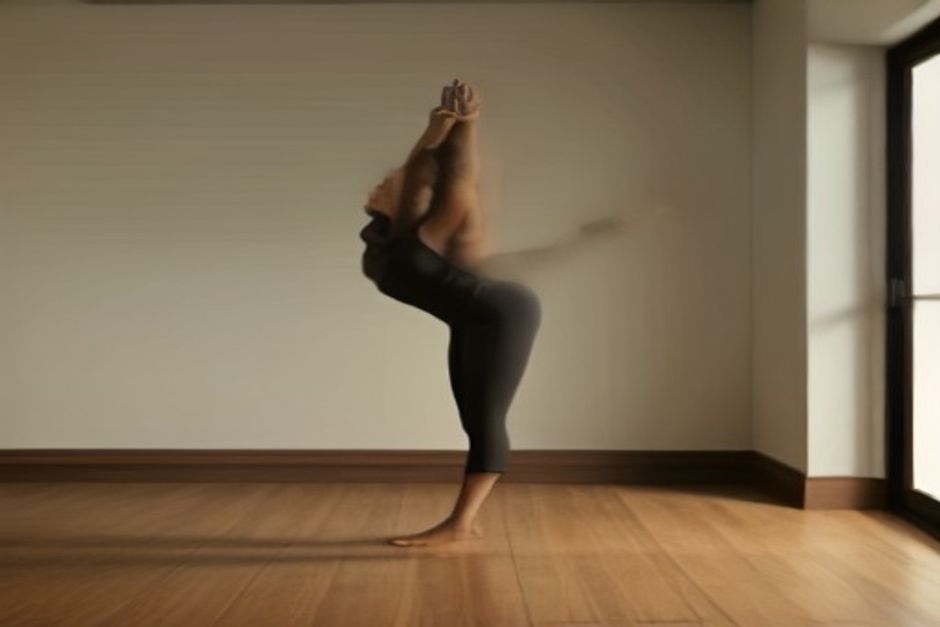
Some people love pigeon pose. The rest of us spend pigeon wondering whether our front knee is about to file a formal complaint. The standing figure-four is the answer: the same outer-hip stretch, the same glute and piriformis release, but upright, adjustable, and easy to leave at any moment. It looks like the number four drawn with your legs, which is the whole origin story of the name — no Sanskrit, no ceremony, just a shape that works.
The target of this stretch is the outer hip and deep gluteal muscles — the same territory covered in our hip anatomy guide under "external rotation." Sit all day and these muscles shorten; run or cycle and they work overtime. Either way, they tend to be the first place people point when asked where their hips feel stuck.
Version 1: at the wall — the honest starting point
How: Stand facing a wall, fingertips resting on it for balance. Shift your weight into your left leg and cross your right ankle over your left thigh, just above the knee, flexing the right foot. Now bend the standing leg and sit your hips back, as if lowering onto a chair behind you. Stop where you feel a clear stretch in the outer right hip — usually earlier than your ego expects. Hold five to eight breaths, switch sides.
Why: The wall removes balance from the equation so you can actually explore the stretch instead of surviving it. Depth comes from bending the standing leg and sitting back, not from pressing the crossed knee down — that knee is along for the ride, not a lever.
Version 2: free-standing — balance included
How: Same shape, no wall. Start by holding something if you need to, then release the hands to your heart or your hips. Soften the standing knee, keep the lifted foot flexed, and find a fixed point to look at — a drishti, a spot on the floor, anything that does not move. Sit back into the stretch slowly.
Why: This version adds single-leg balance to the hip opener, so it trains two things at once — which is efficient and also humbling. Wobbling is not failure; it is the ankle and hip learning to cooperate. If you enjoy this flavor of challenge, tree pose and eagle pose live in the same neighborhood.
Version 3: seated — the chair option
How: Sit near the front edge of a sturdy chair, feet flat. Cross the right ankle over the left thigh, flex the foot, and let the right knee fall open. Stay upright for a mild stretch, or hinge forward from the hips with a long spine for more. Keep the chest lifted rather than rounding over the leg.
Why: This is the version for offices, airplanes, and anyone whose balance or knees prefer sitting. It is also the best way to compare sides honestly — most people have a "good" hip and a "diplomatic incident" hip. Give the tighter side a second round, not a deeper push.
Version 4: reclined — the floor, on your terms
How: Lie on your back, knees bent, feet on the floor. Cross the right ankle over the left thigh, then thread your hands behind the left thigh and draw it toward your chest. The right knee presses gently away. Head stays down; shoulders stay heavy.
Why: When you lie down, gravity does the stabilizing and your hands control the dosage precisely. This is the gentlest deep version and a reasonable substitute for pigeon on days when pigeon is simply not happening.
Common mistakes
- Pressing the crossed knee down. The stretch lives in the hip of the crossed leg, and the entry is the sit-back of the standing leg. Cranking the knee is how ankles and knees get annoyed.
- The floppy foot. Keep the crossed foot flexed — toes drawn back toward the shin. A pointed, relaxed foot leaves the ankle vulnerable and leaks the stretch.
- Rounding the spine to find depth. Folding with a rounded back trades a hip stretch for a back strain. Hinge from the hips; the spine stays long.
- Bouncing. Static and slow wins here. Bouncing invites the stretch reflex, which tightens the exact muscle you are trying to lengthen.
Where it fits in practice
Use the standing version after a warm-up or at the end of a standing sequence — it pairs naturally with warrior work. The seated version is a legitimate desk-day intervention, no mat required. The reclined version belongs near the end of practice, before savasana. All four appear in our broader pose library philosophy: same stretch, many doors.
Knee note: if the crossed leg's knee feels pinching or twisting — as opposed to the hip stretching — back out and take the reclined version instead. Sensation in the outer hip is the goal; sensation in the knee joint is a stop sign, not a challenge. And if you have a hip or knee injury, check with a physiotherapist about whether deep external rotation suits you right now.