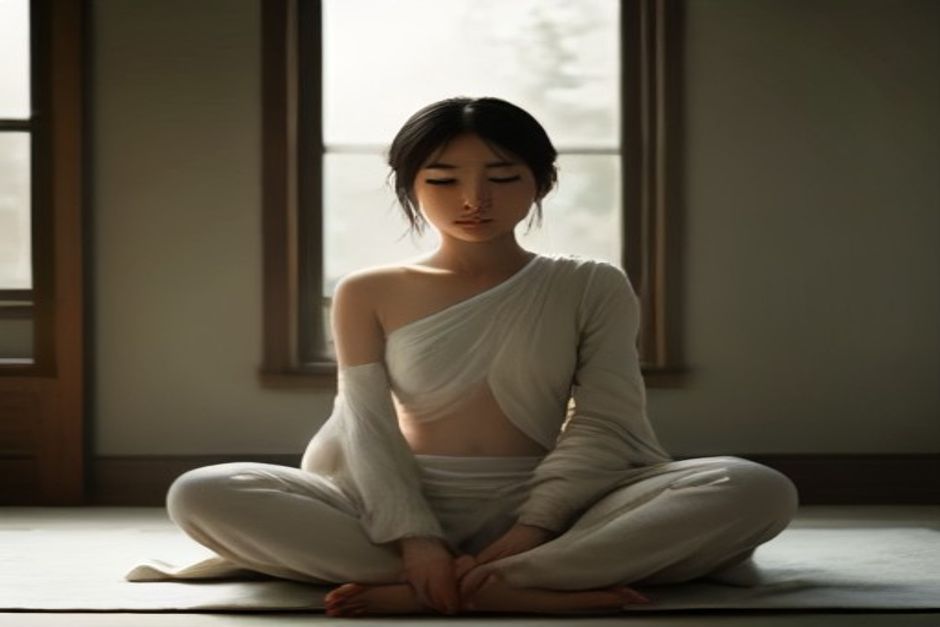
Ardha Padmasana — "half lotus seat" — is the pose on every meditation-cushion label: one foot resting on the opposite thigh, the other leg tucked beneath. It looks inevitable, as if serious meditators simply sit that way. Here is the honest version: half lotus is a hip-mobility test wearing a meditation costume. Pass the test and it is a wonderfully stable seat. Fail it and force it anyway, and your knee pays the bill your hip ran up.
The anatomy in one paragraph
Lotus-family poses ask for external rotation of the thigh bone in the hip socket — a lot of it. The knee, meanwhile, is mostly a hinge: it bends and straightens, and tolerates almost no twisting. When a hip that does not rotate far enough is asked for lotus, something has to give, and the something is always the knee. This is why hip anatomy matters more here than willpower, and why the knee's actual design makes "pushing through" a genuinely bad strategy.
The honest self-test
Before attempting half lotus, sit on the floor in butterfly pose — soles of feet together, knees out. If your knees float near shoulder height and no amount of patient breathing brings them lower over a few weeks, lotus is not your pose this year, and that is information, not failure. Second test: lie on your back, cross one ankle over the opposite thigh in a figure-four, and gently draw the legs toward your chest. If that position already pulls sharply, the seated version will ask for more. Both tests take ninety seconds and can save you months of knee trouble.
Half lotus with support — Ardha Padmasana
How: Sit on a folded blanket or two — enough height that your knees rest at or below hip level. Cross your legs, then lift one foot (start with your more cooperative side) and place it in the crease of the opposite hip, the sole turning upward only as much as it wants to. The foot belongs in the hip crease, not squashed flat on top of the thigh. Let the lifted-side knee drop toward the floor; if it hovers, slide a block or folded blanket under it so the leg is fully supported. Stack the spine tall, hands wherever they rest easily.
Why: Sitting height tilts the pelvis forward, which is what allows the hip to rotate. Supporting the lifted knee removes the sideways torque that otherwise travels straight into the joint.
Half lotus against the wall
How: Set up as above but with your back against a wall, sitting bones a hand's width away from it. Use the wall to find length rather than collapsing into the low back. Stay for one to three minutes, then switch which leg is on top — both sides, always, even if one is comically worse.
Why: The wall removes the balance and posture work so you can feel what the hip is actually doing. It also makes the pose usable for meditation, where comfort outranks ambition.
When cross-legged wins — Sukhasana
How: Sit on your blanket height and place each shin in front of the other, feet resting under the opposite knees rather than on top of anything. Cushion the ankles if the floor bites.
Why: This "easy pose" delivers everything meditation actually needs — a stable base, a tall spine, knees below hips — with a fraction of the knee risk. Meditation does not grade your seat. If you are choosing a position to sit in for twenty minutes a day, choose the boring one you can keep. Our guide to meditation posture makes the full case.
Building toward it, if you care to
Hip rotation changes slowly — over months, with regular, gentle input. The useful inputs are pigeon with a supported pelvis, butterfly with the back against a wall, and low lunges for the hip flexors that keep the pelvis pinned. Ten quiet minutes after practice, three or four times a week, beats one heroic Sunday session. Some hips will never lotus, because some hip sockets are shaped in a way that simply runs out of room. No stretch changes bone shape, and no teacher should pretend otherwise.
You will find half lotus in our pose library alongside the rest of the family — but treat it as an option, not a rank on a ladder.
Skip half lotus entirely if you have a history of meniscus or ligament injury, a hip replacement, or knee pain in daily life — talk to a physiotherapist or doctor first. In the pose: sharp or localized sensation in the knee means come out now, not after the timer. Numbness or tingling in the foot means the same.