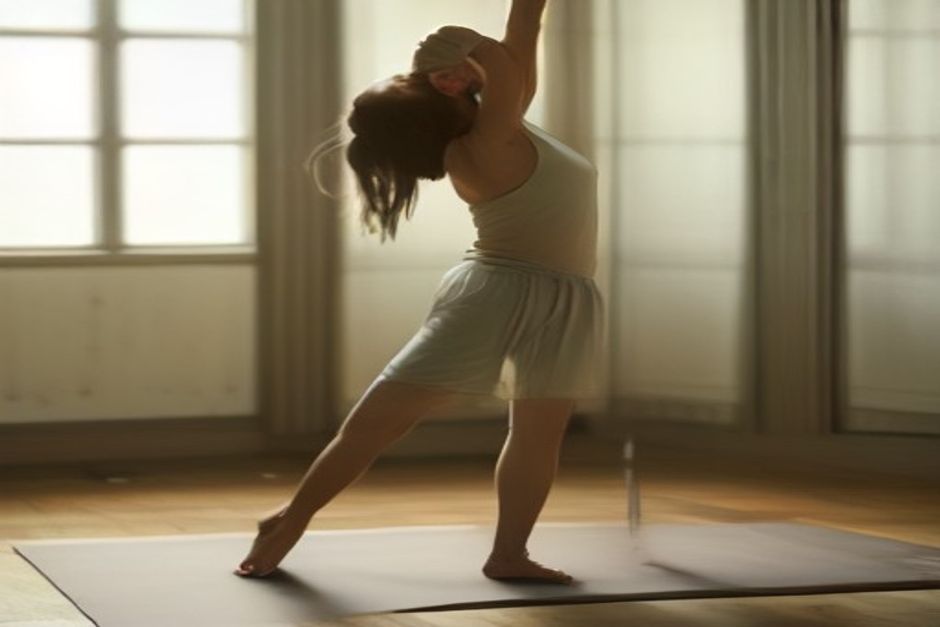
King Pigeon — the full version of Eka Pada Rajakapotasana, where the back foot ends up in the crook of your elbow and your head leans back toward your sole — is one of those poses that lives on yoga posters and almost nowhere else. In most real classes, the honest version is the pigeon fold with a blanket under the hip. This page is about the territory in between: the preparatory work that moves you toward the full pose without pretending you will get there by next Thursday. Spoiler: for most adults, "there" is measured in years, and that is fine. The prep is a good practice all by itself.
What the full pose actually asks for
King Pigeon is three poses wearing one costume:
- A deep quad and hip-flexor stretch on the back leg — deeper than most runners and desk workers have ever needed.
- A real backbend, not a gentle chest opener. The spine has to extend while the front hip is anchored in external rotation.
- Shoulder mobility enough to reach back, catch the foot, and rotate the elbow upward without the joint complaining.
If any one of the three is missing, the pose does not happen — or worse, it happens at the expense of your low back or front knee. So the intelligent approach is to train each ingredient separately, then combine them slowly.
The progressions
Low lunge with quad stretch — Anjaneyasana variation
How: From a low lunge with the back knee padded, bend the back knee and catch the foot with the same-side hand. If the foot is far away, loop a strap around it and hold the strap with both hands. Keep the front of the pelvis dropping and the tailbone lengthening — the stretch belongs in the front of the back thigh, not in a pinch at the low back.
Why: This is the single most important prerequisite. Until your quad allows the heel near the buttock here, the back leg of King Pigeon is theoretical.
Supported pigeon — Eka Pada Rajakapotasana prep
How: Set up pigeon with a folded blanket firmly under the front buttock so the pelvis stays level. Stay upright on the hands at first; fold only when the hip genuinely releases. The front shin does not need to be parallel to the mat — a heel closer to the groin is the knee-friendly option.
Why: This is the hip-rotation half of the pose. It is also where most people should live for a long time. Details and knee rules are on the full pigeon page.
Camel with blocks — Ustrasana variation
How: Kneel with a block on either side of the ankles. Lift the chest, keep the hips over the knees as long as possible, and take the hands to the blocks rather than the heels. Let the head come back only if the neck is comfortable.
Why: Camel teaches the backbend pattern King Pigeon needs — chest lifting up and back while the thighs stay vertical — in a position where you can bail out instantly.
Dancer with a strap — Natarajasana variation
How: Standing, loop a strap around one ankle and hold it overhead with both hands, elbow pointing up. Kick the foot into the strap to open the chest rather than pulling with the arms. Work near a wall for balance.
Why: Dancer is King Pigeon turned upright. It trains the exact overhead grip and shoulder rotation you will eventually use to catch the foot — without the front hip pinned to the floor.
A realistic timeline
Here is the part nobody puts on the poster: if you started yoga as an adult with average tightness, the full pose may take two years, five years, or may simply never be your shape — hip sockets differ, and some skeletons run out of rotation before the pose runs out of demands. That is not failure. The hip flexor and quad opening alone will change how you stand and walk. The backbend preparation will improve your wheel and your posture at a desk. King Pigeon prep is one of those cases where the journey genuinely is the point, mostly because the destination charges an entrance fee many knees should not pay.
Work on the ingredients and let the pose decide when — and whether — it wants to assemble itself.