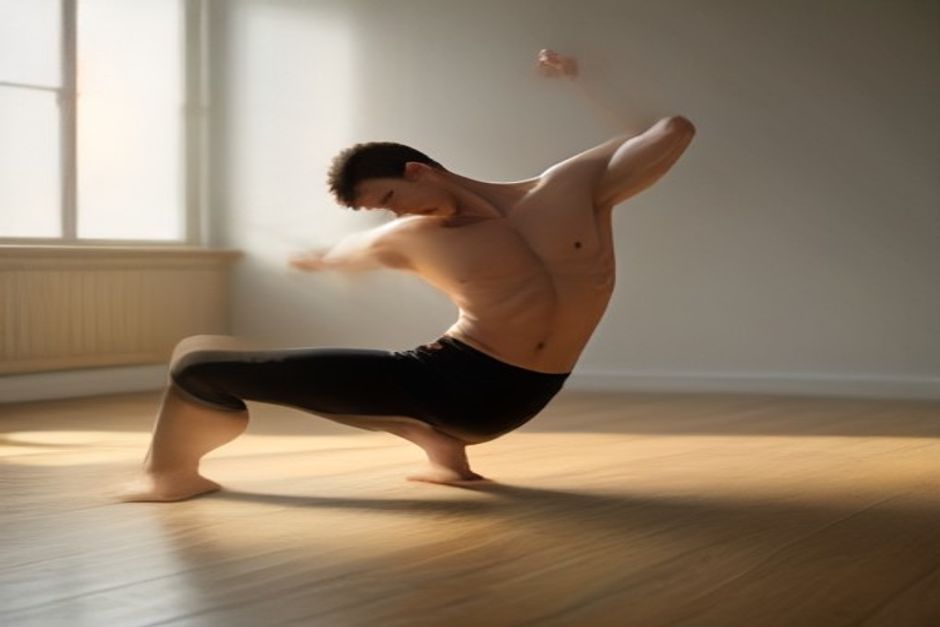
Reverse Warrior — Viparita Virabhadrasana, literally "reversed hero pose" — is what happens when Warrior II decides to open instead of hold. The legs stay in the same demanding lunge; the torso tips back and the top arm arcs overhead, turning a strength pose into a side-body stretch. It appears constantly in flowing classes because it feels generous and photographs well. It also quietly falls apart in two places — the front knee and the low back — unless you know what to watch. This page is what to watch.
The legs do not get a holiday
The most common way Reverse Warrior goes wrong is that the upper body gets all the attention while the legs silently collapse. The moment the torso reaches back, the front knee tends to drift inward and the front thigh unloads — which converts a strong, grounding lunge into a knee-twisting lean. The rule is simple: the pose changes above the waist only. If your legs feel noticeably easier in Reverse Warrior than in Warrior II, something has switched off that should be working.
Reverse Warrior, full version — Viparita Virabhadrasana
How: From Warrior II with the right foot forward: check that the front knee still tracks over the second toe and the front thigh is working toward parallel. On an inhale, flip the front palm to face up and sweep the right arm up and back alongside the ear. Slide the left hand down the back leg — thigh, not knee — and let the torso tip back, ribs spiraling open toward the ceiling. Keep weight evenly through both feet. Breathe into the stretched right side for three to five breaths. To exit, inhale the torso back to upright on the strength of the legs, then straighten the front knee before stepping out or switching sides.
Why: Done this way, the pose pairs a genuine side-body and intercostal stretch (the muscles between the ribs, which rarely get lengthened) with the leg strength of Warrior II. The reach back also opens the hip flexor of the back leg, which desk workers need as much as the low lunge provides.
Gentle version — hand to thigh, short arc
How: Same entry, but bring the front forearm to rest lightly on the front thigh and arc the back arm overhead instead, palm facing the floor. This is technically a cousin of Extended Side Angle, and it is the right choice when balance feels wobbly, the front leg is tiring, or tipping back pinches the low back.
Why: You keep roughly the same side-body length with far less demand on balance and lumbar control. Better a modest arc you can breathe in than a deep one you are bracing against.
The rib cage is the steering wheel
Two lower-body checkpoints, then the important one. Front knee: keep it pointing over the second toe; if it wobbles inward, press the outer edge of the front foot down and re-bend the knee toward the pinky-toe side. Back leg: keep the outer back foot anchored — that press is what lets the hips stay low while the torso travels.
Now the ribs. The stretch should live in the side waist — from the top of the hip to the armpit — not in the low back. If you feel compression in the lumbar spine, you are bending backward instead of sideways-up. The fix: imagine the spine growing longer up out of the pelvis before it arcs, and keep the lower front ribs from flaring. Think "long bow," not "hinge." A shorter reach with length beats a dramatic reach with crunch, every time, in every backbend-adjacent pose from Triangle to Camel.
Breathing is the point
Reverse Warrior is one of the few standing poses where breath is the headline. The arced position stretches the intercostals, so each inhale has somewhere new to go — deliberately send the breath into the open side and feel the ribs widen under the top arm. This is a practical lesson in what the breath mechanics page describes: the rib cage is a moving container, and poses like this teach it to move in places it usually doesn't. Three slow, wide breaths in the pose are worth ten shallow ones.
Where it fits in practice
Reverse Warrior almost always appears mid-flow, straight after Warrior II — often as part of the same breath (inhale to reverse, exhale to Side Angle or Chaturanga). Standing alone, it makes a good mid-sequence reopener after several strength poses, and it pairs naturally with Triangle for a standing side-body theme. If your practice is short, a Warrior II → Reverse Warrior → Triangle chain on each side is a complete standing sequence in about four minutes.