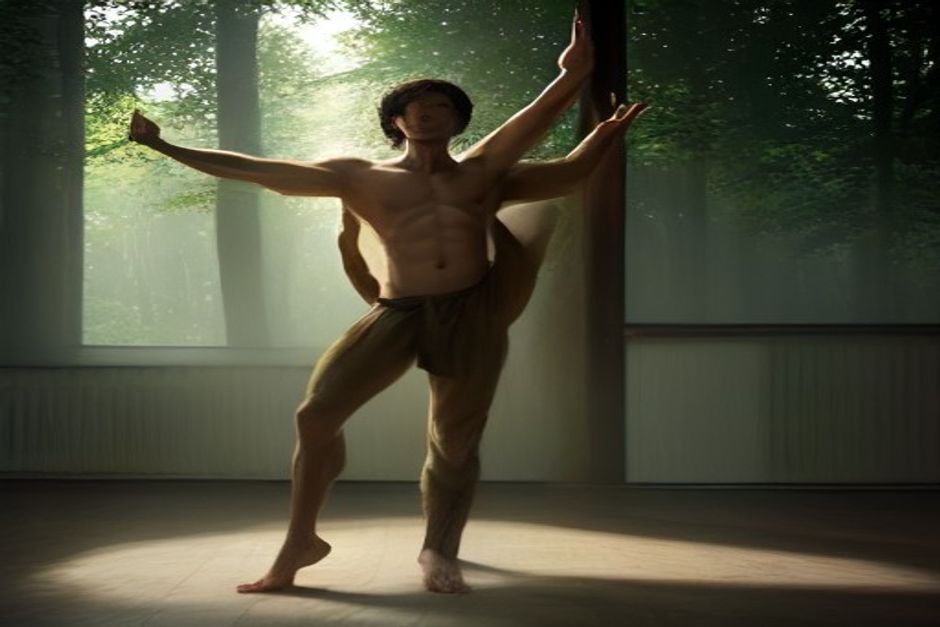
Tree pose is where most people meet balance for the first time, and the meeting usually goes the same way: thirty seconds of stillness, a wobble, a foot slapping down, a glance around the room to see if anyone noticed. Nobody noticed, and the wobble was the practice. Vrksasana — from vrksa, tree — is less about becoming a tree than about what trees actually do in wind: sway, adjust, and stay rooted anyway.
Why balance matters more than you think
Standing on one leg looks like a party trick until you notice that walking is a series of one-legged stands with falling in between. Balance is a trainable skill — the balance anatomy page explains how vision, the inner ear, and sensors in the feet and ankles vote on every step — and it is one of the first physical capacities to fade when it goes unpracticed. Tree pose is the cheapest, safest balance training available: no equipment, low stakes, immediate feedback.
Tree pose, basic version — Vrksasana
How: Stand with feet hip-width apart. Shift your weight into your left foot — all of it, slowly — until the right foot feels light. Bend the right knee and place the sole of the right foot against the inner left thigh or the inner calf, never against the knee joint itself (see below). Press foot and leg firmly into each other. Hands at the heart to start; arms overhead when steady. Fix your gaze on one unmoving point at eye level. Hold for five to ten breaths, then switch sides — and expect the second side to be a different, worse tree.
Why: The mutual press of foot and standing leg creates the stability; the lifted knee opens the hip; the fixed gaze (a drishti) gives the brain an anchor. Three systems, one pose.
The knee rule, in full
How: Your raised foot has two approved addresses: high on the inner thigh, or low on the inner calf below the knee. The one forbidden address is the side of the knee joint.
Why: Pressing a foot into the side of the knee pushes the joint sideways — a direction knees are not built to be pushed. The knee bends forward and back like a hinge; it does not appreciate lateral encouragement. Higher is not better, by the way. Foot on the calf with excellent balance beats foot on the thigh while gripping for survival. The knee anatomy page has the details if you want them.
Wall tree
How: Stand sideways to a wall, one hand resting on it, and take the full pose. Or face the wall with fingertips touching it lightly.
Why: This is not the beginner's shame version — it is the precision version. With balance outsourced to a fingertip, you can feel everything else: how the standing hip wants to jut, how the raised knee wants to droop, where your weight actually sits in the standing foot. A minute of wall tree teaches more than a week of wobbling in the middle of the room.
Chair tree, for real constraints
How: Sit tall in a chair. Cross one ankle over the opposite thigh — a seated figure four — or simply extend one leg and hold. Straighten the spine, bring hands to the heart, breathe.
Why: For anyone with foot, ankle, or vestibular issues — or anyone practicing in an office in shoes — this keeps the hip opening and the upright posture while removing the fall risk. Balance work can wait; the pose's other benefits cannot.
The wobble is the training
Here is the thing beginners get wrong: a tree pose with no wobble is a tree pose with no learning. Balance improves through corrections — the ankle making a hundred tiny adjustments, the attention catching the drift before the fall. A still tree on a good day means your system found the answer; a swaying tree means it is searching, and searching is where the adaptation happens. This is why the pose gets harder when you close your eyes (removing vision's vote) and easier when you pick a drishti — you can tune the difficulty like a dial.
Once basic tree is steady, the honest next steps are not fancier legs but harder conditions: arms overhead and swaying gently, eyes closed for three breaths, or transitions — stepping from tree into warrior III without the foot touching down. Related balances like eagle and half moon build on the same skill.
A daily thirty seconds
Balance responds to frequency like few other skills do. Thirty seconds of tree per side while the kettle boils, barefoot on a hard floor, is a complete program. In a month you will notice the pose change; in a year you will notice everything else change — stairs, icy sidewalks, the moment you trip and don't fall. Trees do not try not to fall. They just keep adjusting. That is the whole pose, and honestly, most of practice.