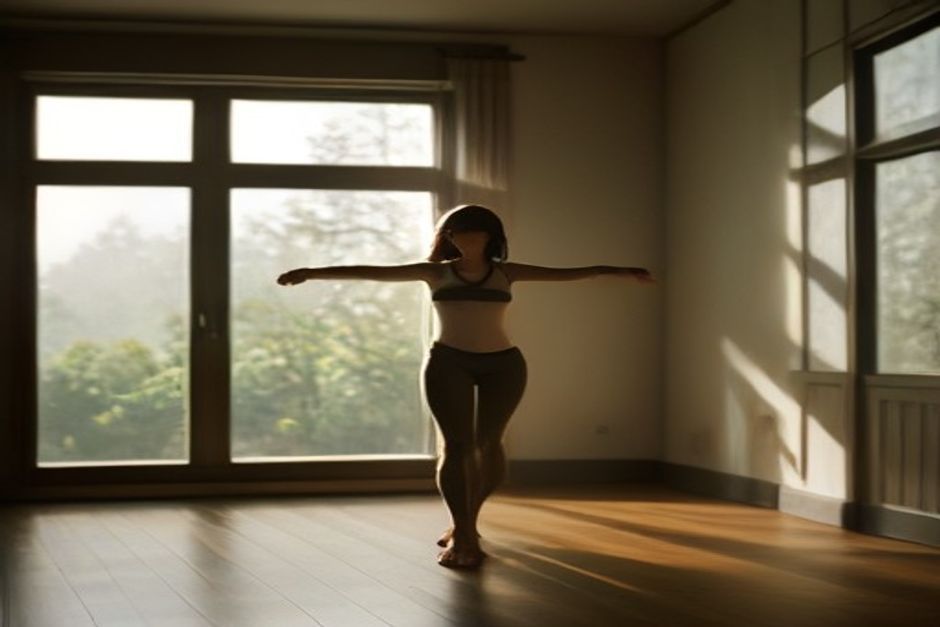
Watch a beginner wobble in a balance pose and you'll usually see the same thing: their eyes are doing laps around the room. Watch an experienced practitioner and their gaze is parked on one spot, calm and almost boring. That parked gaze has a name — drishti — and it's one of the simplest, most underused techniques in all of yoga.
The word itself
Drishti (दृष्टि) comes from the Sanskrit root drish, "to see." It means sight, view, or gaze. In the Ashtanga vinyasa tradition it became a formal part of the method: every pose gets an assigned gaze point, and holding it is considered part of the pose, as much as the position of your feet. In other traditions the instruction shows up more casually — "find a spot," "soften your gaze" — but the principle is the same.
There are nine classical drishtis in the Ashtanga system:
- Nasagrai — the tip of the nose (used in forward folds and many standing poses).
- Bhrumadhya — the space between the eyebrows (in a few seated and twisting poses).
- Hastagrai — the hand, usually the thumb of the raised hand (triangle, side angle).
- Padayoragrai — the toes (seated forward bends).
- Parsva — to the side, left or right (twists).
- Urdhva — upward (poses like Warrior I).
- Nabi chakra — the navel (downward-facing dog).
- Angustha ma dyai — the thumbs (the start of sun salutations).
You do not need to memorize these. What matters is the underlying move: one steady point, soft focus, held for the length of the pose.
Why your eyes decide whether you fall over
Balance runs on three inputs: your inner ear (vestibular system), the position sensors in your muscles and joints (proprioception), and your vision. Of the three, vision is the one your brain trusts most — which is why standing on one leg with your eyes closed is suddenly very hard, and why staring at a moving crowd makes you sway.
A fixed drishti gives your visual system a stable reference frame. When the spot doesn't move, your brain can cleanly separate "I am moving" from "the world is moving," and micro-corrections get faster and smaller. When your eyes wander, every glance feeds your balance system new noise. This is not yogic lore; it's basic sensorimotor physiology, and you can test it in thirty seconds. Stand in eagle pose or Warrior III while reading the titles on a bookshelf. Then repeat with your eyes resting on one unmoving point. The difference is embarrassing.
The attention half of the trick
The balance benefit is mechanical, but drishti has a second job: it occupies the part of your mind that likes to commentate. A wandering gaze usually means a wandering mind — checking the mirror, checking the clock, checking the person on the next mat. A held gaze is a held attention. In that sense drishti is a meditation technique smuggled into a physical practice: same skill as following the breath, just routed through the eyes.
The tradition makes this explicit. Trataka, the practice of steady gazing at a candle flame or a point on the wall, is drishti turned into a full meditation of its own. If you find your balance poses are fine but your mind is restless, that's the branch to explore next.
How to actually do it
- Pick the point before the pose. Don't balance first and aim later. In a standing balance, choose a spot on the floor four to six feet in front of you, roughly at eye level once you're in the pose.
- Soft, not hard. Drishti is a resting gaze, not a stare-down. If your eyes ache or your brow is furrowed, you've turned a focus tool into a tension source. Let the edges of your vision stay fuzzy.
- Keep the neck neutral. Some classical drishtis (upward, between the eyebrows) ask a lot of the neck and eye muscles. If tilting your head back pinches your neck, pick a point on the wall instead of the ceiling. The pose serves you, not the other way around.
- When you lose it, come back. The gaze will break. Noticing that, and calmly re-parking your eyes, is the entire practice — same as returning to the breath in meditation.
The honest part
You'll sometimes hear drishti described in energetic terms — directing prana with the eyes. Take that as a poetic description of a plain effect: attention follows gaze, and where attention goes, sensation and stability follow. You don't need the metaphysics for the technique to work. A wobbly half moon doesn't care what you believe about subtle energy; it cares whether your eyes are still.
Drishti is the cheapest prop in yoga: it weighs nothing, costs nothing, and fixes half of every balance problem on contact.