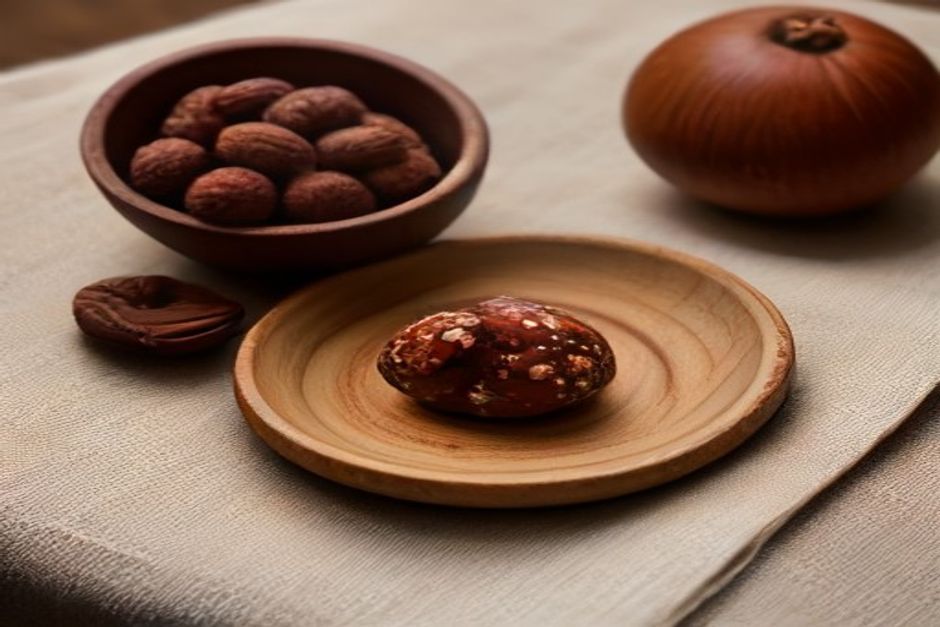
Shops sell these as "bliss balls" or "protein bites," four dollars for a packet of two. The ingredient list, once you decode it, is dates and nuts pressed into a sphere. You own both ingredients. You probably own the food processor. The markup on this product is one of the great quiet scandals of the wellness aisle, and the homemade version takes ten minutes, keeps for two weeks, and tastes better because you get to decide what "better" means.
The formula (memorize this, never need a recipe again)
One cup of pitted dates to one cup of nuts, plus a pinch of salt. That is the entire architecture. The dates are the glue and the sweetness; the nuts are the body and the staying power; the salt is what stops it tasting like candy. Everything else — cocoa, coconut, spice, citrus — is decoration on that frame.
- Dates: medjool are the softest and easiest to work with; cheaper deglet noor work fine if you soak them in warm water for ten minutes first. Pit them. The pits will find your blender blade otherwise, at speed.
- Nuts: almonds, cashews, walnuts, or any mixture. Cashews make the softest, most truffle-like ball; walnuts go slightly bitter in a way that loves cocoa; almonds are the neutral default. Peanuts work and cost the least.
- Salt: a small pinch per batch. Non-negotiable.
Method
Process the nuts first, alone, until they look like coarse sand — twenty seconds. Add the dates and salt, and process until the mixture climbs the sides and holds together when you pinch it, one to two minutes. If it stays crumbly and won't hold, add dates one at a time until it does. If it's sticky paste that coats everything, add a spoon of ground nuts or oats. Roll into balls about the size of a walnut — you should get ten to twelve. Roll them in cocoa, shredded coconut, or crushed nuts if you want them to look like they cost four dollars.
Three variations worth making
- Cocoa and walnut: use walnuts, add a tablespoon of cocoa powder and a drop of vanilla. Roll in more cocoa. Tastes like the brownie version of restraint.
- Lemon and coconut: use cashews, add the zest of a lemon and two tablespoons of shredded coconut to the mix, roll in more coconut. The spring flavor.
- Chai-spiced almond: use almonds, add a quarter teaspoon each of cinnamon and ground ginger, a pinch of cardamom and black pepper. The one to make in autumn.
Nut-free: swap the nuts for rolled oats and sunflower seeds in equal parts — the texture goes slightly softer and the balls become school-safe and allergy-friendly. Toast the oats in a dry pan for five minutes first if you want a deeper flavor.
On cost: a batch of twelve homemade balls runs roughly the price of two shop-bought ones. The dates are the expensive part; everything else is pantry change. Make one batch and the four-dollar packet will never tempt you again.
Storage, and an honest word about portions
In a sealed box, they keep two weeks in the fridge and a solid week at room temperature — which is why they're the standard answer for travel days, hiking bags, and the studio bag's emergency pocket. They survive being sat on. They do not survive being left in a car in August.
Now the honesty: dates are sugar. Natural, fiber-packaged, nutrient-accompanied sugar — but sugar. Two balls is a snack that will carry you from lunch to dinner or through the hour before practice; six is dessert wearing a health costume, and it's the easiest thing in the world to eat six. The useful habit is to pack a portion, not the batch. If you want the lighter pre-practice option, a green smoothie does that job; if you want something warm and savory instead of sweet, kitchari is the other end of the spectrum. For how snacking fits the rest of the day, the nutrition page has the full picture.
Two is a serving. Six is a mood. Know which one you're having.