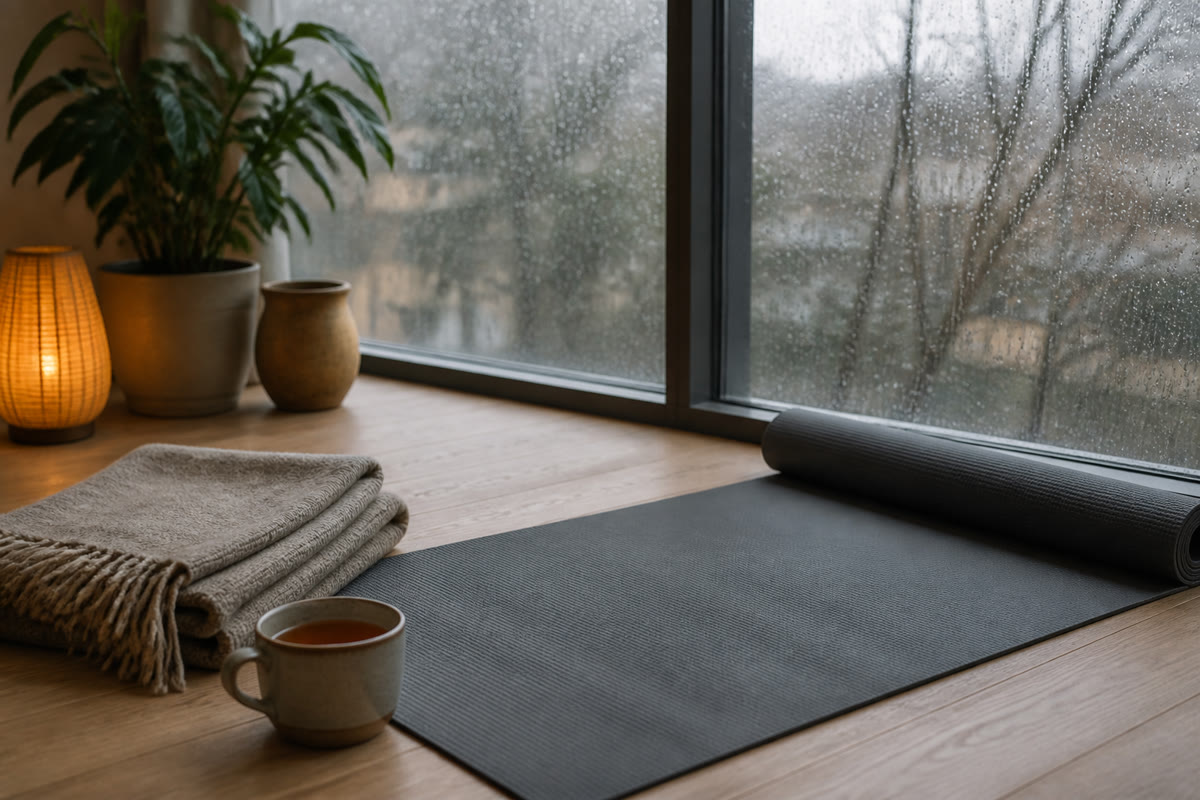
January gets all the attention — fresh starts, new mats, heroic intentions. December gets the candles and the solstice. February gets nothing, and that is precisely its character: the long middle of winter, when the novelty has worn off, the light is still short, and spring is far enough away to feel theoretical. If your practice survives February, it is probably real.
This is not a month for expansion. It is a month for maintenance — and maintenance, unglamorous as it sounds, is most of what a lifelong practice actually is.
Why February practice feels hard
The obstacles are structural, not moral. Motivation runs on novelty and visible progress, and February offers neither: you have done these poses before, and nothing looks different in the mirror from last week. Meanwhile the body genuinely behaves differently in deep winter — colder muscles, stiffer mornings, a nervous system tilted toward hibernation. Add the ambient gloom and it is no surprise that the mat stays rolled.
The mistake is interpreting this as failure. It is a season doing what seasons do. Our winter practice page makes the case in detail: winter practice has different goals than summer practice, and pretending otherwise is how people quit something that was working fine.
The February rule: small and warm
Two adjustments carry the month. First, shrink the unit of practice until it is too small to negotiate with. Not an hour, not a sequence — ten minutes, or three poses, or just child's pose and a long exhale. The point in February is not the workout; it is keeping the appointment. A practice you do beats a practice you admire.
Second, build heat gently instead of demanding it. Cold muscles asked to perform produce resentment, not warmth. A smarter approach:
- Start under a blanket. Literally. Two minutes of slow breathing wrapped up warm, then move. Nobody is watching.
- Warm the spine before the limbs. Cat-cow, gentle twists, slow rolling bridges — the big muscles wake up faster when the spine moves first.
- Use repetition instead of depth. Five easy sun salutations at half depth build more honest heat than one forced deep lunge held while shivering.
- End long and still. February savasana deserves an extra blanket and an extra two minutes. This is not laziness; it is seasonal appropriateness.
A 15-minute February sequence
For the days when even deciding what to do is too much:
- 2 minutes: Seated or lying, hands on ribs, slow breath. Let the exhale run long.
- 3 minutes: Cat-cow, then thread-the-needle or a gentle seated twist on each side.
- 5 minutes: Three to five slow half sun salutations — reach up, fold, halfway lift, fold, rise. Boring on paper, warm in practice.
- 3 minutes: One standing pose per side — warrior I or a simple lunge with the back knee down. Enough to feel legs, not enough to dread.
- 2 minutes: Legs up the wall or a folded-blanket savasana, extra layer on top.
Fifteen minutes, no heroics, no equipment beyond a blanket. The midwinter morning practice offers a similar template tuned for dark mornings if evenings are not your time.
Working with the mood of the month
February's flatness is not only an obstacle; it is also material. Yoga has never been only about feeling good — it is about noticing clearly, and a grey, unmotivated Tuesday is excellent noticing practice. Roll out the mat in a bad mood and just watch it. Not fixing it, not waiting for it to lift before you begin. Ten minutes later, something has usually shifted by a few degrees, and even when it hasn't, you kept the appointment.
Track the month by attendance, not intensity: a simple mark on a calendar after each short practice is enough. The visible chain makes quiet consistency concrete without turning February into another performance project.
That is the whole February lesson, and it generalizes: practice is something you do from your actual state, not your ideal one. December's stillness asks for softness; February asks for faithfulness. Keep the flame small and lit. March will bring its own energy — you do not need to manufacture it early.
Anyone can practice in the good months. February is where the practice learns your name.
More seasonal reflections live in the journal.