The winter solstice is the year's quiet hinge: the darkest day, and simultaneously the day the light starts coming back. People have noticed this pivot for as long as there have been people — stone circles were aligned to it, festivals were scheduled around it — not because ancient cultures loved astronomy trivia, but because it is genuinely useful to mark. In a season that can feel like an endless gray corridor, the solstice says: this is the bottom, and bottoms are also turns. A practice built around that idea is worth more than another resolution list.
Why practice on the solstice at all
Yoga tradition has its own relationship with light and dark — the sun salutation literally greets the sun — but you don't need any cosmology to feel what late December does to a body. Mornings are dark, joints are cold, motivation thins out. Our winter practice guide covers the season's practical side: warming up longer, lowering expectations, keeping the habit alive. The solstice asks for something slightly different. Not a workout, and not a ritual you have to believe in — just one deliberate pause at the exact moment the year pivots. Attention is the whole point. You are practicing noticing, which is what yoga claims to train in the first place.
The practice: slow, low, candlelit
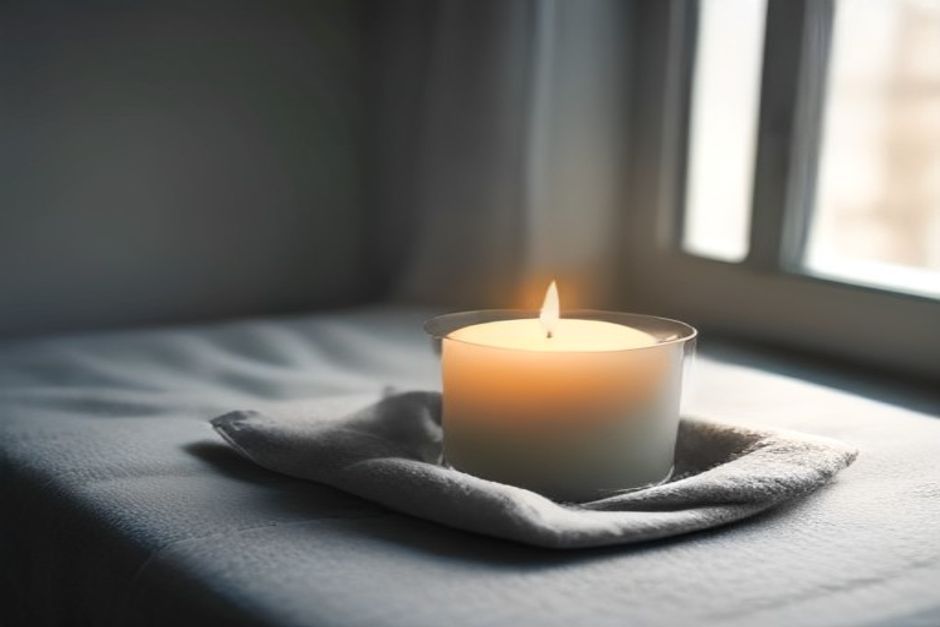
Set aside forty minutes in the evening, after dark — which in December is conveniently early. Dim the room and light a candle or two at the front of your mat. This is not decoration; it gives the eyes a soft place to rest and turns an ordinary living room into a space with a center. The candle-gazing practice of trataka uses the same principle, though tonight the flame is company rather than homework.
- Arrive (5 minutes). Sit or lie down in the dark-adjacent quiet. Feel the weight of the body. No fixing the breath yet — just register that you showed up on the darkest evening of the year.
- Warm slowly (10 minutes). Cat-cow, gentle spinal waves, easy neck and shoulder rolls. Cold muscles deserve a long runway in winter; let the movement stay smaller than your summer version.
- Move with the breath (15 minutes). A few rounds of half sun salutations at half speed, then standing poses held quietly — mountain, a soft forward fold, tree pose near a wall if the balance wobbles. Between each pose, return to stillness and look at the candle. The rhythm matters more than the difficulty.
- Rest deeply (10 minutes). Finish with legs up the wall or a long, blanket-heavy savasana. If the season has you tired, a winter evening practice offers more ideas for this exact slot of the day.
Reflection over resolution
New Year's resolutions get all the press, and their failure rate is famous. The solstice suggests a better instrument: reflection. While you rest in the final pose, let two questions wander through without demanding answers. First: what actually happened this year — not what was supposed to happen, but what did? Second: what is worth carrying into the brighter half, and what can stay in the dark? You are not writing a strategic plan. You are taking inventory in low light, which turns out to be the honest kind. If journaling appeals, keep a notebook by the mat and write for five minutes afterward — the pairing of yoga and journaling works precisely because the body quiets first and the mind follows.
Keep it small enough to repeat
The risk of seasonal rituals is theatrical ambition: the special playlist, the perfect altar, the two-hour ceremony that happens exactly once. Resist it. A candle, forty slow minutes, and two honest questions are enough. The solstice will come around again next year, reliably, whether or not you perform it correctly. Marking it simply — moving a little, resting a lot, noticing the turn — is a practice in the older sense of the word: something you return to, not something you complete. And tomorrow, by a few invisible seconds, the day will be longer. That is the whole message. The light is already on its way back.