The winter solstice is the shortest day of the year — in the northern hemisphere, around December 21st, give or take a day. The light bottoms out. And yet the cultural programming for late December runs in the exact opposite direction: more errands, more events, more noise, more sparkle, more everything. There is a case for doing the opposite for one evening — not as a ritual with rules, just as a honest response to what the season is actually doing.
You do not need to believe anything about solstices for this to work. You only need to accept a plain observation: when the dark comes at 4:30 in the afternoon, the body leans toward slowness. Fighting that for one evening is optional. Going with it, deliberately, turns out to be a surprisingly good practice.
The setup, which is most of the practice
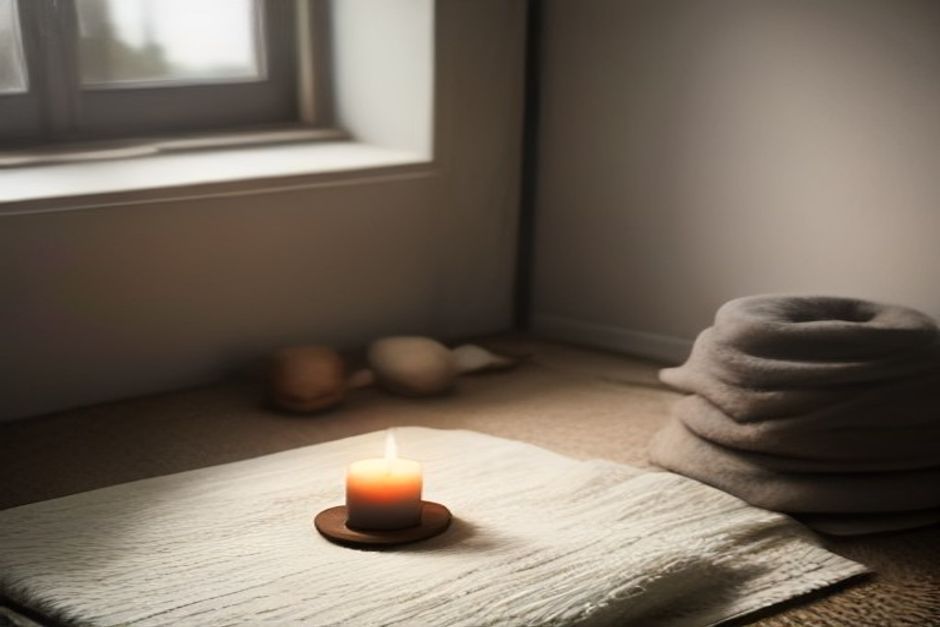
Keep it simple. Dim the lights or turn them off. One candle is enough — real light, low and warm, changes the tone of a room in a way no lamp setting manages. Phone in another room; this is the part that requires actual discipline. A blanket within reach, because you will slow down and cool down. Warm socks on. That is the whole production.
Timing: start as the light fails outside. There is no mystical reason for this — it is just easier to practice slowly when the world outside the window agrees with the plan.
The practice: about forty minutes
Arriving — 5 minutes
How: Sit comfortably — on the blanket, cross-legged or however your hips vote. Eyes closed or resting on the candle flame. Do nothing but notice the breath for a few minutes. Not deepening it, not fixing it. Just watching what is already happening.
Why: The transition is the practice. December brains arrive at the mat still sprinting; five quiet minutes lets them catch up with the body.
Slow Cat-Cow — Marjaryasana-Bitilasana, 5 minutes
How: On hands and knees, move through Cat-Cow at roughly half your normal speed — a full breath per movement, pausing where it feels good. Then let it wander: circles, side-to-side sways, whatever the spine asks for.
Why: This is not exercise; it is a check-in. Slow movement in low light tells you more about how your back actually is than any amount of pushing.
Supported Child's Pose — Balasana, 8 minutes
How: Knees wide, a folded blanket or cushion under the torso, arms wherever they rest. Stay. Let the forehead be heavy on something soft.
Why: The shape of hibernation. Details and contraindications are in the Child's Pose guide — but tonight, props are not modifications, they are the point.
Legs Up the Wall — Viparita Karani, 10 minutes
How: Swing the legs up the wall, a blanket over the body, another under the head if the chin tips up. Eyes covered if you have a scarf handy. Ten full minutes.
Why: The closest thing yoga has to plugging yourself in to recharge. Setup details in the Legs Up the Wall guide.
Long Savasana — 10 minutes
How: Under the blanket, in the near-dark, for ten minutes. If you fall asleep, that is data, not failure — the body filed its report.
Why: Savasana is the hardest pose precisely because there is nothing to do. On the solstice, doing nothing is the theme. Lean in.
Honest rest, not performed rest
A word against making this precious. You do not need the right candle, the right playlist, or a journal with prompts about what you are releasing. If reflecting on the year comes naturally, fine — the dark is good company for it. If all you manage is forty minutes of slow movement and quiet, that is complete. The practice is subtraction: one evening where nothing is optimized, tracked, or improved.
If you want company for the season beyond this one evening, the solstice reflection page goes into the day's longer history, the winter practice guide covers how to adjust your regular routine for the cold months, and the winter evening practice is a version of this you can repeat all season. And if the early dark is tangling with your sleep, the yoga for sleep page is the practical next read.
"The year turns on its darkest day. You do not have to mark it. But resting on purpose, once, in the middle of the loudest month — that is a practice worth keeping."